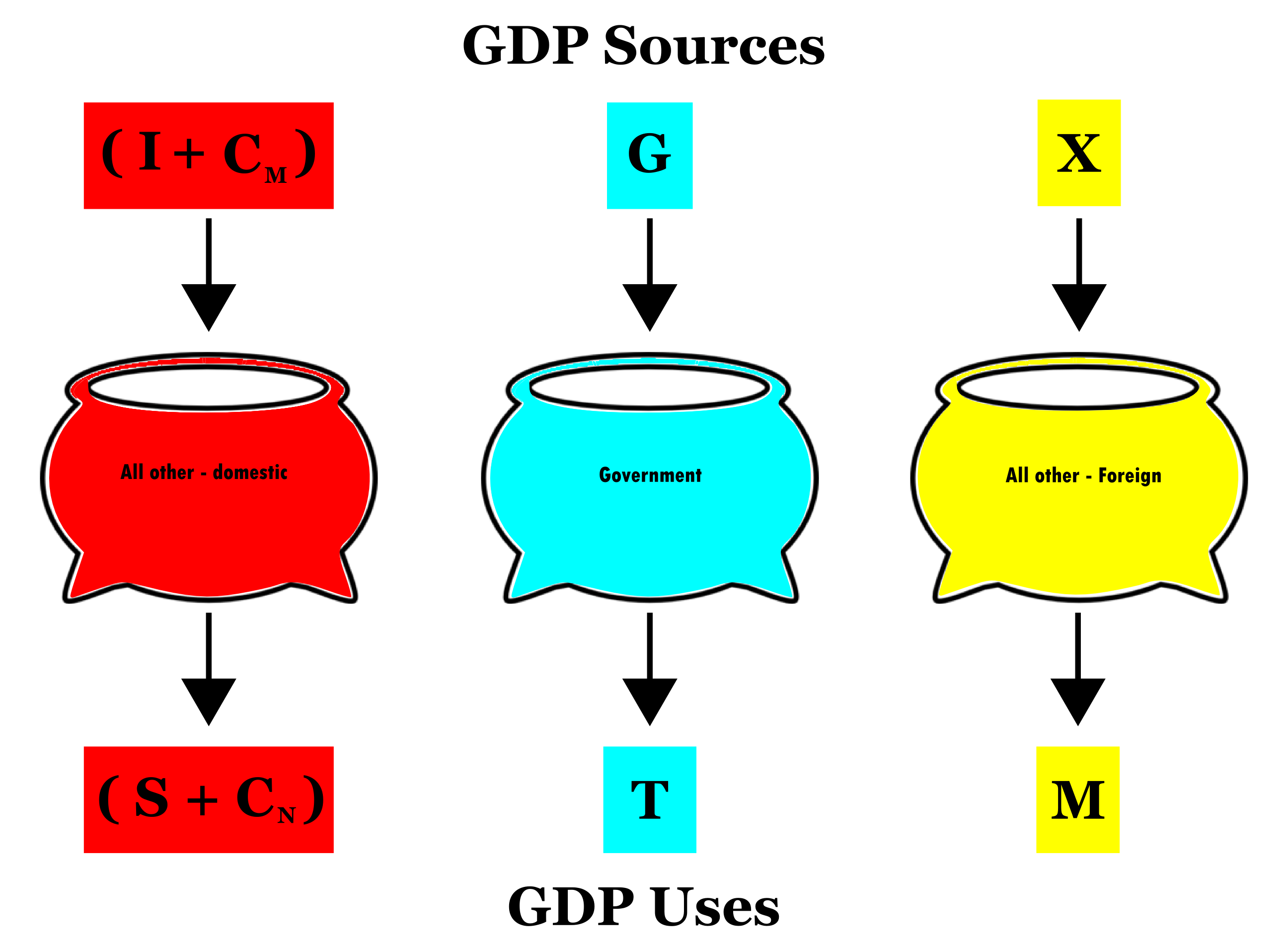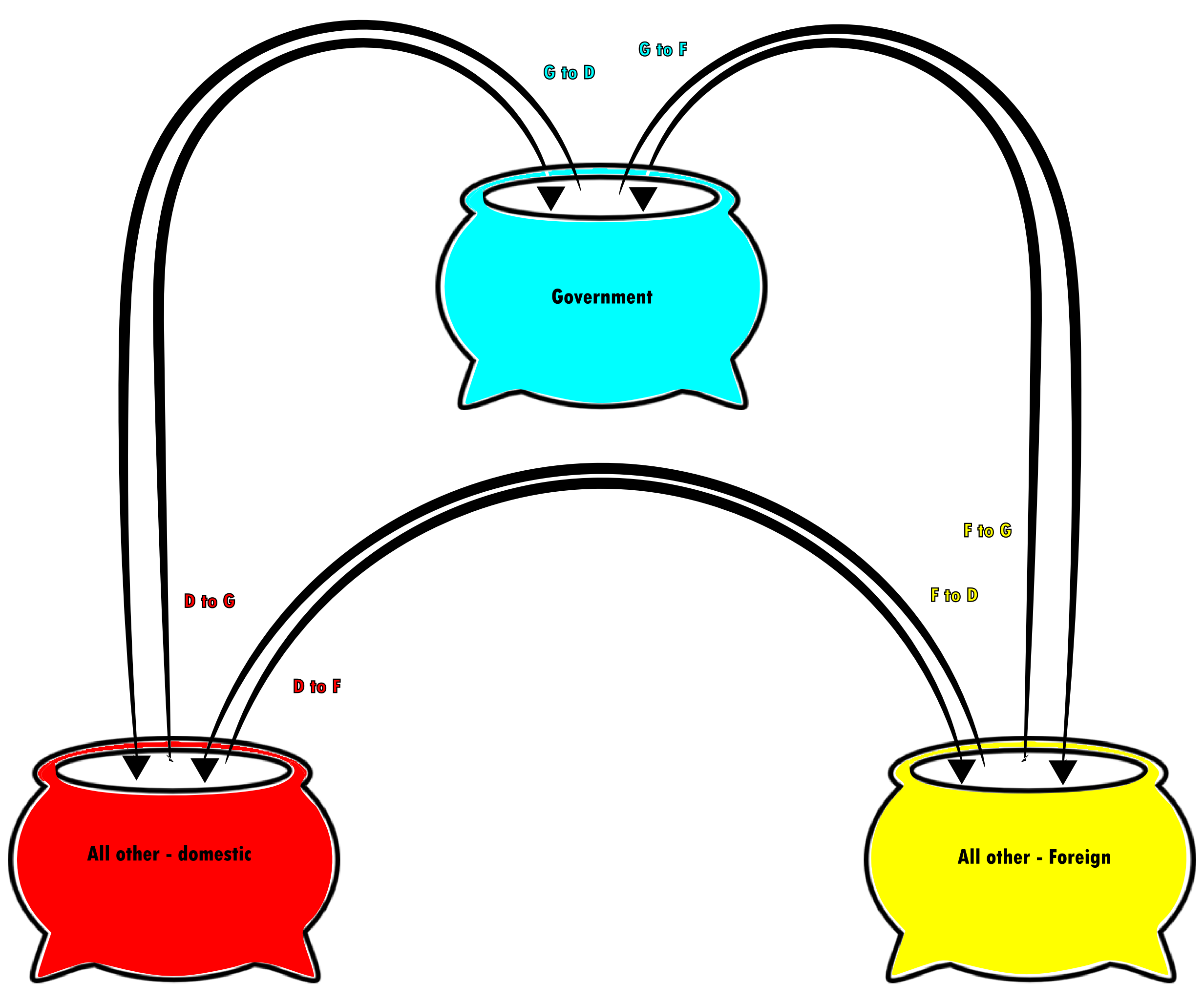
What is now called Modern Money Theory is not just a theory, it is an explanation of modern money. The word Theory is an impediment to teaching about Modern Money. In general we could rename Modern Money Theory to Modern Money Explainer, or Modern Money Explained, or Reality of Modern Money, or The Modern Money Model.
We need to rebrand it to get rid of the impediment. For example Modern Money Theory: A Primer on Macroeconomics for Sovereign Monetary Systems could be renamed Modern Money Primer: An Explanation of Macroeconomics for Sovereign Monetary Systems.
In online introductions to the topic we could start by talking about sector balances. (There is an error in the derivation in this video, although the conclusion is correct. Ellis mistook Compensation for Consumption in one place.)
| CM | Compensation |
| CN | Consumption |
| I | Investment |
| G | Government Spending |
| X | eXports |
| M | iMports |
| S | Savings |
| T | Taxes |
There are two ways to calculate GDP. The two ways should come out to the same result.
| Sources: | GDP = CM + I + G + X |
| Uses: | GDP = CN + S + T + M |
After equating the two ways to calculate GDP and then rearranging the terms, we get the following which just says that all the uses subtracted from all the sources should result in zero because they are two ways of measuring the same thing.
( ( I + CM ) - ( S + CN ) ) + ( G - T ) + ( X - M ) = 0
    ( ( Investment + Compensation ) - ( Savings + Consumption ) )
+ ( Government Spending - Taxes )
+ ( Exports - Imports ) = 0