Yearly Archives: 2009


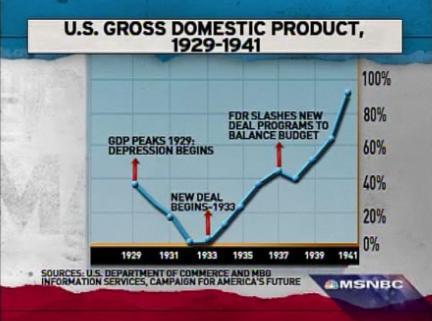
The Real History Of The Depression

Apparently the above graph was used on the Rachel Maddow show this past Monday. This seems to be a pretty strong statement about the history of the depression years.  I await to see what the opposition to economic stimulus can come up with to refute the implications of this graph. (I must admit the scale to the right of the graph makes no sense that I can divine.  However, pay no attention to the numbers that prove Greenberg’s Law of the Media.)

Follow this link to the Huffington Post story about how Representative Steve Austria had to retract his claim that President Roosevelt caused the depression.


As of Feb 13, 2009, I have sent an email to Rachel Maddow asking her to explain the graph. The more I view other statistics about the depression the more I grow suspicious about the meaning of the graph.


Musings on Mark-To-Market 2

In order to evaluate a person’s or a company’s net worth, you must be able to put a value on the holdings of that person or company.  One definition of value is what a willing buyer and a willing seller agree as to the price of an item to be traded.

When you have to put a value on something that you have no intention of selling at the moment, one could look at what the market is saying about similar assets that are being traded at the moment.  You could estimate that your similar asset has this value.  If you mark your asset to market, then you are not putting in your own possibly distorted and self-interested view of the value of the asset.  Mark-to-market sounds like a fairer and more honest way to value your assets.

However, even in the best of times, mark-to-market can distort the value of an asset.

Look at the way we put a value on the stock of a publicly traded company.  We value every share of that company at the price that a small percentage of that company’s share are trading for at any given moment.  It is quite obvious that the vast majority of the owners of the shares are not interested in selling at the current price because they are in fact not selling at the current price.

Even if they all wanted to sell at the current price, suddenly there would not be enough buyers at that current price.

So we can see that mark-to-market is only a measure, and sometimes a very faulty measure, of the value of an asset.  The very idea of an asset having an accurately measurable value is probably just an abstraction. Although it is an essential abstraction in the workings of any large economic system.

When a measure of value that makes an economic system work well, suddenly becomes toxic, it may be time to think of a better way.  The way we see mark-to-market become toxic is that certain loan and other contractual arrangements that a person or company may make depend on an assessment of the value of the asset.  When the value of that asset drops below a contractually set percentage of a loan, the borrower may be forced to raise more equity.  This may force the borrower to sell the asset.  This is hardly the definition of a willing seller.

The act of many borrowers suddenly being forced to sell, only makes the value to the market lower.  This in turn forces more sales until the prices spiral down to a level where there are enough buyers for all of these assets suddenly going on the market.  This is certainly not good for the economy in the short term.

There are other ways to value an asset.  One could use the replacement cost of an asset to value it. If the asset produces income, one could use a discounted cash flow model.

Can we set up accounting rules that allow for other measures of an asset value that would not force people and companies to take economically ruinous actions?  Is it a good idea to do so? Or are these seemingly ruinous actions actually good for the economy in the long term?  What about the affect on individual people even if the total effect might be good in the long term?

Interview With Joseph Stiglitz

The above interview with economist Joseph Stiglitz provides another point of view on how best to manage the recovery.

Follow this link to Huffington Posts’s coverage of this interview and the ensuing comments.  The Huffington Post article really focuses on the issue of the mark-to-market rule and how the Treaury Secretary’s new plan affects the rule.


Analogy That Explains The Stimulus Package

People seem to be reaching for analogies between prudent family budgeting and federal government budgeting.  I try to point out the huge differences between an individual family and the government.  However, I have thought of an analogy that may make it easier to understand what the government is trying to do.

The point of the following story is that sometimes there is capacity in the system to produce goods that people need.  Factors like lack of credit (money) or lack of faith in the future cause people to stop spending.  The irony is  that  there is still the need,  the capacity to satisfy that need, and something of value to exchange for satisfying that need. Yet the system is frozen into inaction.

Suppose you do not have enough money for a meal.  However, you happen upon a restaurant that needs its sidewalk shoveled.   You offer to shovel their sidewalk, but they have not made enough money today to pay for it.  You discover that they are about to close for the afternoon and dispose of their excess prepared food.. So, you bypass the money issue by agreeing to do the shoveling in exchange for the meal.

The restaurant agrees.  They get their sidewalk shoveled for no expenditure of cash.  You get a meal (for no expenditure of cash) that they had already prepared and would have thrown out.  Both parties to this deal are far better off than they were before the deal was struck.

Nothing fundamental changed in the situation, yet you were able to consummate the exchange once you realized that the money problem was an artificial barrier.

The deal works without upsetting any economic balance because you both had excess capacity that was going to waste.  You had the time and energy to shovel a sidewalk and they needed a sidewalk shoveled. You needed a meal and they had food that would have gone to waste.  All that was missing was something to get over the hurdle of what was preventing the deal from going forward.

In the current economic downturn our economy has trillions of dollars of excess capacity.  Our society has the needs that could be satisfied by putting that excess capacity to work.  The federal government can step in to make it happen.  Rather than use a barter system, it facilitates the trade of people’s labor for the wages and manufacturing capacity of business by fooling them into thinking there actually is enough money.  Business gets to earn money for the use of its facilities.  Everyone comes out a winner because there were excess capacities on both sides.

The signal for when to stop this intervention is when the excess capacity is all used up and normal activity is sufficient to keep every one occupied without the help of the government.  Eventually the government gets to extract the money that it pretended was available by taxing the booming economy.

This is what should happen unless people get the idea that there is no need to extract the excess money from the economy (pay off the debt). If you had made structural changes to the tax system so that the boom does not get taxed, then you upset the balance. For some reason when the economy is running full tilt, people get the idea that it can run even fuller tilt.  This is where you hope some adult can step in and explain the facts of life.


Vaccines And Autism

Follow this link to the story in London Times that casts doubt on the original study that linked vaccines to autism.

It is horrible to contemplate that thousands of children may have died from reduced levels of vaccination because of the reaction to these doctors who cooked up some phony stories so that they could get their article published.

Formulations for vaccines have been modified and the trail of study for causes of Autism may have been diverted for over 10 years because of what these doctors did.


Health Benefits of Kissing

Follow this link to story about the health benefits of kissing.

According to the article:

Couples who share a passionate kiss this Valentine’s Day will enjoy sensations of relaxation and excitement because of a complex series of chemical processes, as well as their love for their partners.

I knew there had to be news other than the economic crisis.

The study authors try to come up with a chemical/mechanical explanation for why hormone levels rose and that these hormones might affect the mind and body. One thing that just occurred to me is that perhaps the mind is the cause of the hormone and other physical ractions, not the other way around.


Failing to Solve the Economic Crisis

Follow this link to the story published in The Nation by Naomi Klein about what could happen if politicians do not work to solve the economic crisis.

Her story discusses some of the street level protests in Argentina, Iceland, Latvia, South Korea and Greece.  Some of these protests brought down governments.

I certainly hope that does not happen in this country or any other major democracy in the world.

One of my worst fears is that the current situation will give the principles of capitalism such a bad reputation that we could end up with the likes of communism again.


Cutting the Wrong Parts Of The Stimulus

Follow this link to the column by Paul Krugman about the Senate cuts to the President’s stimulus plan.

When I heard that the centrists had cut some education spending from the plan, I thought it sounded like focusing on exactly the wrong thing to cut.  Apparently Krugman feels the same way.

It’s time for Obama to again ask, “Are these people serious?”