Psyc* K*ll*r and S*mm*rt*m* [More Music] 2
I haven’t the foggiest idea what this means in the traditional sense, but musically, there is no question. Take your pick.
-RichardH
I haven’t the foggiest idea what this means in the traditional sense, but musically, there is no question. Take your pick.
-RichardH
I haven’t the foggiest idea what this means in the traditional sense, but musically, there is no question. What on earth do the words to this piece really mean? Musically, it does evoke an emotional response in me.
I do like the first clip better because k. d. lang has such a great voice that I always enjoy. I do not like the second clip quite as much because the voice of the soloist is not as good in some respects that I cannot describe in words. The accompaniment in both selections is excellent. The one in the second clip might even be a little better than the one in the first clip, again for reasons that I cannot describe in words.
Even though Leonard Cohen may have written this piece, the poetry (or at least the rhyme) comes out better in k. d. lang’s rendition.
If you have a dislike for either or both performers, then please skip over the one or ones you dislike.
I hope my introductory remarks didn’t spoil the music for you. Some of my readers require explicit explanations of all posts.
Maureen Dowd’s August 10th column is Don’t Send In the Clones.
As you leave behind high school to redefine and even reinvent yourself as adult, you need exposure to an array of different ideas, backgrounds and perspectives — not a cordon of clones.
I am not a fan of Maureen Dowd as I used to be, but she can still write an occasional column that reminds me why I used to be a fan.
I think this column is very much in tune with President Obama’s address to which I link in the post Obama: Muslim’s Right To Build A Manhattan Mosque
This is an excellent example of how President Obama carries out his oath of office.
I do solemnly swear (or affirm) that I will faithfully execute the office of President of the United States, and will to the best of my ability, preserve, protect and defend the Constitution of the United States.
William Greider has written the article Elizabeth Warren Uncovered What the Govt. Did to ‘Rescue’ AIG, and It Ain’t Pretty.
The subheading is The government’s $182 billion bailout of insurance giant AIG should be seen as the Rosetta Stone for understanding the financial crisis and its costly aftermath.
The article is very long, so I can save you some trouble by cutting to the chase.
Lots of ordinary citizens have figured this out. If some banks are too big to fail, then government should compel them to become smaller banks. The harsh reality is that our bloated financial sector is too large for the economy it serves, its power too concentrated at the top. Neither the president nor either political party is yet ready to face the imperative of breaking up the mega-banks. Until they do, the system will remain unstable and prone to excesses, maybe worse.
Notice no mention of the favorite secondary players against whom Faux Noise likes to whip up public outrage. If they keep the outrage misfocused this way, the primary players can go unblamed.
With post after post, I have been trying to shift the public’s view of the blame for the financial crisis from Dodd and Frank and from Fannie Mae and Freddie Mac to The Fed, Goldman Sachs, and the mortgage lenders.
Do not make the mistake of thinking I am doing this to absolve Dodd, Frank, Fannie, and Freddie from their rightful share of the blame.
I am doing this because a focus on the secondary players causes us to lose focus on the primary players. If we don’t fix the problems with the primary players first, then fixing the problems with the secondary players leaves us vulnerable to a bigger collapse than the one we just saw.
Help me figure out how to phrase the problem so that people will finally understand what is at stake. It is fun to beat up on our favorite villains, but we cannot afford to miss who the real trouble makers are.
Put politics aside, and solve the real problem. After that, if there is any energy left, play all the politics you want. Blame it on big Government, blame it on Dodd, and Frank. Why should I worry about the fairness of it all, if the world is saved from having to live through a catastrophic financial collapse?
Barney Frank phobia is running rampant among the commenters on the Worcester T & G comment boards. For the latest example, see the comments about Editorial cartoon by David Hitch.
The premise of these people is that the recent economic crash was primarily created by Senator Dodd and Representative Frank.
In answer to this propaganda, I always present the case that the crash was primarily caused by the banks who were happy to give mortgages to people who had no hope of paying them off. The banks only held the mortgages long enough to sell them to unwary investors. The banks were assuring the investors and the ratings agencies that these were high quality mortgages that met all standards even though the loans were called “Liar Loans” in the trade. They got this name because the mortgage brokers encouraged the mortgage applicants to lie about their ability to pay the monthly payments. The banks were touting the fact that nothing on the application form would be verified by the bank. The banks just wanted mortgage paper that they could sell at a huge profit to investors.
I finally goaded one of the Barneyphobes to post a video of proof that it was Frank’s fault.
It seemed pretty likely that this video played the same trick that they played on Shirley Sherrod to make it look like she was saying the opposite of what she had really said.
I couldn’t find the C-SPAN video of Frank’s full speech in 2005 that was cherry picked in the above video. I did find a C-SPAN video of an interview with Barney Frank recorded on Sunday, November 26, 2006. At that time he was incoming chairman House Financial Services Committee. To me it seemed pretty clear that the edited video was unlikely to have represented his ideas in a fair manner.
More over, I had previously given a link to an article in The Wall Street Journal about a Harvard BA Thesis that corroborates my take on the recent crash. Any opinion piece in The Wall Street Journal is likely to be as extreme right wing as one could possibly get. If even they think that the bankers and insurance companies (like AIG) were primarily responsible for the crash, I would have thought even a Worcester T & G reader might accept the idea. (Well, I would have thought that for only a nanosecond.)
Any way, I only report. You, dear reader, can decide for yourself.
You might want to read my post about the book 13 Bankers
. In that post I have a number of quotes from the book that explains who did what to whom to bring about the financial crisis. In the book, Fannie Mae and Freddie Max are not blameless, but they are not the prime movers.
Greenspan Calls for Repeal of All the Bush Tax Cuts, 7 August 2010, New York Times.
At the beginning of the George W. Bush Presidency, then Federal Reserve Chairman Alan Greenspan implicitly endorsed tax cuts.
While Mr. Greenspan did not endorse a specific approach, his broad support for the tax cuts nearly a decade ago was pivotal in securing one of the Bush administration’s top domestic policy goals and in providing political cover for members of Congress.
Now, in response to accusations of political expediency, Mr. Greenspan says his approach has been consistent: supporting tax cuts when surpluses loomed, and endorsing revenue increases now that deficits are the leading worry. He also says his earlier endorsement of tax cuts was made with important caveats that were later ignored by policy makers and the public.
To begin with, he says he believed the tax cuts in 2001 were primarily needed to avoid the economic distortions caused by “surpluses as far as the eye could see,” as many economists at the time projected.
Greenspan seems to have feared that the projected surpluses would lead to the reduction of US Federal debt to zero.
That, in turn, caused the central bank to worry that one of its primary levers for the conduct of monetary policy — the purchase and sale of Treasury securities — would no longer be available.
“I was against deficits, but I was also equally against surpluses,” Mr. Greenspan said.
Now,
Mr. Greenspan is calling for the complete repeal of the 2001 and 2003 tax cuts, brushing aside the arguments of Republicans and even a few Democrats that doing so could threaten the already shaky economic recovery.
“I’m in favor of tax cuts, but not with borrowed money,” Mr. Greenspan, 84, said Friday in a telephone interview. “Our choices right now are not between good and better; they’re between bad and worse. The problem we now face is the most extraordinary financial crisis that I have ever seen or read about.”
This appears to be quite a shift for the Republican libertarian Greenspan.
___________
David Stockman–Bush Tax Cuts Will Make U.S. Bankrupt, 7 August 2010, NPR-All Thinks Considered. Stockman interview with Guy Raz.
The Stockman NPR interview aired on the same day that the above Greenspan article was published. Both men are trumpeting the same song.
RAZ: In the early 1980s, Stockman became a kind of Washington wunderkind, the vanguard of a new type of economic thinking, supply side, deregulation, low taxes to stimulate growth.
As the White House budget director, Stockman was an architect of what would come to be known as Reagonomics. But a few years into the job, he became disillusioned.
Mr. STOCKMAN: The military budget got out of control and the tax cuts went to special interests as much as they did to the broad public.
RAZ: And he noticed a problem. The government wasn’t collecting enough money to cover its costs and he started telling that to Reagan.
Mr. STOCKMAN: As time passed, he was less and less enthusiastic about what I had to say.
RAZ: So, in 1985, Stockman left. Now these days, he’s still a conservative and still a Republican, but he doesn’t think his party is taking a responsible position on taxes any longer. At the end of this year, the Bush era tax cuts are set to expire. Republicans want them renewed, Democrats want to keep the tax cuts for the middle class but not for the wealthiest 2 percent of Americans.
Now, Stockman says they’re both wrong and he says extending either of those cuts is tantamount to the government declaring bankruptcy.
Mr. STOCKMAN: We’ve had a rolling referendum on what we want in government and what we don’t ever since the first Reagan spending cut program, which I was part of in 1981. And it seems pretty clear to me that by 2010, we’ve decided a lot of things that caused (sic!) a lot of money, the American people won. I might not agree with that, but apparently they do.
So we’re spending $3.8 trillion in defense, non-defense, entitlements, everything else, and we’re taking in only 2.2 trillion. So we got a massive gap, you have to pay your bills. You can’t keep borrowing from the rest of the world at that magnitude year after year after year. So, in light of all of those facts, I say we can’t afford the Bush tax cuts.
Raz and Stockman make implicit reference to the so-called Laffer Curve.
[Bold typeface added by me.]RAZ: You seem to suggest that many of our economic troubles are the result of Republican economic policies over the past few decades. You are a Republican. You are a conservative. Why do you think Republicans are largely to blame?
Mr. STOCKMAN: Because the Republicans abandoned their old-time fiscal religion in favor of two theories, which I think are now proving to be both wrong and highly counterproductive and damaging.
One was monetarism, which said let the dollar float on the international markets. Let 12 men and women at the Fed decide whether to raise or lower interest rates and use the Fed to try to run this massive economy. What they’ve done instead is run the printing press, they’ve flooded the world with dollars. The whole monetarist policy has been a mistake.
The second thing was the perversion of supply side. Yes, there was a good idea that in certain circumstances, lower tax rates will encourage economic activity and savings. But when you make it a religion, when you make it a catechism and you say you cut taxes no matter what the circumstance, what the season, what the condition, then I think the whole idea has been perverted.
By getting off track over the last 30 years, the Republican Party has basically given out (sic!) its historic view that the key thing was financial discipline, financial responsibility and that we had to live within our means. Today, we have two free lunch parties, and as a result, we’re borrowing ourselves into grave danger with each passing month and year.
RAZ: Now, Republicans, David Stockman, in the Senate led by, obviously, the Minority Leader Mitch McConnell, they say they’re simply following, you know, the Reagan philosophy of supply-side economics, a policy that you pushed. Do you think they’re being disingenuous?
Mr. STOCKMAN: Utterly disingenuous. I find it unconscionable that the Republican leadership faced with a 1.5 trillion deficit could possibly believe that good public policy is to maintain tax cuts for the top 2 percent of the population who, after all, have benefited enormously from this phony boom we’ve had over the last 10 years as a result of the casino on Wall Street.
-RichardH
In his 5 August 2010 blog post, Paul Krugman writes Bending the Curve about the most recent Medicare Trustees Report projection that the recently-past Health Care Reform Bill will substantially lower the increase in Medicare spending as a percent of GDP over the next few decades.
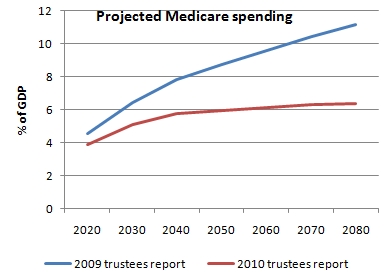
Krugman says, “In other words, the Medicare actuaries believe that the cost-saving provisions in the Obama health reform will make a huge difference to the long-run budget outlook. Yes, it’s just a projection, and debatable like all projections. And it’s still not enough. But anyone who both claims to be worried about the long-run deficit and was opposed to health reform has some explaining to do. All the facts we have suggest that health reform was the biggest move toward fiscal responsibility in a long, long time.”
-RichardH
In the 6 August 2010 NY Times, Paul Krugman writes The Flimflam Man.
[T]he innovative thinker [charlatan] du jour [is] Representative Paul Ryan of Wisconsin.Mr. Ryan has become the Republican Party’s poster child for new ideas thanks to his “Roadmap for America’s Future,” a plan for a major overhaul of federal spending and taxes. News media coverage has been overwhelmingly favorable; on Monday, The Washington Post put a glowing profile of Mr. Ryan on its front page, portraying him as the G.O.P.’s fiscal conscience. He’s often described with phrases like “intellectually audacious.”
But it’s the audacity of dopes. …
Mr. Ryan’s plan calls for steep cuts in both spending and taxes. He’d have you believe that the combined effect would be much lower budget deficits, and, according to that Washington Post report, he speaks about deficits “in apocalyptic terms.” And The Post also tells us that his plan would, indeed, sharply reduce the flow of red ink: “The Congressional Budget Office has estimated that Rep. Paul Ryan’s plan would cut the budget deficit in half by 2020.”
But the budget office has done no such thing. At Mr. Ryan’s request, it produced an estimate of the budget effects of his proposed spending cuts — period. It didn’t address the revenue losses from his tax cuts.
The nonpartisan Tax Policy Center has, however, stepped into the breach. Its numbers indicate that the Ryan plan would reduce revenue by almost $4 trillion over the next decade. If you add these revenue losses to the numbers The Post cites, you get a much larger deficit in 2020, roughly $1.3 trillion.… All it would do is cut benefits for the middle class while slashing taxes on the rich.
And I do mean slash. The Tax Policy Center finds that the Ryan plan would cut taxes on the richest 1 percent of the population in half, giving them 117 percent of the plan’s total tax cuts. That’s not a misprint. Even as it slashed taxes at the top, the plan would raise taxes for 95 percent of the population.
There is more in the article; read it all.
-RichardH
On 6 August 2010, Bloomberg reports Romer Resigns in 2nd Exit for Obama Economy Team. Similar report from the Washington Post.
-RichardH