Monthly Archives: April 2011


The Real Problem With The Bush Era Tax Cuts

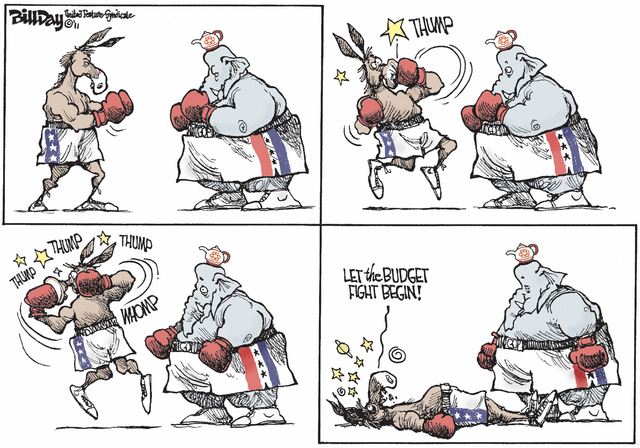
Since President Obama and the Democrats allowed the Republicans to get their way and continue the Bush Era tax cuts for the wealthy, we see the inevitable outcome.  The budget is being slashed.  The ostensible reason to slash the budget is  to bring it into balance.  Of course the real reason is to justify further tax cuts.

Sure the budget slashing in response to the tax cuts will hurt the poor and the elderly, but that is not its biggest detriment to our country.

The biggest problem with the continued favoring with tax policy of capital gains and interest write-offs for hedge fund managers is the distortion of the economy.  The profits for coming up with money manipulation schemes becomes huge compared to the reasonable profits coming from doing more research and manufacturing when the money manipulation profits are taxed at far lower rates than the tax rates for making useful stuff.

This imbalance further drains the talents of our people from inventing and making things into schemes to manipulate money.  Keeping manufacturing jobs in this country becomes a distraction for the capitalists.  They’d rather make money by inventing clever ways to profit from speculating on other people’s manufacturing activities.

Far from discouraging job producing industry, equalizing the tax rate for this less useful  manipulation work will shift resources from the bankers who hire few people to the manufacturers who hire many people.  Stopping this Bush era tax policy is key to restoring jobs to this country.  The current tax policy doesn’t create jobs in this country, it destroys them here and sends them elsewhere.

One hedge fund manager can earn over a billion dollars.  For  factory workers making $75,000 only one billion dollars would pay the salaries of 13,000 workers.  For every hedge fund manager like this, many multiples of 13,000 factory workers go unemployed.  This is where the drain on the economy is coming from.

Entitlements are not causing loss of jobs in this country.  Tax policies that favor speculation by the ultra-wealthy rather than their using their money to create jobs is what is killing the economy.

As long as progressives focus on trying to get the middle class to sympathize with the plight of the poor, they have a weak argument.  If they focus on how the tax cuts cause loss of jobs and loss of income for the middle class, they will have an argument that could resonate with voters.

When progressives don’t focus on the real problem for the middle class, the right is able to pretend that their policies will actually help job prospects for the middle class.  In this dynamic, the middle class thinks that they have to choose between their own welfare and the welfare of the poor.  In fact the welfare of the middle-class is in harmony with taxation policy that can help the poor.  That is what I call a win-win proposition for the middle and lower class to the slight detriment of the uber-wealthy.

23 Things They Don’t Tell You About Capitalism

TheRealNews.com is conducting a series of interviews with Ha-Joon Chang, the author of 23 Things They Don’t Tell You About Capitalism.

As of this writing there are only 4 published segments in the series, and they have gotten about half way through the 23 things.

Some of the things that have been covered so far are:

  • There is no such thing as a free market
  • Companies should not be run in the interest of their owners
  • Most people in rich countries are paid more than they should be
  • We do not live in a post-industrial age

There are fascinating insights that come out of the discussions with Ha-Joon Chang.

Ha-Joon Chang (Korean: 장하준, Hanja: 張夏准, b. South Korea in 1963) is one of the leading heterodox economists specialising in development economics. After graduating from Seoul National University Department of Economics, he trained at the University of Cambridge, where he currently works as a Reader in the Political Economy of Development, Chang is the author of several influential policy books, including 2002’s Kicking Away the Ladder: Development Strategy in Historical Perspective.


Why We Must Raise Taxes on the Rich

Robert Reich has posted the article Why We Must Raise Taxes on the Rich on his blog and on Truthout.org

He closes with the following:

All the President has to do is connect the dots – the explosion of income and wealth among America’s super-rich, the dramatic drop in their tax rates, the consequential devastating budget squeezes in Washington and in state capitals, and the slashing of vital public services for the middle class and the poor.

This shouldn’t be difficult. Most Americans are on the receiving end. By now they know trickle-down economics is a lie. And they sense the dice are loaded in favor of the multi-millionaires and billionaires, and their corporations, now paying a relative pittance in taxes.

The President has the bully pulpit. But will he use it?

My comment on Truthout.org would have been (if only their website weren’t still suffering from the effects of the vandals):

I can forgive Obama for all his failures except one.  I cannot forgive him for failing to even make the case for the policies we need.

His silence in the face of the relentless attack from the right makes it harder for all progressives to make the case.

As a very early supporter of Obama, I have had the pleasure of quickly refusing to fund his re-election campaign.  He won’t get anything, not even a vote from me, if he doesn’t quickly repair the one unforgivable mistake mentioned above.


2,000 Protesters March On Koch Industries’ D.C. Office

Perhaps this is the only avenue left to make any political progress in this country.

From the article on the Think Progress web site:

In Washington, D.C. today an estimated 2,000 protesters marched on Koch Industries’ Washington D.C. offices and attempted to give Charles and David Koch an invitation to come out and speak with the protesters.

and the following:

Last Thursday, tea party activists rallied on Capitol Hill to pressure Republican lawmakers to cut government spending. Crowd estimates ranged from “dozens” to “fewer than 200,” yet the event attracted dozens of reporters and significant media interest, producing hundreds of stories in local and national press. At today’s rally, which was ten times bigger than the tea party one, ThinkProgress spotted three reporters — none from mainstream publications.

This is the kind of behavior of the mainstream press that has me reading the news on the internet for an hour or so before I pick up my copy of The Boston Globe from the box in front of my house.  The printed newspaper is mostly good for the funny pages.


Who Not To Blame For the Mortgage Meltdown

James Kwak published a brief comment on The Baseline Scenario Blog about the fallacy of blaming the mortgage meltdown on Fannie Mae, Freddie Mac, or the Community Reinvestment Act.

Kwak  talks about a frequently referenced article by Edward Pinto and an analysis of that article by David Min.


As for Fannie and Freddie, Kwak says:

… Min shows ( p. 8 ) that prime loans to <660 borrowers had a delinquency rate of 10 percent, compared to 7 percent for conforming loans and 28 percent for subprime loans, implying that calling them the moral equivalent of subprime is a bit of a stretch.  Min also shows that most of the Fannie/Freddie loans that Pinto classifies as subprime or high-risk didn’t meet the Fannie/Freddie affordable housing goals anyway — so to the extent that Fannie/Freddie were investing in riskier mortgages, it was because of the profit motive, not because of the affordable housing mandate imposed by the government.

As for the Community Reinvestment Act, Kwak says:

… only banks are subject to the CRA (not nonbank mortgages originators) and most risky loans were made in middle-income areas where the CRA is essentially irrelevant.


A commenter on The Baseline Scenario Blog has posted a link to David Min’s article Faulty Conclusions Based on Shoddy Foundations.

Based on work done by his AEI colleague Edward Pinto, Peter Wallison, minority member of the Financial Crisis Inquiry Commission, concludes federal affordable housing policies were the driving cause behind the financial crisis, causing a decline in underwriting standards that triggered the U.S. housing bubble. Unfortunately, Pinto’s research findings relied upon so heavily by Wallison and others are false.