Executive Summary
Rising prices in the face of rising supply is not a violation of the law of supply and demand. If the demand curve shifts upward faster than the supply curve shifts upward, then prices will rise even as supply rises. This is what the law of supply and demand tells us.
Now For The Rest Of The Story
There is a long and circuitous path to the article, DeLong: Sorrow and Pity of Another Liquidity Trap.
On Brad Delong’s web site he posts the article Paul “Cassandra” Krugman Croaks Again! in which he praises Krugman’s article.
In turn Krugman’s article Liquidity Trapped praises a previous DeLong article.
Finally we get to DeLong’s article in Bloomberg, DeLong: Sorrow and Pity of Another Liquidity Trap. In this article DeLong sets up the premise to justify explaining a seemingly odd deviation from economic law.
There is only one real law of economics: the law of supply and demand. If the quantity supplied goes up, the price goes down.
…
Thus by late 2007, the 10-year U.S. Treasury rate was exactly where it had been when the Clinton surpluses ended at the close of 2001. “How long could this go on?” we wondered. Eventually the market’s appetite for Treasury bonds at high prices and low interest rates had to reach its limit, right? Supply and demand isn’t just a good idea — it’s the law.
Now, maybe the setup is just a strawman for the purposes of easily knocking it down. Otherwise, I am surprised that two economists who have my deep respect can fluff such basic stuff as the law of supply and demand.
I have plotted some hypothetical and simple examples of some supply and demand curves to show what the law of supply and demand is really about and how the experts proceeded to miss the details.
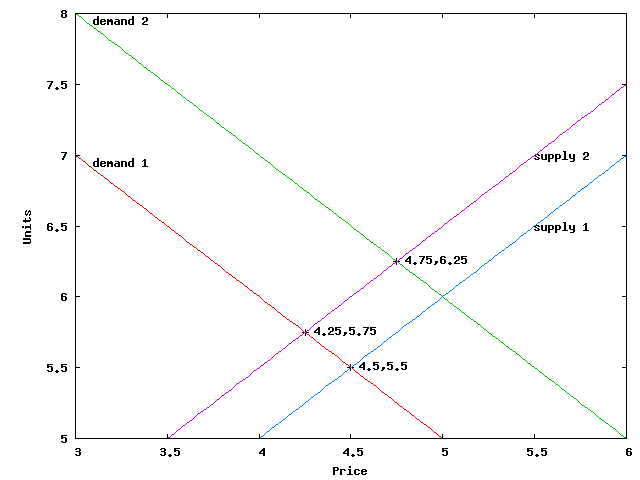
Hypothetical, Simple Supply and Demand Curves
DeLong’s premise is that If the quantity supplied goes up, the price goes down.
We see that in the first scenario in the following table.
| Scenario | Supply Change | Price Change |
|---|---|---|
| Start at supply curve 1 and demand curve 1, increase the supply to supply curve 2, but stay on the same demand curve | 5.5 units » 5.75 units Supply goes up |
$4.5 » $4.25 Price goes down |
| Start at supply curve 1 and demand curve 1, increase the supply to supply curve 2, and increase the demand to demand curve 2 | 5.5 units » 6.25 units Supply goes up |
$4.5 » $4.75 Price goes up |
However, the second scenario shows that the supply can go up and the prices can go up, too. This is not a violation of the law of supply and demand as long as the inferences from the law are stated in all their details.
If the quantity supplied goes up due to a change in the monotonically increasing supply curve and the demand curve does not change and the demand curve is monotonically decreasing, then the price goes down.
In the second scenario, both the supply curve and the demand curve have changed, thus breaking the assumptions of the fully stated inference. This is why, though the supply goes up, so does the price.
It is not unreasonable that with earth shaking events going on in the world that affect the economy, both the suppliers of the product will change their supply curve and the customers for a product will change their demand curve. Where the final numbers for supply and demand match up depends on how those curves change. Just about any combination of rising or falling supply can result in a rising or falling price.
Could both of these world renowned economists have forgotten that when you study an economic situation by changing one variable, that the usually stated or implied assumption is all other things being equal?
You are not allowed to assume that the results apply when you violate the assumption.