Yearly Archives: 2011
Does Faux News Ever Lie?
If there are any readers of this blog that deny that Faux Noise has a record of telling lies, I offer this video clip from The Daily Show.
Jon Stewart told Chris Wallace that he thought Wallace was hired by Faux News to act as somewhat of a counterbalance to the other disreputable people on the network. Calling Wallace a counterbalance is like saying a brick on the same side of a balance scale as an elephant is a counterbalance to the elephant.
For completeness sake, here is the video of John Stewart’s appearance on Chris Wallace’s show.
Solution to The Housing Market Crash
Apparently I haven’t yet posted my idea for getting the real estate market back to some semblance of normal. If I have posted it, even I can’t find it by searching this blog.
In the run up to the bursting of the housing market bubble, our version of free market capitalism found a way to profit from enticing people who could not afford it to take out a mortgage and buy a home. They even went so far as to entice people to speculate on real estate to make a profit. This led to the construction of more single family homes than actually made economic sense.
When the bubble burst and the number of foreclosures rose drastically, we ended up with more vacant homes with no buyers in sight that could make a sound economic case for why they should own a house.
We could wait for the population to grow so that the fraction of the population for which it makes economic sense to own a house equals the number of houses available. This could take many years.
Meanwhile there are large numbers of people who have been cast out of their houses from foreclosures who need housing and could afford to rent these vacant houses if they were offered for rent at a reasonable price. There are also people who can afford to pay their mortgages, but see no reason to pay back a mortgage that is far larger than the value of their house. They abandon their house and let the bank take it. Presumably they won’t be able to buy a house for many years after they have defaulted, but they certainly have the cash to pay rent in nearly the amount they had previously been paying for a mortgage. (There are some tax issues that make it a little more complicated than this.)
The banks who are servicing the mortgages and are bringing on the foreclosures do not have the expertise (and perhaps not the legal right) to become landlords to renters. However, if there were a way for the banks to get some value out of the foreclosed homes that are sitting empty, you’d think they would jump at it.
You would think that some enterprising capitalists would come up with the idea of raising capital to buy these homes at foreclosure bargain prices, rehabilitate them as needed, and rent them for a market rate that the dispossessed former home owners could afford. The businesses that these capitalists would create would be able to hire experts in renting and managing single-family rental properties for a profit.
Admittedly there are problems to be solved before this simple explanation of the solution could be realized. If nothing else, our entrepreneurial capitalists are supposed to be very clever at solving problems that get in the way of establishing profitable businesses.
The banks are currently sitting on about $1 trillion dollars that they have borrowed at low interest rates from the Federal Reserve Bank. By sitting on, I mean they have invested in U.S. Treasury bonds that pay more interest than the Fed is charging the banks to borrow the money. If they could fund an enterprise at high enough lending rates and low enough risk, they could put that $1 trillion to work in the economy. They could actually be part of the funding sources for these companies that want to turn empty houses into money making rentals.
The new companies would not have to rely solely on borrowing as they could also raise some capital in the stock market, from venture capitalists, and from hedge funds. Real estate investment trusts might also be perfect vehicles for this.
Perhaps the banks just don’t want to sell the foreclosed homes at reasonable prices given the current real estate market. As long as the banks keep the homes on their books, they don’t have to admit that these assets are not worth nearly as much as they are pretending. This allows them to pretend that they are solvent and don’t need to raise more capital.
The entrepreneurs could work out some arrangement with the banks to buy bank stock along with the houses so that the banks appear to have the capital even though they sold the houses at far below the money they lent in mortgages.
Why the banks’ parent holding companies could even set up wholly owned subsidiaries to do the job of renting out and managing the properties.
As a last resort, perhaps the banks could retain some rights to capital gains on the houses above and beyond the net profits that would be owed to the companies buying the houses and renting them out. These retained rights could be carried on the banks’ books as capital assets that would compensate for the losses in the sale prices of the homes. An income producing property has a value based on the income that it is producing that may be different from its value as a property for sale. So the banks’ books might even be more truthful than pretending that the banks will someday recoup the money they lent for the mortgages.
Once the vacant houses were mostly occupied by renters, normalcy would be restored to the single home construction and purchasing market. This would presumably happen much faster than just waiting for population growth.
Not being an entrepreneur myself, you have to wonder why I can think up this solution, but no real entrepreneur has come along to put this idea into action. What do you think are the reasons why my idea won’t work?
Our Allies In Congress Have A Plan To Fix The Deficit
I received an email from TrueMajority.org titled Our allies in Congress have a plan to fix the deficit. To quote from the email (and the web page at the previous link):
Our allies at ProgressiveCongress.org and in the Congressional Progressive Caucus are mounting a nation-wide tour to drum up support for good jobs, ending the Bush tax cuts and making the American economy work for working people.
The Caucus’ “People’s Budget” was already the best and most comprehensive progressive budget option in the House. And with dozens of cosponsors, it’s a viable option to balance the budget while protecting investments in social programs.
You can read more at their web site and sign a petition in support. You could also contribute some money if you were of a mind to do so.
Back in April, I had a blog post, Introducing the people’s budget.
Progressive Caucus Leader Says Raise Retirement Age
Now this is the kind of headline we don’t need. Watch the video below as “MSNBC Host Cenk Uygur and Congressman Earl Blumenauer (D-OR) discuss whether or not we should raise the retirement age for social security. What reforms should we really be discussing?”
I think the point that Cenk Uygur was trying to make is that we shouldn’t be discussing Social Security benefit cuts until we have rescinded the Bush tax cuts for the wealthy and other anti-progressive steps that have already been taken. They kept talking around each other without facing their real point of disagreement. Cenk should have said, “I don’t think you should be talking about these changes until we have taken other steps. Earl, why do you think it is appropriate to talk about this aspect before we have even finished the discussion about more important priorities?” Then they could have had a fruitful discussion.
It is interesting to consider the discussion in this video in the context of my previous post Get Radical: Raise Social Security. If some astute people can put enough money aside in their private investments to live on in retirement for 40 or 50 years, why can’t Social Security do the same for its clients? Is there really a need to raise the retirement age?
Get Radical: Raise Social Security
Thomas Geoghegan in his article Get Radical: Raise Social Security gives us the kind of thinking that we need in our politics.
Right now Social Security pays out 39 percent of the average worker’s preretirement earnings. While jaws may drop inside the Beltway, we could raise that to 50 percent. We’d still be near the bottom of the league of the world’s richest countries — but at least it would be a basement with some food and air. We have elderly people living on less than $10,000 a year. Is that what Democrats want to “save”?
…
A bigger pension — a raise in Social Security benefits — is the stimulus this demoralized country needs. Come on, Democrats: think of F.D.R., Robert Wagner, or heck, even Lyndon B. Johnson. Let’s ask ourselves: Who are we for?
At the very least, this is the kind of bargaining position from which the Democrats need to start. Instead of conceding the point to the other side and then starting negotiations, progressives need to decide where they want to end up and start way to the left of that point.
As it is now, the radical right must be thrilled. They start way to the right of where they think they can get and somehow end up pretty close to that starting point. The other side just caves because of a lack of ideas and skill.
No Need For Dem. and GOP Governors To Embrace Austerity
The above video of the interview with Bob Pollin explains that “There are many ways states can deal with crisis without cuts to services.” The paper from the Political Economy Research Institute at The University of Massachusetts, Amherst Fighting Austerity and Reclaiming a Future for State and Local Governments is the supporting research for the claims of Bob Pollin.
I have had special sympathy for the constraints on state and local governments in handling their budget crises because they were constitutionally forced to balance their budgets on an annual basis. I thought that there was not much they could do to rescue themselves, but depended on federal help that was being blocked by Republicans in the Federal government.
I was ready to argue with the interviewee who just did not comprehend that reality, Instead what I found was a person who fully understood the constraints and had come up with methods I had not considered to fight against those constraints.
After having listened to this interview, I now have much less sympathy for what the state governments are doing and what they are failing to do.
The Truth About The Economy
Robert Reich connects the dots on the economy, in less than 2 minutes and 15 seconds. Who knew he could draw!?!
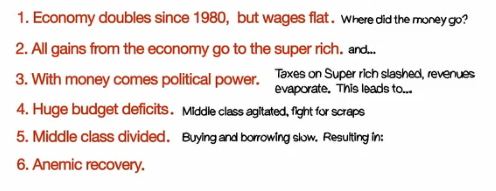
Visit MoveOn.org to help promote the above video.
Medicare Saves Money
Here is the money quote from the article Medicare Saves Money by Paul Krugman:
Indeed, as the economist (and former Reagan adviser) Bruce Bartlett points out, high U.S. private spending on health care, compared with spending in other advanced countries, just about wipes out any benefit we might receive from our relatively low tax burden. So where’s the gain from pushing seniors out of an admittedly expensive system, Medicare, into even more expensive private health insurance?
I think the same reasoning in our country is applying here as the reasoning that most people go through to minimize the taxes they pay on investments. I have heard it said that if you put money away in tax deferred accounts, you will end up paying more in taxes than if you paid the taxes right away. I did a few hypothetical calculations and found out that this claim is true. However, the reason you pay more taxes is that you make more money. If you calculate how much money you have after paying your taxes, you will find you have more by investing in tax deferred accounts like IRAs and 401k’s than if you invested without the benefit of tax deferral.
People get stuck on the idea of minimizing their taxes, when they ought to be concentrating on maximizing the money they get to keep after paying taxes. Doing one of these things is not the equivalent of doing the other. (For the mathematically inclined who want to know why the difference, the simple answer is that compound interest is not mathematically linear. In fact, it is geometrically nonlinear.)
Now for Krugman’s strong finish:
The point, however, is that privatizing health insurance for seniors, which is what Mr. Lieberman is in effect proposing — and which is the essence of the G.O.P. plan — hurts rather than helps the cause of cost control. If we really want to hold down costs, we should be seeking to offer Medicare-type programs to as many Americans as possible.
There Are Differences Between Obama and Bush
JB made a comment on the article Wrestle Mania Over Debt Ceiling. The comment was:
Republicrats have dropped the ball on both sides. There really is very little difference between Bush & Obama. Both have abhorrently squandered money thru expensiver power grabbing programs. Both have intruded in our personal lives whether thru the Patriot Act, or the bureaucracies such as the FBI given more power to search without cause, or thru Obama’s executive order to assassinate U.S. citizens suspected of terrorism without a trial by jury. Both are war mongers. Bush went on his war parade bombing Iraq and Afghanistan, Obama has expanded it by adding Pakistan, Yemen, and Libya to the list. I don’t care how much they hate us over there, they simply aren’t a major threat until they start making inter-continental ballistic AK-47 bullets that can travel from a cave in Pakistan over the ocean to the U.S. We need someone that’ll drop these power grabbing executive orders, and IMMEDIATELY begin withdrawing troops down from the mess in the middle east, or the gig is up with a major economic collapse.
My response to the comment was:
I agree with the many similarities you point out. However stating the similarities does not prove that there is little difference unless you can also prove that there really are no differences.
Would Bush have pushed through health care reform legislation? Would he have pushed through financial reform legislation? Would he have pushed through the Lilly Ledbetter fair pay act? Would he have appointed good Supreme Court Justices? Would he have pushed through an economic stimulus program?
Yes, there are many unfortunate similarities between Bush and Obama. There are also many important differences.
While it is important to recognize the differences between Bush and Obama, it would be like hiding our heads in the sand to ignore the similarities. Given both the differences and similarities, it may be hard to figure out exactly what to do in the lead-up to the 2012 Presidential election.