Apropos of my questioning of Glenn Hubbard’s intelligence and/or integrity (see Romney’s “Recovery Plan” Could Bring On Another Recession) comes the post Hoisted from Comments: Simon van Norden: What Is Republican Economist Glenn Hubbard Thinking Department? So i am hoisting what has already been hoisted, and it was already too complicated for me to figure out which words were coming from which mouth (or keyboard).
Hoisted from Comments: Simon van Norden: What Is Republican Economist Glenn Hubbard Thinking Department?
Hoisted from Comments: Simon van Norden:
Matthew O’Brien Schools Republican Economist Glenn Hubbard…: To understand the integrity of Hubbard’s argument, consider his claim that
[U]ncertainty over policy–particularly over tax and regulatory policy–slowed the recovery and limited job creation. One recent study by Scott Baker and Nicholas Bloom of Stanford University and Steven Davis of the University of Chicago found that this uncertainty reduced GDP by 1.4% in 2011 alone.”Note the phrase “this uncertainty: he’s talking about uncertainty “particularly over tax and regulatory policy.” Now read the analysis by Baker, Bloom and Davis http://www.epi.org/files/2011/PolicyUncertainty.pdf. From their abstract
The index spikes around presidential elections and major events such as the Gulf wars and the 9/11 attack. Index values are high in recent years and show clear jumps associated with the Lehman bankruptcy, the 2010 midterm elections, the Euro crisis and the U.S. debt-ceiling dispute.
Uncertainty over regulatory policy? No mention. Uncertainty over tax policy? No mention. What Hubbard seems to be doing is interpreting the uncertainty created by elections (and the debt-ceiling showdown) as uncertainty about regulatory and tax policy (as opposed to, say, government spending.)
As I have said, uncertainty over where is the next customer for my products in my warehouses going to come from is a major cause of corporations not investing the surplus money that they have. Well, they may be investing it in non-productive financial games and derivatives, but certainly not in much hiring or factories.
The other thing worth realizing is that uncertainty might be bad for the economy, but erasing all uncertainty by definitively picking the wrong policy would be even worse. So considering the possibilities, a little uncertainty, bad as it is, might be better than the alternative.
To be fair to Glenn Hubbard, I show this image from the the analysis by Baker, Bloom and Davis http://www.epi.org/files/2011/PolicyUncertainty.pdf.
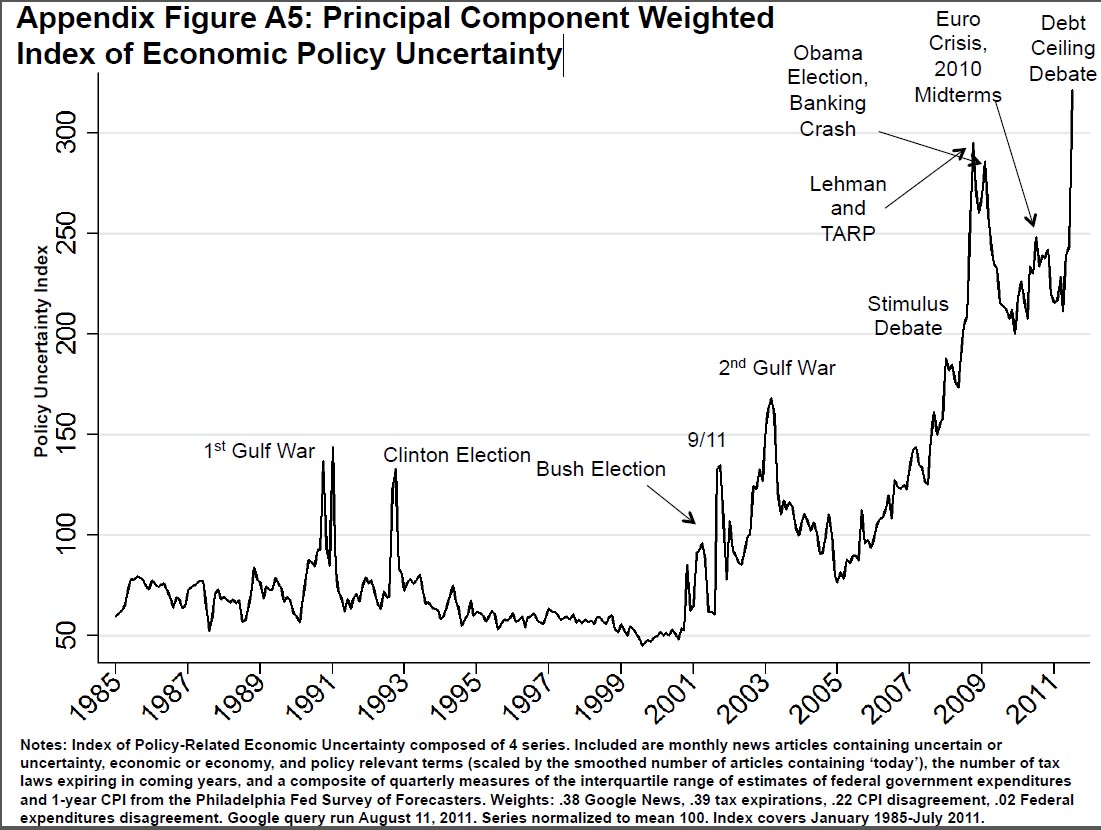
The index does include stories about tax policy, but those are not the issues that the authors highlight on the chart.
From earlier in the report, we have:
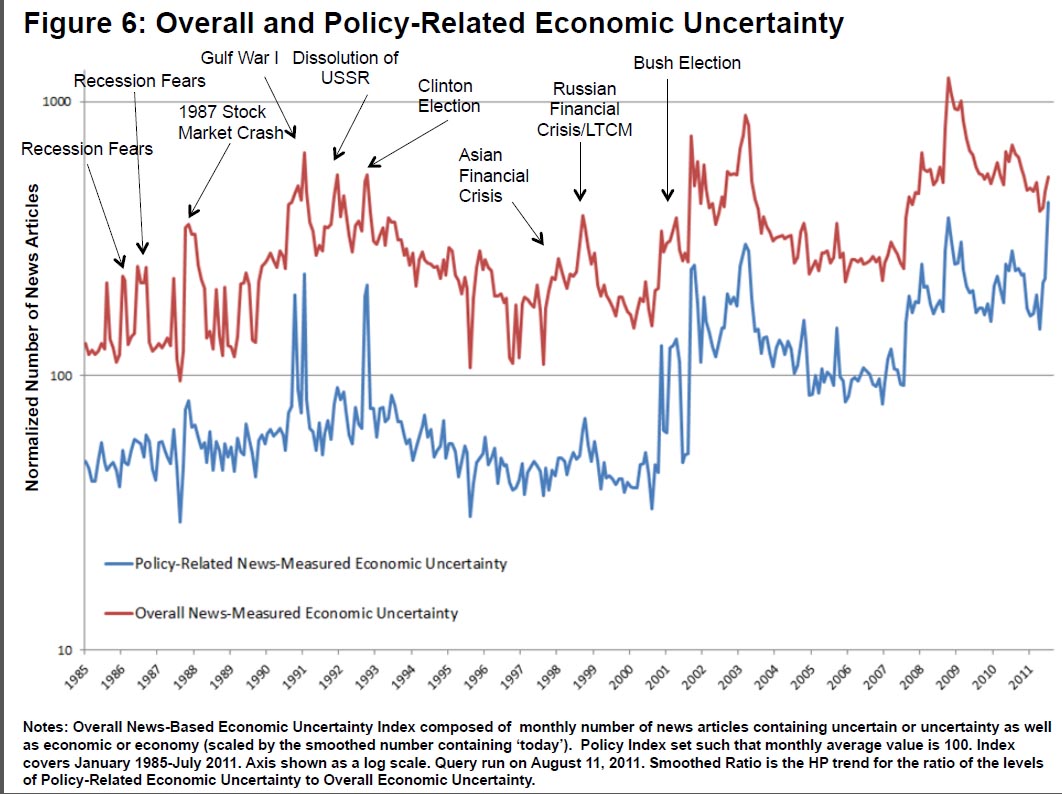
In summary, Figures 6 and 7 make three points. First, according to our news-based approach, overall economic uncertainty is considerably higher in the past 10 years than in the previous 15 years covered by our sample period. (See Table 1 as well.) Second, policy-related uncertainty has increased more rapidly than overall uncertainty. As a result, it accounts for a larger share of economic uncertainty in the past decade, more than 50% since 2005 and peaking at an astonishing 80% in July 2011 during the debt-ceiling debate. Third, policy uncertainty accounts for most of the high-frequency movements in economic uncertainty since 9/11, and a considerably larger share than in earlier periods. These results imply that policy-related concerns are an increasingly important aspect of overall economic uncertainty, and that by July 2011 they appear to be the major driving force behind movements in overall economic uncertainty.

So far I have only included talk of the measures of uncertainty, but what about the impact on the economy?
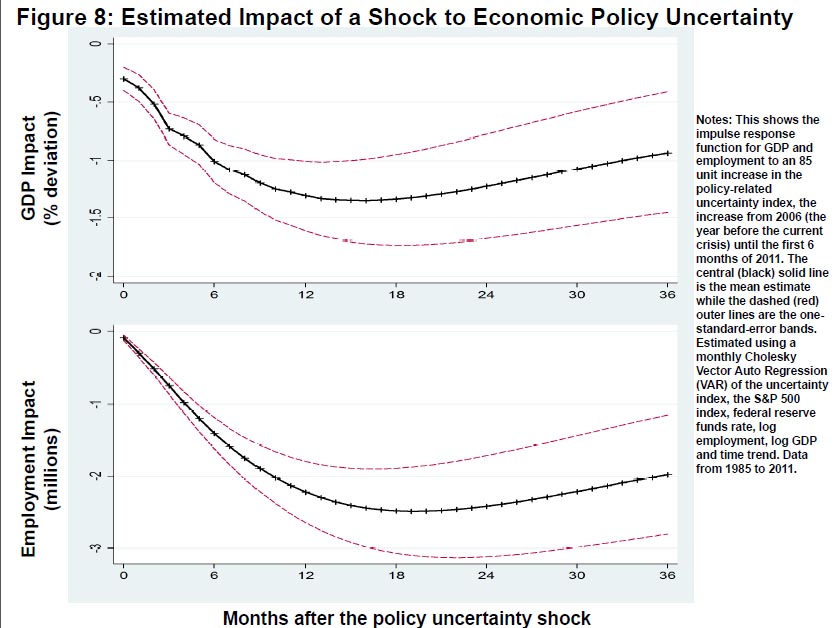
Of course, this approaches identifies relationships between variables from our Cholesky ordering and differences in the timing of changes in each variable. So, for example, it could be that policy uncertainty causes recessions, or that policy uncertainty is a forwardlooking variable that rises in advance of anticipated recessions. With these caveats in mind, the VAR estimates provide evidence at least of important co-movements between our index of policy-related uncertainty and economic activity, with some suggestive evidence on causation.
Looking at Figure 8, we see that an 85 point rise in policy uncertainty (the rise in our policy uncertainty index from 2006 to the first six months of 2011) is followed by a persistent fall in real GDP with a peak negative impact of about -1.4% at 15 months. Similarly, it also followed by a persistent fall in employment, with a peak effect of about 2.5 million at 18 months. These appear to be substantial effects, lending support to recent concerns over the damage of policy uncertainty on economic activity.
These effects of political uncertainty on growth and employment appear to be robust to controlling for other related factors. For example, if we add controls for broad economic uncertainty using the index in Figure 6 or from Bloom et al. (2009), we find that the impact of political uncertainty still yields a drop in real GDP of almost 1%. Similarly, using our Google News-based index of policy uncertainty, or changing the functional form by using the log of the uncertainty index (to get proportional increases) again leads to significant negative impacts on GDP and employment.
I admit that I did not use a fine toothed comb on the report, but from my cursory reading, I see no attempt to look specifically for the effect of demand destruction on the ensuing economic behavior. You would think that this would be an obvious thing to consider, except for the complete absence of any discussion of this from most of the main stream press. I guess it is not so obvious to business news reporters. Covering business and covering the economy require different skills from a reporter. I am not sure the business reporters have the skills to understand the economy.