Yearly Archives: 2012


A telling GOP defection

The Los Angeles Times has the column A telling GOP defection by columnist George Skelton.  The subheadline is “Loss of Assemblyman Nathan Fletcher should be a wake-up call for party in California.”

While this is about California politics, it might be a spreading phenomenon.

Fletcher says his frustration is aggravated by the war experience.

“Any combat veteran wrestles with a sense of survivor’s guilt,” he told me. “I wasn’t any better a Marine than those who didn’t survive. They were just in the wrong place at the wrong time. That gives me a real sense of obligation.

“You shouldn’t waste your life. It is a gift, and you ought to do something of meaning…. I just have a lower threshold for some of the pettiness and silliness that goes on. If the [Democratic] speaker of the Assembly has a good idea, we shouldn’t oppose it just because somebody says he’s the enemy.

“I know what an enemy is. I’ve watched people die. I’ve been to car bombing scenes and seen little sandals where children were killed. I don’t see the other side [in politics] as the enemy just because we disagree.”

Also, he continues, “in the Marine Corps, if you have a mission, you just have to get it done. When I came into elected office, I had that same sense of obligation. I feel that’s missing in the current environment. It’s good to have some on the ideological extreme. But we need more people who want to be pragmatic and figure how to make it work.”

The tipping point for Fletcher came last fall when he negotiated with Gov. Brown to eliminate a corporate tax break that rewarded companies for not building facilities and creating jobs in California. The $1-billion savings would have provided tax breaks for small businesses, buyers of manufacturing equipment and income tax payers who don’t itemize. Republicans blocked the bill.

GOP colleagues told Fletcher, he says, that “‘it may be the right thing to do, but we can’t let Jerry Brown get a win,’ which is just dumb.”

There comes a time when good politicians figure out what it is they really want to accomplish.  They realize that political games just for the sake of the game is not why they got into politics.


George W. Bush’s Mandate To Buy Private Health Insurance

This blog post is meant as an antidote to the collective amnesia that is running rampant throughout the country.  The disease is particularly acute in The Supreme Court.  One might expect this convenient amnesia from the conservative Justices who had already decided their conclusion before the Obamacare law was even challenged.  What I find amazing is that among the Progressive Justices and even with the Solicitor General who is supposed to be presenting the case for Obamacare, there seems to be this amnesia.  The fact that the newspapers cannot remember what was in their own pages less than 10 years ago does not surprise me at all.  So why is a senior citizen with failing memory the only one who seems to remember?

From the article Newt Gingrich is no conservative we have the quote:

In 2003, Gingrich stumped hard for President George W. Bush’s prescription drug bill, which has added about $17 trillion to Medicare’s unfunded liabilities. “Every conservative member of Congress should vote for this Medicare bill,” Newt urged.

From WikiPedia:

Beginning in 2006, a prescription drug benefit, called Medicare Part D, was made available. Coverage is available only through insurance companies and HMOs and is voluntary.

From the Medicare web site:

What Is the Part D Late Enrollment Penalty?

The late enrollment penalty is an amount added to your Part D premium. You may owe a late enrollment penalty if, at any time after your initial enrollment period is over, there is a period of 63 or more days in a row when you don’t have Part D or other creditable prescription drug coverage.

Medicare Prescription Drug Coverage (Part D)

Medicare offers prescription drug coverage to everyone with Medicare. If you decide not to join a Medicare drug plan when you’re first eligible, and you don’t have other creditable prescription drug coverage, or you don’t get Extra Help, you’ll likely pay a late enrollment penalty.

To get Medicare prescription drug coverage, you must join a plan run by an insurance company or other private company approved by Medicare. Each plan can vary in cost and drugs covered.

Does this sound voluntary to you?  If you don’t volunteer, you pay a stiff penalty, sort of like Obamacare.  So much for the dependability of WikiPedia.

The Boston Globe is carrying the Associated Press story Many health care mandates already exist in US.  The article  cites many precedents and yet fails to mention the Bush plan which is most similar to the Obamacare plan.  So much for the credibility of The Associated Press.


Is There More to Sen. Snowe’s Resignation Than Congress’s “Crumbling Center”?

Truthout has the story Is There More to Sen. Snowe’s Resignation Than Congress’s “Crumbling Center”?

Snowe’s announcement she will not seek another term in the Senate may have little to do with “civility” or “loss of the center” within contentious politics and more to do with the fact her husband is knee-deep in controversy over an educational for-profit college chain know as Educational Management Corporation or Wall Street ticker (EDMC).

I am sure there must be room for inventing another of Greenberg’s Laws here, but I just haven’t figured out what it is yet.

If there isn’t a law in this story can we at least conclude that resigning from Congress because of a “lack of civility” is about as plausible as wanting to “spend more time with your family?”


Reich: Political jujitsu to save health care law

I found the Robert Reich column, Reich: Political jujitsu to save health care law, at SFgate.

If the Supreme Court strikes down the individual mandate in the new health law, private insurers will swarm Capitol Hill demanding that the law be amended to remove the requirement that they cover people with pre-existing conditions.

If this happens, Obama and the Democrats should say they’re willing to remove that requirement – but only if Medicare is available to all, financed by payroll taxes.

So I suppose I ought to withdraw my previous post Conservative Supreme Court Justices Inadvertently Make Case For Health Insurance Mandate before the justices realize that they have shot themselves in the foot.  Now we’re supposed to want them to knock out the mandate so we can get our Medicare for all just as we really wanted.

Reich also notes,

Those who are opposing the law say a requirement that individuals contract with private insurance companies isn’t regulation of interstate commerce. It’s coercion of individuals.

I am still having a hard time figuring out why the Republicans and George Bush could pass a law to require everyone to buy prescription drug coverage from private insurance companies or pay stiffer penalties than those of Obamacare.  That was constitutional but Obamacare is not?
One wonders how the brains of the conservative Justices of the Supreme court have suddenly stopped working.  They ask silly question, pretending not to know the answers when the answers are obvious.  They pretend that this law is unprecedented when just a few years ago  the Congress and George Bush instituted a similar law.
If there is any place where we ought to make English the official language it is in the Supreme Court. They just don’t seem to know the meaning of some simple words like “logical”, “unprecedented”, “What is the difference between eating broccoli and bankrupting the country?”  Maybe that is why they don’t know whether to shit or go blind.

Commentary: Case is not about Trayvon Martin’s hoodie

Commentary: Case is not about Trayvon Martin’s hoodie by Leonard Pitts Jr. in The Miami Herald does an excellent job of clarifying the issue.

This, then, is what killed Trayvon Martin, the fact that we are so stubbornly convinced of that redundancy that a boy walking home carrying nothing more threatening than Skittles and iced tea can become a source of terror sufficient for a George Zimmerman to stalk him and to kill him.

It doesn’t matter if he wore a hoodie.

It doesn’t matter if he punched Zimmerman.

It doesn’t matter why he was suspended from school.

What matters is that he is unavailable for comment about those things, and always will be. What matters is that none of them changes the essential truth of what this is about.

Though innocent of any crime, Trayvon Martin was gunned down by George Zimmerman. He was sacrificed for all our fears.

When people are armed with lethal weapons and they have stereotypical assumptions about the motives of a certain class of people that they meet, then it is almost inevitable that a situation like this one will occur.  What can we do to lessen the chance that the people who are subject of this type of stereotyping will be needlessly put in danger, and what can we do to lessen the chances that people who hold these stereotypical beliefs will end up taking actions that they will regret for the rest of their lives?


Conservative Supreme Court Justices Inadvertently Make Case For Health Insurance Mandate

McClatchy has the article On Day 2, Supreme Court health care arguments center on mandate.

Solicitor General Donald Verrilli Jr. presented the case for the Obama administration’s side.

Unconvinced, conservatives pressed Verrilli for what limits might be imposed if Congress were permitted to impose the insurance mandate. Roberts asked about requiring cellphones to call emergency services, Alito asked about mandatory burial insurance, and Scalia asked about compulsory broccoli consumption.

I must admit, that before reading this article, I did wonder the how insurance mandate could be justified under the Constitution in the face of arguments like this.

Verrilli stressed throughout his hour at the lectern that the 40 million uninsured Americans posed what he called “an economic problem” that Congress is empowered to fix.

I then realized that the obvious answer to the conservative judges’ questions is that unlike the health care issue, a cellphone mandate, a burial insurance mandate, or a broccoli mandate would not be an effort to try to solve a national emergency situation that is on track to bankrupt the country if it is not solved.

I looked up the topic of The Constitution is not a suicide pact on WikiPedia.

“The Constitution is not a suicide pact” is a phrase in American political and legal discourse. The phrase expresses the belief that constitutional restrictions on governmental power must be balanced against the need for survival of the state and its people. It is most often attributed to Abraham Lincoln, as a response to charges that he was violating the United States Constitution by suspending habeas corpus during the American Civil War. Although the phrase echoes statements made by Lincoln, and although versions of the sentiment have been advanced at various times in American history, the precise phrase “suicide pact” was first used by Justice Robert H. Jackson in his dissenting opinion in Terminiello v. Chicago, a 1949 free speech case decided by the U.S. Supreme Court. The phrase also appears in the same context in Kennedy v. Mendoza-Martinez, a 1963 U.S. Supreme Court decision written by Justice Arthur Goldberg.

In the face of certain bankruptcy of the Federal Government and the country, surely the Congress is empowered to enact reasonable measures to save the country. I doubt that the framers of the Constitution imagined that the document should be construed as restricting the government from reacting to an existential threat to the country.


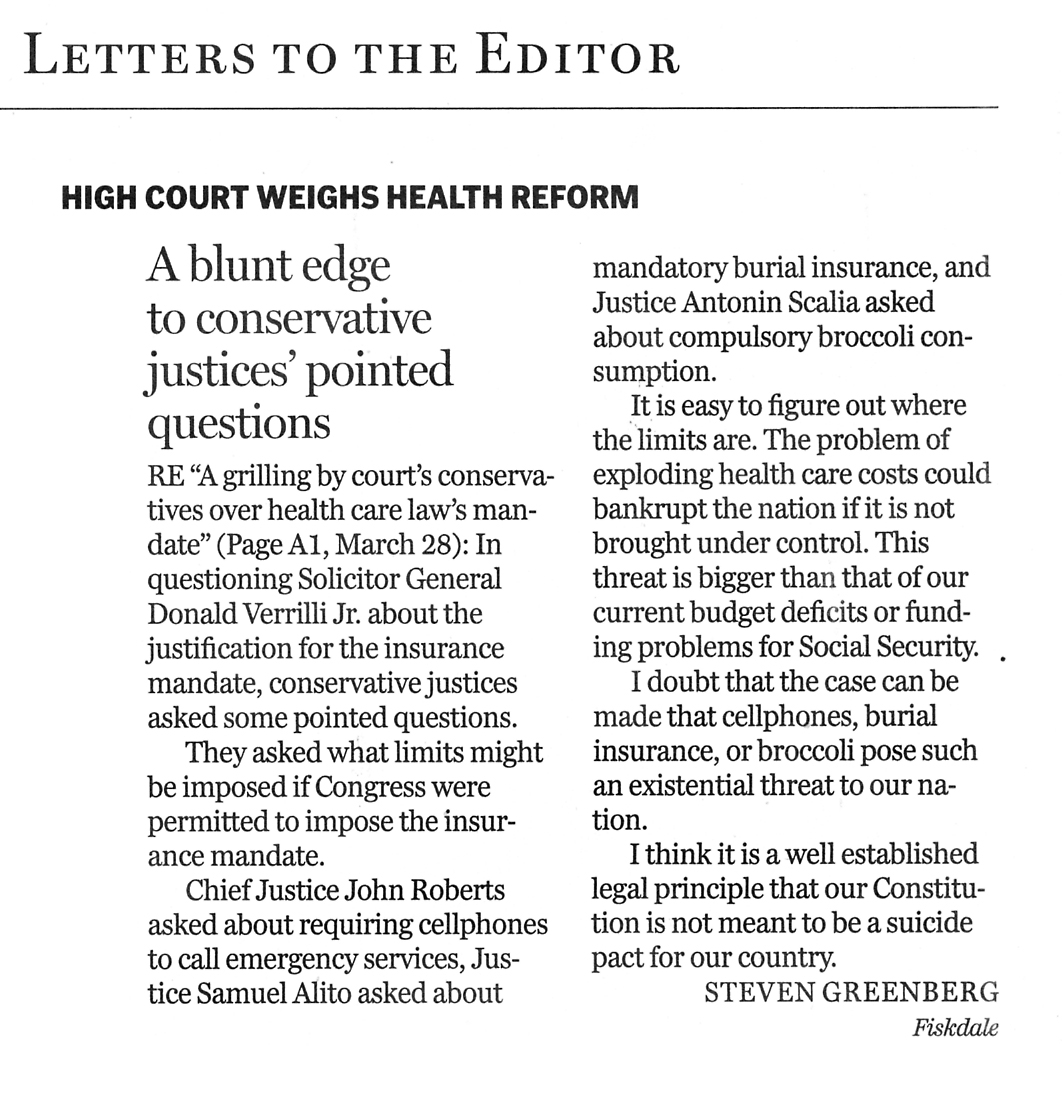
Here is my letter to the editor of The Boston Globe that was published on March 29, 2012.

Image of Boston Globe Letter To The Editor

For those with access to The Boston Globe here is the link to my letter to the editor.

In case my letter left any doubts, here is a picture that explains my idea of where the threat of exploding health care costs sits in relation to the boundary of permissible federal regulation without explicit enumeration in the constitution,


Why Won’t They Listen?

The New York Times book review, Why Won’t They Listen? ‘The Righteous Mind,’ by Jonathan Haidt, is a companion piece to my previous post Jonathan Haidt Explains Our Contentious Culture.

In the book review, William Saletan writes:

You’re smart. You’re liberal. You’re well informed. You think conservatives are narrow-minded. You can’t understand why working-class Americans vote Republican. You figure they’re being duped. You’re wrong.

.
.
.
Haidt’s faith in moral taste receptors may not survive this scrutiny. Our taste for sanctity or authority, like our taste for sugar, could turn out to be a dangerous relic. But Haidt is right that we must learn what we have been, even if our nature is to transcend it.

The reviewer very astutely assesses the value of the book and its ideas while also posing some thoughtful questions about those ideas.  I think I may have hinted at some of those questions in my previous post.

Haidt’s insights are not completely new to me. The book How We Decide covers some of the same ground from the psychological side of things.


The following quote from the review of Heidt’s book shows why we need to be thoughtful about the conclusions we draw.

To the question many people ask about politics — Why doesn’t the other side listen to reason? — Haidt replies: We were never designed to listen to reason. When you ask people moral questions, time their responses and scan their brains, their answers and brain activation patterns indicate that they reach conclusions quickly and produce reasons later only to justify what they’ve decided. The funniest and most painful illustrations are Haidt’s transcripts of interviews about bizarre scenarios. Is it wrong to have sex with a dead chicken? How about with your sister? Is it O.K. to defecate in a urinal? If your dog dies, why not eat it? Under interrogation, most subjects in psychology experiments agree these things are wrong. But none can explain why.

The problem isn’t that people don’t reason. They do reason. But their arguments aim to support their conclusions, not yours. Reason doesn’t work like a judge or teacher, impartially weighing evidence or guiding us to wisdom. It works more like a lawyer or press secretary, justifying our acts and judgments to others. Haidt shows, for example, how subjects relentlessly marshal arguments for the incest taboo, no matter how thoroughly an interrogator demolishes these arguments.

What I take from the description of these experiments is that if you first trigger a visceral reaction to a subject, then the reasoning process will be turned to justifying this visceral reaction.  If you can avoid triggering this reaction, then you might be able to reason about a subject in a balanced way.

The terms “hot button issues”, “red meat issues”, “wedge issues” came from an understanding of the human nature of thinking and reasoning.  If you want to elicit a certain response, you need to trigger the visceral reaction that most suits your needs and then you won’t have to even be concerned about the reasoning that will follow.  You must also avoid triggering the visceral reaction that does not suit your needs.

If the Republicans get to introduce a topic with the visceral reaction that suits their needs, then there is little the Democrats can do to use reason to convince people that the Republican position is wrong.

Perhaps, what the Democrats need to do is to bring up the visceral reaction that suits the Democrats’ needs and then start to reason.

An example might be the discussion I had on the web site of the Politico news story, Senate passes JOBS Act, with tweak.  One of the comments on the article was as follows:

Hopefully this time next year America will have it’s ease from the painful lesson of voting in Obama in 2008.

We’ll see business come back stronger and quicker under a new Pro- business President like Romney.

My response was:

But Romney’s activities as a “business man” are the exact cause of much of the trouble this country finds itself in.

Outsourcing jobs

Draining company assets to pay for salaries of vulture capitalists and letting the debt holders try to get their money back in bankruptcy court.

Draining the funds put aside for employee pensions, closing the factories, and leaving workers without jobs or pensions or health care insurance.

How much more of this “pro business” behavior do you think this country can survive?

Perhaps I could have tweaked this response a bit.  The point is to hit the visceral concepts of stealing assets, stealing pensions, stealing jobs, and stealing health benefits.

JOBS Act: The Dumbest “Bipartisan” Move Since Repealing Glass-Steagall

Truth Out has the article JOBS Act: The Dumbest “Bipartisan” Move Since Repealing Glass-Steagall .

This time it’s the deceptively named “JOBS Act,” introduced by the far-right Republicans in Congress and passed overwhelmingly by members of both parties. The President indicated his eagerness to sign the bill early on. Once again basic protections for investors, including individuals and families, are being recklessly overturned in a deregulating frenzy. Some of those protections were enacted in the wake of the Enron scandal, in which sociopathically unscrupulous business people conducted a hoax that ruined thousands of families and deprived many of their life’s savings.
.
.
.
Worse, the bill is designed so that even billion-dollar corporations can be considered “startups,” leaving the door open for a dozen Enrons of tomorrow to shaft the unwary. The common-sense protections proposed by Sen. Jeff Merkley were rejected, while the equally rational protections of Sens. Scott Brown and Jack Reed, which were passed, will be fairly easy for clever sharks to swim around. We’ve seen this play before, and it never has a happy ending. That will no longer be required of them, thanks to the “JOBS” Act.

I have been so busy working on my volunteer projects that I have not been following the news as closely as usual.  I never got around to reading Scott Brown’s email that mentioned “crowd funding” also mentioned in this article.

This article does give faint praise to Brown’s contribution to the bill.

I wonder what Elizabeth Warren has to say about this bill.  Maybe I’ll do a little research and find out.  You can always beat me to it.


Here is the relevant section from Scott Brown’s Enewsletter that I had not had a chance to read.

Have you ever wished you were a part-owner of Facebook or Google when they first started? Or, are you an entrepreneur with a great business idea, but you can’t move forward because of the credit crunch?

To make it easier for people to invest in great ideas or start a small business, I’ve introduced a bill (S. 1791) to legalize something called “crowdfunding.” Here’s the background story: Believe it or not, we still live under investment laws that pre-date the first computer, and those laws prevent most people from investing small amounts – say a hundred dollars – in a new startup company or small business. Because of these rules, only the very wealthy are permitted – and can afford – to get through the red tape necessary to fund a new company.

That’s right – it’s nearly impossible for most people to invest one dollar of seed money into someone else’s new business. This makes no sense, especially in the Internet era, where every day we see new ideas, programs and social networks take off. The same technology and culture that has helped assure people that it is safe to buy a product on Ebay or donate to a charity over the internet can be used to help investors make smart decisions about what companies to support. Over the past couple of weeks, I’ve hit the road to discuss this and other issues facing our small businesses.

Like so much of Scott Brown’s overblown and naive rhetoric, it is pure hogwash that “it’s nearly impossible for most people to invest one dollar of seed money into someone else’s new business.”  From time immemorial, entrepreneurs have been raising money from family and friends to start new businesses. A Vietnamese friend of mine once explained how his extended family started businesses in this country.  Every one contributed money to an investment fund.  Participants with ideas for businesses would ask to borrow from the fund.  They would be given money to start their business.  They would of course have a plan to pay it back.  They would also get the help of more experienced participants who may have already used this fund to start their own businesses.  I don’t think there were any laws that made it nearly impossible for this collaborative to operate.  I am willing to bet that large numbers of immigrant families have used this technique to bootstrap their way into the middle and upper classes in America, and they have been doing it for centuries. When I was growing up, my grandfather used to tell us bedtime stories about how our family got started in this country.

Since crowd funding has been going on long before Brown introduced his bill, (See Crowd funding on WikiPedia or do a Google search), one has to wonder what is in this bill that suddenly makes possible something that has already been going on for quite a while.

Politico has the story Senate passes JOBS Act, with tweak.

The change comes with an amendment, sponsored by Sen. Jeff Merkley (D-Ore.), Sen. Michael Bennet (D-Colo.) and Sen. Scott Brown (R-Mass.), which would place additional restrictions on so-called crowdfunding, in which small amounts of money are collected from large groups of people.

Merkley said the crowdfunding portion of the House bill is “simply a pathway to predatory scams.”

Gee, Scott Brown didn’t mention “simply a pathway to predatory scams.” in his newsletter.