Yearly Archives: 2014


Florida amendment aims to restrict Stand Your Ground court records

Aljazeeera America has the story Florida amendment aims to restrict Stand Your Ground court records.

Had the provision been in effect two years ago, for example, the Tampa Bay Times would not have been able to conduct its award-winning investigation on how Stand Your Ground has been applied unevenly across the state.

“We relied heavily on these records to examine the key details behind each case and track how defense lawyers were using the law and how judges, prosecutors and police were interpreting it,” said Chris Davis, the Times’ investigations editor, in an email to The Stream.
.
.
.
Florida State Attorney Angela Corey has come under fire from civil rights groups expressing concern over what they consider to be an uneven record in several high-profile cases. Under Corey’s tenure, George Zimmerman was acquitted in the shooting death of unarmed black teenager Trayvon Martin, and Michael Dunn received a partial verdict which stopped short of convicting him for the killing of another unarmed black teenager, Jordan Davis. Meanwhile, Marissa Alexander, a 34-year-old African-American woman, was sentenced to twenty years after firing warning shots at her estranged husband.

I wonder if these laws could be held unconstitutional violation of the Interstate Commerce clause.  I would like to visit Florida in the winter, but I am afraid to go there because of these laws.


Google, Apple, and Other Tech Titans’ Wage-Suppression Conspiracy Estimated to Cover One Million Workers

Naked Capitalism has the post Google, Apple, and Other Tech Titans’ Wage-Suppression Conspiracy Estimated to Cover One Million Workers by Yves Smith.  Here is a quote of a quote from the post.

What’s more important is the political predicament that low-paid fast food workers share with well-paid hi-tech workers: the loss of power over their lives and their futures to the growing mass of concentrated power in Silicon Valley, whose tentacles are so strong now and so great, that hundreds of thousands of workers around the globe—public relations and cable company employees in the British Isles, programmers and tech engineers in Russia and China (according to other documents which I’ll write about soon)—have their lives controlled and their wages and opportunities stolen from them without ever knowing about it, all the while being bombarded with cultural cant about the wisdom of the free market, about the efficiency of free knowledge, about the need to take personal responsibility and to blame no one but yourself for everything that happens in your life and your career.

I had seen the headline a number of times and had not followed the link to read the article.  After all, I had never worked for Google nor Apple.  However, what they did probably affected me and all the people I have ever worked with in the industry.  I knew that there were industry salary surveys that companies used to set salaries in ways that skirted the anti-trust laws.  It never occurred to me that companies were blatantly breaking these laws, and that the breakage was being carried out at the highest corporate management levels possible.


George F.R. Ellis, On the Nature of Cosmology Today

Reader MardyS provided this link to an excellent lecture George F.R. Ellis, On the Nature of Cosmology Today (2012 Copernicus Center Lecture). It fills in some more about the history of the universe (multiverse) than I had previously understood.  If I watch enough of these videos, I’ll understand all of what we know about the universe today by the time I am 170.


There is the following introduction on the YouTube site.

Cosmology is today a precision science with masses of high quality data every increasing our understanding of the physical universe, but paradoxically theoretical cosmology is simultaneously increasingly proposing theories based on ever more hypothetical physics, or concepts that are untestable even in principle (such as the multiverse). We are also seeing ever more dogmatic claims about how scientific cosmology can solve philosophical problems that have been with us for millenia. This talk comments in these trends, carefully distinguishing what is and what is not testable in scientific cosmology, and relating this solid scientific background to some of the recent philosophical claims made about how scientific cosmology relates to issues of meaning.

The fourth Copernicus Center Lecture – “On the Nature of Cosmology Today” – was delivered by Professor George Ellis, a famous cosmologist, mathematician, philosopher of science as well as researcher of the relationship between science and religion, currently Emeritus Distinguished Professor of Complex Systems in the Department of Mathematics at the University of Cape Town in South Africa. The 2012 Copernicus Center Lecture was part of the 16th Kraków Methodological Conference – “The Causal Universe”, which was co-organized by the Copenicus Center for Interdisciplinary Studies.


The history of how Mardy came to provide this link originates from my posting on Facebook of the previous post Neil deGrasse Tyson on Science, Religion and the Universe | Moyers & Company.


These Charts Show What is Wrong With American Capitalism

Naked Capitalism has the article These Charts Show What is Wrong With American Capitalism by Yves Smith.

… the stock market for a very long time has not served mainly (or lately, much at all) as a vehicle for companies to raise funds to expand their business. Instead, it serves as a machine for manipulating stock prices.

As I read this article, I was thinking that these charts are a measure of the symptom, but what has changed in the world to make this happen now.  In other words, what is the cause?

I then followed a link in the article to a previous article Our New York Times Op Ed on the Corporate Savings Glut.  This doesn’t so much answer the question of what is the cause, but it does provide some possible actions to help fix the problem.

Rather than blindly marching to Austeria, we need to set fiscal policy to the task of incentivizing the reinvestment of corporate profits in business operations rather than games at the casino.

Possible measures to achieve these aims include:

1) an aggressive tax on retained earnings that are not reinvested with a 24 month period after they have been booked (this provision needs to be designed carefully to defeat efforts to circumvent it through artful accounting);

2) a financial asset turnover tax that raises the cost to management (and others) of speculating rather than reinvesting profits in productive capital investment;

3) a reinvigorated public or public/private investment program that helps speed up the shift to new energy technologies (as scaling up usually induces a drop in unit costs of production).

Ultimately, I think the cause has to do with automation and job outsourcing to lower wage countries.  This  has made it more attractive for companies to try to economize their way to greater profits rather than grow their businesses. This is now how companies compete with each other.  They race to out economize their competition. This is the same reinforcing cycle that causes and perpetuates depressions. As business shrinks its costs, it also shrinks its customer base. As customer demand falls, it makes less sense to invest in more production and makes more sense to cut costs further.

Since the result of all these companies reacting in the same way to a common set of circumstances is this self-reinforcing cycle, no single company behaving differently is enough to change the circumstances. Moreover, no single company is strong enough to fight the trend for long.

The only solution to change things quickly is for governments that have the resources and abilities to change the environment, to use those abilities to tilt the balance in a better direction. The resources that governments have to stay the course of making these changes without fear of running out of money is being sovereign in their own currencies and only borrowing in their own currencies. Not every country has this ability, but the US, Japan, China, Russia, the UK, and perhaps the EU can definitely do this

balanced scales

Picture a balance scale with two large and nearly equal weights on opposite sides. The amount of effort that the governments need to put in is on the order of magnitude of the size of the imbalance, not the size of either of the two weights. The longer we wait, the more likely that the imbalance starts to grow in size to match one of the two weights.  This applies to the three items mentioned in the excerpt above.


The Boston Globe Cheats Its Subscribers

Do you actually pay for a subscription to The Boston Globe, as I do?  When you read the Doonesbury Comic strip in your newspaper, do you think you are getting the whole comic strip.  Compare this image to what you saw in the newspaper today.

The whole Doonesbury strip

If you cannot trust them to publish the whole comic strip, how can you trust them to print all the news?

If you pay them good money, how can you trust them to give you all that you paid for?

I sent a letter to the editor complaining about this. If I get any response, I will add it to the bottom of this post. Maybe they will have an explanation of how they are going to regain my trust.


Cosmos, A Space Time Odyssey on the National Geographic Channel

The television series Cosmos, A Space Time Odyssey on the National Geographic Channel, is on at 10PM Eastern on Monday nights.  It is also rerun at other times and days.

The National Geographic Channel schedule is available on the web.

This series in produced in conjunction with another television network that I will not name and which I will not watch.  I am sorry that I did not look up this alternative place to view the show until now.  If it as morally repugnant to watch this on the other channel, I hope you will find this alternative acceptable.  It is going to be hard for me to do, but I think I will try to watch the show on NatGeo.

I’ll make up some excuse to ease my mind about the morality of watching such a show that might in the slightest way benefit that other channel.


Neil deGrasse Tyson on Science, Religion and the Universe | Moyers & Company

Neil deGrasse Tyson on Science, Religion and the Universe | Moyers & Company is the second part of a three part series hosted by Bill Moyers.


I have not seen part 1 yet, let alone part 3, but this segment stands on it own so remarkably well, that I wanted to post it right away.

It should be no surprise to anyone who has watched or listened to Neil DeGrasse Tyson that he explains so eloquently why belief in a supreme being does not have to be part of a person who knows enough science.

Of course he says it much more eloquently than I ever could.  However, to put the feeling in my own words, I might say I  can understand why someone might want to attribute the unknown to the mysterious workings of a supreme being.  On the other hand, I am quite willing to look at a mystery of science, and accept the fact that we don’t know the answer yet.  I do not need to make up an answer that is outside of the realm of science for my own peace of mind.

Tyson has at the tips of his fingers, numerous examples of mysteries of science of the past that even the most brilliant scientists of those days were willing to attribute to a supreme being.  However, all of the examples he mentioned have been explained by science since then.  So, it is not impossible that there is some mystery that actually is the hand of a supreme being, but history has shown that the chances of any current day mystery being that hand of a supreme being is extremely low.

Mathematicians have proven that there are some things that are true in any self-consistent mathematical system that cannot be proved to be true using that system.  Not things we haven’t proved yet, but things that they can prove cannot be proved.  Keeping this in mind, it would not surprise me if there were mysteries of science that we will never figure out.

I have little doubt that most of the mysteries we know about now will be solved in the thousands or millions of years of intelligent life that will follow my own lifespan.  That means that I also know for sure that some of those mysteries will not be solved in my lifespan.  I can live with that idea.  If you cannot live with that idea, then feel free to make up any explanation you want that will give you peace of mind, if that is what you would prefer.  As Tyson says, just don’t insist that your idea be taught in our public schools as science.


Congressional Progressive Caucus’s Better Off Budget

I have found two Congressional publications so far for the Congressional Progressive Caucus’s Better Off Budget. The first is a 2 page summary.

When the federal budget invests resources wisely, we can meet the needs of working families and shrink the deficit. The Better Off Budget not only creates jobs, it reduces deficits by $4.08 trillion over the next 10 years. It’s the right budget for the country, for working families and for our future.

The second one goes a little deeper in 26 pages.

In a previous post Congressional Progressive Caucus Budget Strikes Back Against Austerity, I took the commentator to task for implying that increased spending must be “paid for”.  Reading the two page summary, I didn’t find the statement to be quite as bad as the analyst implied.

Still, this two page summary might leave some people with the impression that cutting the deficit is an important issue to tackle.  The above quote only mentions reducing the deficit in 10 years.  Perhaps toward the end of the 10 years it might be appropriate to have some deficit reduction, but it must be clear that deficit reduction is completely unnecessary and unwanted until the recovery is much more robust and the income inequality is reduced significantly.

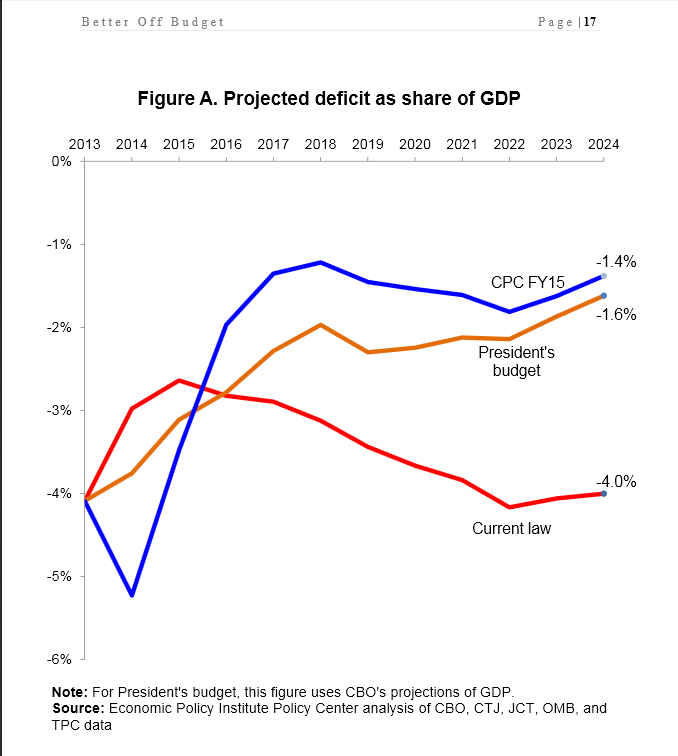
When I looked at the 26 page document, I did find some charts that plotted the deficit as a fraction of the gross domestic product.

Projected Deficit As Share Of GDP

This shows a very short term increase in the deficit and then a rapid decline in the deficit.  By the beginning of 2015, the Better Off Budget deficit is smaller than the current law and smaller than the President’s proposed budget.  I don’t have the capability of determining exactly when the deficit ought to start to decline as the economy recovers.  A lot depends on the speed of the recovery and the needs of the economy for deficits.

As a rough measure, I bet it would be safe to say that a long term federal budget deficit that is a smaller share of the GDP than is the growth of the GDP in the same period of time would be a deficit that is well within the capability of the economy to handle without a hiccup.

If we could get a budget like this passed, it would probably be a good first step.  My fear is that if it turns out that the economy does not recover as fast as hoped and the need for deficits does not go down as fast as hoped, voters will be left with the impression that this budget failed and we need to go back to austerity.  This is what happened after the President’s too weak stimulus at the beginning of his term in office.  Rather than recognizing that the stimulus and deficit were too small, and that they needed to be increased and tried for a longer period of time, the voters were convinced that the program was a failure and that we had to go in  the opposite direction.  (Or at least that is how the 2010 vote that turned the House Republican was interpreted by the nattering nabobs of negativism.)

The fact that President Obama was either too timid, or didn’t believe it himself, to explain what had happened, has made correcting the problem unnecessarily hard from a political point of view.  The political problem is amply demonstrated by the need for a Congressional Caucus to publish a budget that is much better than the President’s proposed budget.


Journalist Schools BBC on Russian Intervention in Crimea

Naked Capitalism has the post Journalist Schools BBC on Russian Intervention in Crimea by Yves Smith.

A fellow blogger with substantial experience in Europe sent this BBC footage, which I believe readers will find instructive. There were several things I liked about this segment. First, in contrast to US TV, where two sides who hold strongly opposed views talk past each other, there was a real discussion. Each side actually went beyond its talking points while remaining civil. Second was that the Telegraph writer Liam Halligan debunked some popular perceptions about Russia and Putin.

Here is the video of the BBC show.


We seem to have this uncontrollable urge to “do something”, even when there isn’t much to be done.

Even I have the troubling thought that we can’t just sit there and do nothing, but the choice isn’t between doing something and doing nothing. The choice is between doing something to make the situation worse and doing nothing. In that case, doing nothing does seem to be the better alternative.

With the empty threats that Obama has been making against Russia, it calls to mind Mark Twain’s statement, “It is better to keep your mouth closed and let people think you are a fool than to open it and remove all doubt.”

Or as I have always said, “Never make a threat that you aren’t willing to carry out.” It would be the height of foolishness to carry out some of the threats that have been made. What credibility do you have when the person you are threatening knows that you have made a threat you dare not carry out?

The corollary to this is not that if someone calls your bluff on an idle threat that you must go through with it to maintain your credibility. The corollary is that if your bluff gets called, learn the lesson to stop making such threats. You should have foreseen the likelihood of getting into such a spot before you opened your mouth.