Yearly Archives: 2022


Inflation Misinformation

I came across this meme on Facebook. It is a shame that one side’s misinformation gets countered by the other side’s misinformation.
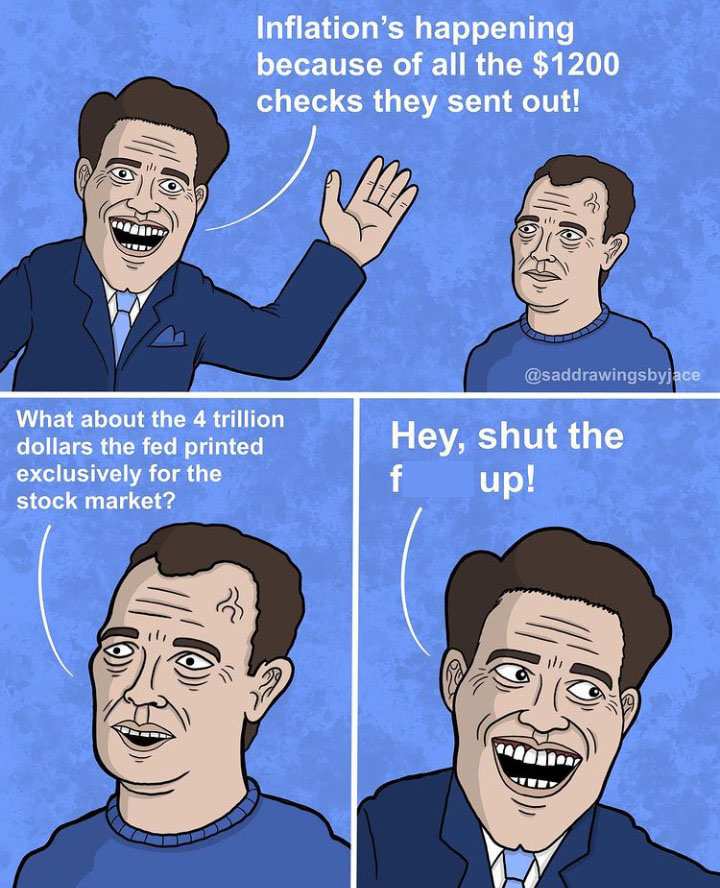

The $4 trillion the fed “printed” went mostly to the top 1%. They don’t use very much of that money to buy consumer goods, hence no CPI inflation. They did inflate where they do spend money, and that is partly the stock market. Most people think of rising stock prices as a good thing, so there were no complaints. When the government started directing more money to the 99%, they wanted to spend this money on consumer goods. With manufacturing and supply chain disruptions because of Covid, the supply of consumer goods was not able to be produced to match the consumer demand, hence inflation.

I am not saying that it was better to send money to the already wealthy. I am saying that a little analysis of the situation would have given planners a hint that they were going to have to have plans for controlling inflation. Perhaps besides controlling monopoly pricing power, they should have been thinking of ways to accelerate consumer goods supplies to meet the increased demand.


Seattle’s Democratic City Council revoking worker hazard pay during the still ongoing pandemic

Status Coup has the video Jordan talks with Seattle Council Member Kshama Sawant about Seattle’s Democratic City Council revoking worker hazard pay during the still ongoing pandemic.

Jordan talks with Seattle Council Member Kshama Sawant about Seattle’s Democratic City Council revoking worker hazard pay during the still ongoing pandemic


Seems like even the unions are not on the side of the workers.


Russian UN Ambassador on NATO-Ukraine escalation

The Gray Zone has the this episode VIDEO: Russian UN ambassador responds to US ‘war propaganda’ in interview w/Grayzone

Aaron Maté and Max Blumenthal speak with Deputy Permanent Representative of Russia to the UN Dmitri Polyanskiy on escalated tensions on the Russian-Ukraine border, US accusations of an imminent Russian invasion, and the context missing from a US media that refuses to interview Russian officials.


Whether you believe the Russian Ambassador or not probably depends on your preconceived notion. I know it has an impact on me. At least I recognize that Polyansky represents the Russian point of view, even if my own historic experience since 2014 is somewhat aligned with what he is saying. Unlike most of my readers, Max and Aaron know who Victoria Nuland is. I keep trying to remind people, but it probably is ignored by most.


Russia/Ukraine, and Avoiding Catastrophic War

Project Censored has a podcast Russia/Ukraine, and Avoiding Catastrophic War.

Mickey spends the hour with American University historian Peter Kuznick, co-author with Oliver Stone of The Untold History of the United States. They discuss the current U.S. and NATO confrontation with Russia over Ukraine; summarize the recent history of Ukraine and U.S. relations, while placing current affairs in Cold War context; and emphasize the urgency of settling the crisis peacefully.

On Facebook, Walter Kloefkorn commented:

“Project Censored’s” show this week is a one hour discussion with historian Peter Kuznick about the Ukraine situation. Highly recommended if you’d like a sane analysis, as opposed to the blather from the talking heads of all stripes on MSM.

If we are going to get this type of explanation heard in the USA, we are going to have to be the ones to spread this.


Economic Update: Fascism

Democracy At Work has the episode Economic Update: Fascism.

On this week’s show, Prof. Wolff talks about the US’ 2021 trade deficit and its implications, the FED’s inflation policy dilemma, and the political economy of the Baltimore and Bronx fires. In the second half of the show, Wolff uses the actual history of fascism in Italy, Germany and Spain to analyze the positions and prospects of fascism in the US today.


My comment to Prof. Wolff was:

If only you understood MMT. The interest rate we pay on Treasury securities is close to zero. If we didn’t pay interest, what would China do with its excess dollars?

Eventually China will de-dollarize its international trade. However, that won’t happen quickly unless we threaten them with economic sanctions. You didn’t mention that before I gave up watching this episode in disgust.


US Reaping What It Sowed in Ukraine

Consortium News has posted the article US Reaping What It Sowed in Ukraine.

But the U.S. and NATO’s interest in Ukraine is not really about resolving its regional differences, but about something else altogether. The U.S. coup was calculated to put Russia in an impossible position. If Russia did nothing, post-coup Ukraine would sooner or later join NATO, as NATO members already agreed to in principle in 2008. NATO forces would advance right up to Russia’s border and Russia’s important naval base at Sevastopol in the Crimea would fall under NATO control.

On the other hand, if Russia had responded to the coup by invading Ukraine, there would have been no turning back from a disastrous new Cold War with the West. To Washington’s frustration, Russia found a middle path out of this dilemma, by accepting the result of Crimea’s referendum to rejoin Russia, but only giving covert support to the separatists in the East.

In 2021, with Nuland once again installed in a corner office at the State Department, the Biden administration quickly cooked up a plan to put Russia in a new pickle. The United States had already given Ukraine $2 billion in military aid since 2014, and Biden has added another $650 million to that, along with deployments of U.S. and NATO military trainers.

Ukraine has still not implemented the constitutional changes called for in the Minsk agreements, and the unconditional military support the United States and NATO have provided has encouraged Ukraine’s leaders to effectively abandon the Minsk-Normandy process and simply reassert sovereignty over all of Ukraine’s territory, including Crimea.

In practice, Ukraine could only recover those territories by a major escalation of the civil war, and that was exactly what Ukraine and its NATO backers appeared to be preparing for in March 2021. But that prompted Russia to begin moving troops and conducting military exercises, within its own territory (including Crimea), but close enough to Ukraine to deter a new offensive by Ukrainian government forces.

This part of the story has been wiped from the minds of most people in the USA. I have the nasty habit of remembering things I am supposed to forget. That is one of my purposes for recording these things on this blog.


Resource Limits to American Capitalism & The Predator State Today

The Institute For New Economic Thinking has featured the video Resource Limits to American Capitalism & The Predator State Today.

James K. Galbraith discusses the shift of US capitalism from an industrial state to what he calls a predator state: a finance-led, military-centered corporate republic that continues to prevail. To overcome it, he lays out what is needed to focus on employment, stability and adjustments to rising resource costs. Lynn Fries interviews Galbraith on GPEnewsdocs.


Let’s get one bit of silliness out of the way. The interviewer is trying to differentiate between the work of the interviewee from the work of his father. She concentrates on the fact that the father included his middle name of Kenneth in his legal name and the son uses his own middle initial K. She doesn’t seem to notice that the father was John and the son is James.

What I find so enlightening about James K. Galbraith is that he is a progressive Economist, but does not talk like the Modern Money Theory progressive economists, nor of the Marxist/Co-Operative economist Richard Wolff. Galbraith has mentioned that he has advised the Chinese government. Another progressive economist, Michael Hudson, has also been an advisor to the Chinese Government. There are similarities and differences among these people on how they talk about the policy decisions we have to make. I find it interesting to try to synthesize all that I know about what these people are saying so that I can formulate what makes the most sense to me.


What is Inflation?

YouTube has a video Modern Money Doughnuts Episode 2.

Modern Money Doughnuts – an international show about modern monetary theory and ecological economics.

What have doughnuts to do with modern money? Quite a lot, as it turns out. Gabrielle Bond and Steven Hail explore the relationship between The Deficit Myth and Doughnut Economics, and explain why their show is named Modern Money Doughnuts.

Discussing the following questions, with our guest, Professor Fadhel Kaboub
What is inflation, what causes it, what doesn’t cause it and why has the inflation rate spiked in the USA and some other countries (not all – much less so in Australia and virtually not at all in Japan)? What are the best ways of managing inflation pressure points? What links the present inflation scare to the barriers to a Green New Deal and the problem of building a distributive and regenerative economy


Fadhel needs to reread “Super Imperialism” and he also needs to go back in history to the late 1960s instead of the 1970s to see the source of what started us on the path of inflation. Certainly OPEC exacerbated the existing inflation, but they were reacting to the inflation that had already started.

Fadhel does a disservice to his argument when he fails to mention why consumer demand outstripped consumer supply in the late 60s and 70s. The Vietnam war took away workers and sent many of them to Vietnam. The military spending build up detracted from consumer supply investment. When you pay workers (who are also consumers) to build military equipment that supplies no consumer needs, then you are setting up a system where consumer demand exceeds consumer supply (inflation).


How and Why the US Cannot Recover: Is It a Failed State?

Michael Hudson has posted what he calls The Blueprint to the US Empire.

On YouTube it can be found under the title How and Why the US Cannot Recover: Is It a Failed State?”.

Michael Hudson’s many books include “Super Imperialism,” “Killing the Host,” “… And Forgive Them Their Debts,” “The Bubble and Beyond,” and “Global Fracture.” This provocative title invites genuine discussion about the state of the US economy, its failures and what this might portend for the future of the US dollar as global reserve currency, the problem of the US balance of payments, and the role of military production in the US economy. Prof. Hudson is Distinguished Research Professor at the University of Missouri, Kansas City, and lectures at the University for Sustainability in Hong Kong. His frequent trips to China give him a unique understanding of long-term economic trends.