SteveG


Majority opposes Paul Ryan’s Medicare plan

The Boston Globe has published the story Majority opposes Paul Ryan’s Medicare plan from Bloomberg News.

House Republicans twice have approved legislation sponsored by Ryan to convert Medicare to a voucher program. The plan would rely on competition among private insurers to hold down health care costs.

I wrote the following letter to the editor of The Boston Globe.

I pity the reporter who had to write “House Republicans twice have approved legislation sponsored by Ryan to convert Medicare to a voucher program.  The plan would rely on competition among private insurers to hold down health care costs.”  A fit of rolling on the floor laughing is not a pleasant sight to see.

Is there anyone alive today or who has read any history who understands why Medicare was invented?  As I recall it, Medicare was needed because it was just about impossible for people over 65 to get private health insurance at a reasonable price.  That was decades ago.  Has anything changed that would make us think that reverting to that era would be an improvement?

Considering our history of astronomically rising health care costs under the current private insurance market for those under 65, why would we assume that having more of the same would produce radically different results?  30% of the current costs for health care already go to private insurance companies with no health benefits to the public at all.

I am surprised that we cannot hear the collective roar of laughter from all over the country  when Republicans make such obviously silly proposals.  Yet, as much as 38% of those between 18 and 49 don’t get the joke.

Maybe the ROTFL isn’t so bad, but to see LMAO may be traumatic.


Patients Would Pay More if Romney Restores Medicare Savings, Analysts Say

The New York Times has the article Patients Would Pay More if Romney Restores Medicare Savings, Analysts Say.

Some of the wording in this article had me confused, but the bottom line is that Romney’s false claims about what Obama has done to Medicare revolve around Medicare Advantage as I have been saying in many blog posts.

But Medicare Advantage, which was created 15 years ago in the hope that private-market competition for beneficiaries would result in lower prices, has consistently cost more than standard Medicare — costs that Medicare beneficiaries must help subsidize through their premiums.

The reductions for Medicare Advantage providers are “a matter of basic fairness because they’ve been overpaid for years,” Ms. Moon said. As for beneficiaries, she added, “they’re guaranteed basic Medicare benefits. They may lose some extra benefits they may have been getting, but in effect you’re saying some of the windfall benefits may go away.”

“The bottom line,” said Representative Chris Van Hollen of Maryland, the senior Democrat on the House Budget Committee, which Mr. Ryan leads, “is that Romney is proposing to take more money from seniors in higher premiums and co-pays and hand it over to private insurance companies and other providers in the Medicare system.”

As a subscriber to Medicare Advantage since I turned 65 about 3 years ago, I have always realized that it was a waste of government money to subsidize insurance companies this way, but if we were paying for it anyway, I might as well use it.  I won’t be sorry to see it go, especially if the savings in my Medicare premiums allow me to buy the miniscule extra benefits on my own.


Is an Anti-Austerity Alliance of Left Neo-classicals and Post-Keynesians Possible? Is it Desirable?

The post on New Economic Perspectives comes in two parts. Part 1 – Is an Anti-Austerity Alliance of Left Neo-classicals and Post-Keynesians Possible? Is it Desirable? and Part 2 – Is an Anti-Austerity Alliance of Left Neo-classicals and Post-Keynesians Possible? Is it Desirable?

From part 1 is this excerpt:

The advice of MMTers to progressives is to prioritize what government should spend money on and put forward those demands without linking them to the amount of taxes collected in countries that control their own currencies such as the US, UK, Canada, Australia, Japan and China. Secondarily, some in MMT might suggest using taxation as a means for shaping economic behavior and regulating economic inequality, uses of taxation which are considered commonsensical among economists of most schools and political tendencies.

These posts are like a Russian novel. It is hard to keep all the players straight between their atual names and the categories the author puts them in. Also like Russian novels, the post is worth reading if you are really interested in the topic.

A little bit of clarification emerged for me when I read this excerpt from part 2.

The non-economist progressive public sphere, such as it is, is in awe of Paul Krugman but Post-Keynesians and MMTers continue to find critical flaws in his reasoning and model of how the economy works.
.
.
.
An example of reality vs. unreality and stakes involved revolves around widely divergent theories of banking, debt and loaning money. Critically important in this era of politically overpowerful, mega-banks devoted to casino-like speculation on asset prices, is an understanding of what banks actually are and how they might be regulated or transformed to serve the greater good. The largely Post-Keynesian theory of endogenous money supported by a set of empirical observations of how banks and credit-creation works, suggests that banks create money by lending it and that lending occurs independent of reserves in the bank. Banks have social “license” to lend and use it when they see the potential for profit and loan amounts are not drawn on money in their accounts but the loans create money.  This license is a source of political and economic power, enabling banks to drive and shape the economy and the amount of money in circulation by lending or not lending as the case may be.    Neoclassicals of the Left and Right deny that this license exists and instead see lending as driven by reserves, a crude “piggybank” model of bank lending with bankers as transparent intermediaries.  Krugman and other have started to equivocate on this matter but still do not accept that changes in credit/debt add to or subtract from aggregate demand overall.

Perhaps the biggest value to me of my having posted this is to provide me with a reminder to go back and reread the original posts, try to understand some of the complicated sentences better, and follow up on the many links in the articles.


Doctors dispute Akin’s claim, but some supporters say it was misunderstood

The Kansas City Star has the generally good article Doctors dispute Akin’s claim, but some supporters say it was misunderstood.

If you are wondering about the supporters’ claims to a misunderstanding,

But Tim Wildmon, president of the American Family Association — a nonprofit that describes itself as a pro-family organization — told The Star on Monday that “fair-minded people” know what Akin really meant by his statement. Wildmon speculated that Akin was differentiating between forcible rape and statutory rape, which can be consensual.

“What I read from some medical sources, when a woman is raped, her body shuts down in some respects that may prevent her from getting pregnant,” Wildmon said.

Wildmon adds a new wrinkle, but then goes back to repeat the same stupid statement that got Akin in trouble in the first place.

The part of the article that gets my goat is the statement:

A 1996 study in the American Journal of Obstetrics and Gynecology, generally considered one of the few peer-reviewed research efforts on this subject, estimated that 5 percent of rapes result in pregnancy.

The above statement tells you nothing about the truth or falsity of the claims of either side.  To complete the above half a statistic, there would need to be a statement like, “and it is estimated that X percent of incidents of consensual intercourse result in pregnancy.”  If X is significantly higher than 5%, then there could conceivably (no pun intended) be some truth to Akin’s claim.  If X is significantly lower than 5%, then it might be true that rape has an enhanced rate of causing pregnancy.  If X is not significantly different from 5%, then it might be tru that rape versus consensual sex has no affect on the rate of pregnancy after the act.

So the half statistic has shown that rape may lead to enhanced rates of pregnancy, or it might lead to lowered rates of pregnancy, or it might have no effect at all.  In other words, you don’t know anymore about the effect of rape on pregnancy than you did before you read that statistic. You don’t even learn anything about the claim to rarity.  Without knowing the number X, you can’t say whether 5% means rare or frequent.

For this reason, I give the article a 5 star rating for proving Greenberg’s Law of the Media – “If a news item has a number in it, then it is probably misleading.”
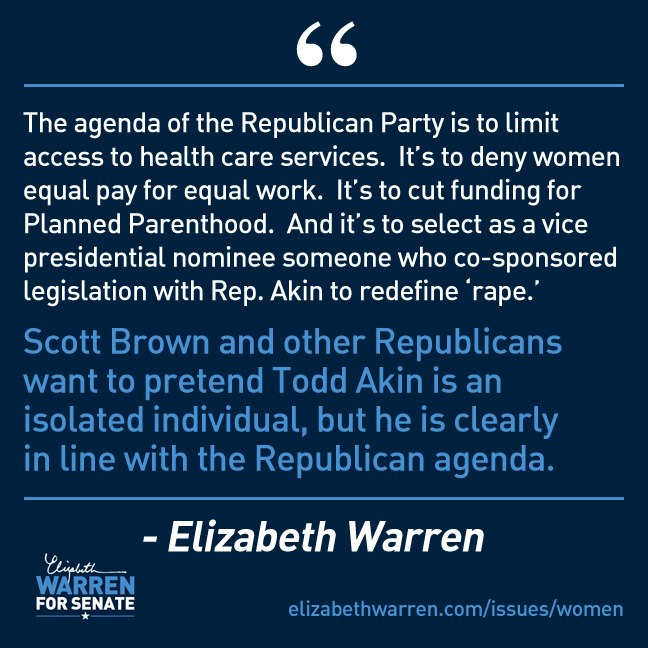

Black Report: No Criminal Prosecution of Wall St. and Who is the European, Romney or Obama?

The Real News Network has the video Black Report: No Criminal Prosecution of Wall St. and Who is the European, Romney or Obama? This is one episode in the weekly series The Black Financial and Fraud Report.


BLACK: Well, also, also there’s a track record, and representative Ryan voted for all of the Bush things that are inconsistent with libertarian ideas and are inconsistent with being, you know, a fiscal hawk. So when it was a Republican president, he gave them everything he wanted. And the Republican president, of course, created very substantial deficits. Now, deficits are supposedly the demon,…


As I have pointed out before, saying deficits are bad in one phase of an economic cycle is not inconsistent with saying that deficits are good in a different part of the cycle. However, in the Republicans’ case they are saying deficits are good when they are actually bad, and they are saying they are bad at precisely the moment when they are good. If they would just stick to one story, they would at least be right half the time. Which is not quite as good as shifting your policy at the right time to be right all the time.

If you listen to the whole video above, you will realize that this is further proof of my remarks in my previous post, Paul Ryan – An Unserious Man:

It occurs to me that the mentality that brought you toxic mortgages and the tricks and traps hidden inside them is the same mentality that is bringing you these various Republican economic proposals.


Paul Ryan – An Unserious Man

The New York Times has the Paul Krugman piece An Unserious Man.

Mitt Romney’s choice of Paul Ryan as his running mate led to a wave of pundit accolades. Now, declared writer after writer, we’re going to have a real debate about the nation’s fiscal future. This was predictable: never mind the Tea Party, Mr. Ryan’s true constituency is the commentariat, which years ago decided that he was the Honest, Serious Conservative, whose proposals deserve respect even if you don’t like him.

But he isn’t and they don’t. Ryanomics is and always has been a con game, although to be fair, it has become even more of a con since Mr. Ryan joined the ticket.

At first, I misread Ryanomics as a reference to a past President’s economic plan.

Krugman concludes with:

The first sign of trouble has already surfaced over the issue of Medicare. Mr. Romney, in an attempt to repeat the G.O.P.’s successful “death panels” strategy of the 2010 midterms, has been busily attacking the president for the same Medicare savings that are part of the Ryan plan. And Mr. Ryan’s response when this was pointed out was incredibly lame: he only included those cuts, he says, because the president put them “in the baseline,” whatever that means. Of course, whatever Mr. Ryan’s excuse, the fact is that without those savings his budget becomes even more of a plan to increase, not reduce, the deficit.

So will the choice of Mr. Ryan mean a serious campaign? No, because Mr. Ryan isn’t a serious man — he just plays one on TV.

It occurs to me that the mentality that brought you toxic mortgages and the tricks and traps hidden inside them is the same mentality that is bringing you these various Republican economic proposals.  In the case of the mortgage fiasco, the big banks got armies of expert lawyers to write complicated contracts that no sane person would agree to if they understood them. Then they went out in droves to sell these things to the rubes.  They invented something called liar loans.  It wasn’t the borrowers who were lying.  It was the mortgage brokers who put in the lies, many times unbeknownst to the borrowers.  The same type of people are now doing this scam in the political realm.

Remember that Romney was the one who figured out how to just skirt the laws so that he could take over companies, strip out their assets, rob the employees of their pensions and health care, and then leave the bones of the company on the scrap heap.

If you think these economic proposals make sense, common or otherwise, then you are one of the rubes they are depending on to get elected.