SteveG


Bill Of Rights RIP

Here is an email I received to petition the White House once more. This time, the deadline for action is really near – and I do mean deadline in the most literal sense of the word – if you miss it, the Bill Of Rights may be dead.


Here is the message that I sent via this call to petition.

Dear Mr. President,

I urge you to veto the National Defense Authorization Act. While you seem to believe it limits your powers, my concern is that it gives unconstitutional powers to presidents, including the power to imprison people without charge or trial. You should use your Constitutional power to veto this dangerous bill.

I don’t know how I could possibly vote for you in 2012 if you fail to veto this bill.

Sincerely,
Steven Greenberg


Americans face Guantánamo detention after Obama climbdown

The UK Guardian article Americans face Guantánamo detention after Obama climbdown, does say:

But on Wednesday the White House said Obama had lifted the threat of a veto after changes to the law giving the president greater discretion to prevent individuals from being handed to the military.

Critics accused the president of caving in again to pressure from some Republicans on a counter-terrorism issue for fear of being painted in next year’s election campaign as weak and of failing to defend America.

I don’t know if this version of the story is a little overwrought or not.  You can read The Raw Story article Obama will not veto National Defense Authorization Act.

When it comes time to vote for President in 2012, I don’t know how I am going to be able to vote for Obama.  In the last election, I used the threat of not voting for him as a way to nudge him in a different policy direction.  Now that he has an established record, there is no nudge room left.  I don’t know if I could sleep at night if I were to cast a vote for him again.


The Bipartisan Political Alliance That Will Turn The Fight Over Medicare On Its Head

The Talking Points Memo article The Bipartisan Political Alliance That Will Turn The Fight Over Medicare On Its Head talks about an alliance between a Senator and a Representative.

Sen. Ron Wyden (D-OR) is teaming up with Paul Ryan, the House’s top budget guy and the author of the GOP’s controversial budget which proposes phasing out traditional Medicare and replacing it with a private plan.

There is a lot of verbiage in the article that makes it a little confusing as to which of the two politicians has moved the most off of his own original plan.

It always makes me nervous when Wyden pulls a stunt like this.  I voted for him when I lived in Oregon.  He was known for being a strong advocate for seniors before he was elected to the Senate.  Some of the things he has done since then with regard to Medicare and Social Security make me wonder, “What on earth is Ron thinking?”

Most of the surprises from Ron Wyden since his  election as  Senator have not been pleasant for me, who supported him.

He was doing so well with his threatened filibuster of the terrible internet bills. See Senator Wyden Filibuster Of SOPA/PIPA Censorship Bills.  Then he goes and disappoints with this needless cave on Medicare.


Did they really detect the Higgs Boson?

The io9 article Did they really detect the Higgs Boson? discusses this question and has links to even more details and background information.

As for why we should care, the article offers these two reasons:

This is a big deal because 1) The Higgs Boson is the last undetected particle in the Standard Model of physics, and 2) The Higgs field is what gives other particles their mass.

The author gives his opinion on whether or not the the Higgs Boson has really been found.

But particle physicists like to be more careful before they say something has been officially “discovered.” They normally demand a 5-sigma detection — with less than a one in a million chance of being wrong. It makes sense to set a high bar, but for my part, I’m convinced that the Higgs is real and that we know its approximate mass. The remaining work will be to make it official.


Stop Arguing About Economic Theory And Politics

Political arguments over economic theory seem to argue over whose economic theory is right. This argument really does not take into account what economic theories are all about.

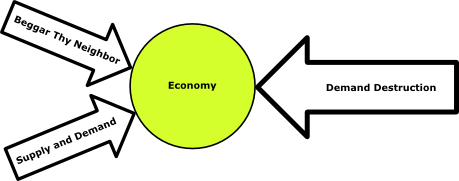
For the purposes of this discussion I happened to choose the theories mentioned in the  post Eurocrisis: “Democracy is Not a Given”.  The figure below shows, graphically, how these theories relate to each other.


Macro economic theories focus on particular forces that move the economy. In any historical period when one theory seems to explain where the economy is going, the particular force of that theory may be so dominant, that other forces don’t matter much.

In a  particular historic moment, if one force dominates, you still have to figure out which force it is so that you pick the right theory to apply to explain what is happening.

In real life, there are many forces pushing in different directions. You can see from the figure that you could actually pick the wrong force, supply and demand instead of all three, and get pretty much the right result.  That might be okay for a while, but as the sizes of the forces change over time – beggar thy neighbor runs out of steam, you might have a hard time figuring out what is going wrong if you base your thinking on assuming that your wrong original choice was right.

Since there are many more forces that can be identified than the three that I have shown, it may be hard to say which one or ones, if any, are dominating. If you want to consider all possible forces and apply them in the proper strength, the calculation of where the economy is going to go becomes very difficult. This is where you might want to resort to computer modeling so you can have the computer make the difficult calculations.

A computer model is only as accurate as the completeness of the forces included in the model and their accurate measurement. The model also has to have an accurate representation of the economy, which is the object that these forces are moving.

Now imagine that the economic policy of the federal government is determined by the political process. Do you think the average lawyer or business person in Congress is capable of doing these calculations, or even understanding them?

Let us look at a similar situation decided by Congress successfully. One example that I can think of is the NASA moon missions. The Congress and President Kennedy decided on a destination. They created legislation, set up an agency to carry it out, and provided a budget. Congress did not legislate the size of the rocket, how many stages it should have, nor the details of the decade long research that would have to go into deciding these things.

As with a space mission, you cannot decide how to direct economic policy without first figuring out what the destination should be. The economic destination has to do with things like the rate of improvement of the lifestyles you want for your citizens, how competitive you think you have to be compared to other world economies, the level of economic security that people should feel, the cleanliness of the environment they should enjoy, and the sense of justice that is right.

Once you know where you want to go, then you can set up agencies filled with experts who can figure out how you can get there. You need to give the agency a budget. You also need to figure out how you are going to measure progress to your destination. You then set the agency to its task, and leave the details to them. Of course you keep monitoring progress and make adjustments to the agency to make sure it is working. However, you do not meddle in technical details if you do not have the expertise to do so.

If we all have a clear picture of the expertise that is needed to make these detailed decisions, then it is easier to know if the person who wants to meddle is qualified. It is also easier for the person who wants to meddle to know if she or he has adequate expertise to do it.

I think it is less than helpful for the general public to be arguing over whether Keynesian economic theory is right or the Austrian Theory is right. It is not the right question to even be trying to decide. The real question for the public to decide is whether or not we have the right destination in mind and whether or not we are making good progress toward that destination. It takes a fair amount of expertise to even get those issues right.

Eurocrisis: “Democracy is Not a Given”

There are two parts to The Real News posting Eurocrisis: “Democracy is Not a Given”.

One part is Eurocrisis: “Democracy is Not a Given” – German policy of low wages and beggar thy neighbor is root of euro crisis. German policy of low wages? Certainly not. I have never heard about this in the progressive press, let alone the lame stream press. Well, watch the videos, you may be shocked.


The other part is Class War: Low Wages and Beggar Thy Neighbor – The words “class war” maybe unfashionable, but it is still a battle between labor and capital.


The specter of economic imperialism rising again in Germany gives one pause, to say the least.


Maybe the previous post Paul Krugman: What Germany’s Jobs Miracle Can Teach Us didn’t have the whole story.


There is a simple economic lesson here about how economics is not so simple. The German attempt to increase employment by lowering wages based on the economic theory of supply and demand, should not have worked because of the Keynesian economic theory of demand destruction, but did work because of an entirely different economic principle of beggar thy neighbor.


I’ll rephrase Dr. Heiner Flassbeck’s conclusions for the United states.

The wage suppression that the Republicans have been trying since 1980 based on the theory of supply and demand, has not worked because of Keynes’ ideas of demand destruction. Beggar thy neighbor won’t come to our rescue because we don’t have neighbors big enough and rich enough onto whom we can shift our own problems. What little shifting we could do has already been done. The end of this road is similar to the end of the road that Germany’s policy of beggar thy neighbor is fast approaching for Germany.


See the subsequent post The Euro Crisis in 7 Simple Charts: They’re telling you a real pack of lies for the charts that support the videos in this article.


House passes Republican payroll tax cut plan

The Raw Story article House passes Republican payroll tax cut plan gives some detail on the plan.

Defying a White House veto threat, the US House of Representatives voted Tuesday to tie a payroll tax cut extension to the swift approval of the controversial “Keystone XL” US-Canada oil pipeline.

You had to know they would do this. Now, does the President have the guts to veto it if it should somehow make it past the Senate/House conference committee?


Newt Gingrich – Candidate For The 99% 2

Here is Ron Paul’s ad about Newt Gingrich.


The obvious thing to do is to compare this ad with the one Karl Rove made against Elizabeth Warren. The main difference, I think, is that this one is not using lies to make its point. This ad is not telling you that Newt Gingrich is a completely different person from the one you have come to know over the years if you follow the news at all.


Government’s Role Is Different From Business’s Role

Government and Business play two different but essential roles in our society.

Think of the government as the citizens banding together to do things in a cooperative, wholesale way what they couldn’t do at all or as efficiently as individuals. Some of these things cannot be done by individual companies either. Companies banding together as monopolies or oligarchies have extremely unfortunate consequences, so we frown on allowing that to happen without strict controls by the government (the people).

I’ll provide some examples, but do not intend to write a book in an attempt to cover everything.

Government provides infrastructure such as roads, sewers and sewage treatment, and flood control. These are large projects that consist of many pieces that must work together, but we don’t need multiple copies in competition with each other.

Government also provides services that have no short term payback, but have important long-term consequences. Education of the citizens and work force are important. Some of what citizens need to learn is related to making society work as a whole and have little to do with satisfying the needs of a company or business.

Companies have primary responsibilities to their owners/share holders. There are no national boundaries to where the owners live or where the company does business. We should not expect large, multinational companies to have an allegiance to only one country.

Government, on the other hand, has its primary responsibilities to its citizens and residents. We should expect the government to have a keen interest in the welfare of its residents.

One of the advantages of our economic system is diversification. It is very hard to predict which inventions will lead to new industries that change the world. With diversification of companies we get many different attempts to make a business out of an invention. Most fail, some succeed on a grand scale. Companies come into existence and go out of existence as the needs of people change over time. This is what makes our economy vibrant.

What the government provides should not come and go with quite the same rapidity. Health care, retirement, education, infrastructure, defense, currency, and many other things need to be dependable for the long run. Certainly they need to adapt to changing conditions, but they probably shouldn’t disappear altogether in one form to suddenly reappear somewhere else in another form.

I won’t go into any details, technical or otherwise, but the interaction between the federal government and the economy is hugely different from the interaction between even the largest companies and the economy.  Any national politician, who does not recognize and understand that difference, can only lead us to wrack and ruin.  We have plenty of evidence of that in the present let alone our most recent history.

When we realize these vastly different roles, we can see that being a great success in business does not necessarily make for great success as a politician – be that mayor, governor, senator, representative, or president. When we elect people to these roles, we don’t want them thinking just like business people. We want them to understand that they are taking on a different role and different responsibilities from what they did when they succeeded in private life. We should always ask candidates to explain their understanding of how the role of government is different from the role of business.

Business experience isn’t a bad thing for a politician. However, when running for office, we ought to demand that politician show us an understanding of how the new role will be different from the old one. If the politician does not recognize the difference, there is little hope that this politician will have a highly beneficial impact on the lives of the citizens/residents with respect to the large matters given to the care of the government.


Rescued from Real People, Boston’s De-Occupied Dewey Park Now Re-Landscaped for Passing Motorists

The post Rescued from Real People, Boston’s De-Occupied Dewey Park Now Re-Landscaped for Passing Motorists has some very thought provoking ideas in it.

I’ll quote just three paragraphs.  You’ll have to read the article itself to fill in what came before and what came after.

So it was no surprise that the mostly young, idealistic and courageous occupiers were forced from day 1 to recreate government, to develop mechanisms to deal, face to face with drug abuse, violent/uncontrolled behavior, unemployment, homelessness, hunger and poor health.  It wasn’t all just marches and demonstrations and rallies and teach ins; it was also a daily struggle for human and humane survival.  And the fact this was happening was also a daily embarrassment to the city and a reminder of how badly our cities fail for so many of their citizens.

The occupation movement did not create these people or their problems — those who received the trillions in bailouts were far more responsible — nor did they  exacerbate any of their conditions.  Homeless, suffering people and conditions came to the occupation, and the movement did its best to deal with them.

None of those conditions are gone merely because tents will now be replaced with freshly mowed grass that almost no one will see or walk on.   The problems and the people who struggle with them are still there, dispersed to who knows where, mostly out of sight and hence mostly out of mind.  And that was probably the unacknowledged plan that compelled the good Mayor to lie.

I think the Occupy Boston movement was about far more than we imagined.