SteveG


Listen To Elizabeth Warren Speak


In the video above, we don’t get to Elizabeth Warren for quite a few minutes (8 minutes and 35 seconds), but it is worth hanging on to hear her. Or you could skip ahead to that part by using the slider under on the video.

If you had any fear (and I don’t know why you would) that Elizabeth Warren’s campaign for the Senate would be like Martha Coakley’s campaign, I think this interview would put those fears to rest.

I first saw the video in the story, Elizabeth Warren: We will not let Republicans ‘rip arms and legs off’ of consumer agency, on the Rawstory web site.


ALEC Exposed: State Legislative Bills Drafted by Secretive Corporate-Lawmaker Coalition


I first found the link to the above video on Truth-Out.

I finally found the list of bills mentioned. Bills Affecting Worker and Consumer Rights and More.

This is a list of bills and resolutions that attack worker and consumer rights.


Remember when they all laughed at Hillary Clinton for talking about some “vast right-wing conspiracy”?

One might wonder how she knew about it. When you wonder about this question, you then start to wonder how it came to pass that Bill Clinton pushed all these trade bills and he pushed the repeal of the Glass-Steagall act. These are some of the major items on ALEC’s agenda.

Did Hillary stop talking about the vast right wing conspiracy because of the ridicule? Or did someone she was very close to try to rein her in and keep her on the reservation, so to speak?

I suppose another possibility was that Bill had been duped by ALEC, and Hillary’s remarks were an attempt to repent for the mistakes of Bill.

Good research always raises more questions than it answers.


Debt ceiling debate turns ‘scary’

Politico has an article  Debt ceiling debate turns ‘scary’.  Here are a few quotes from the article.

President Obama has threatened to veto House Republicans’ debt plan.

Washington’s frayed nerves showed through Monday amid tough talk on the right, a White House veto threat, canceled weekend passes and the top Senate Democrat likening default to a “very, very scary” outcome even for those “who believe government should be small enough to drown in a bathtub.”

Finally we get to the word veto.  It is about time.

To let you know how serious I take this, here is an investment change I made today.  I had a variable annuity that has been invested in an investment grade bond fund.  It is my only investment in bonds. I have been thinking for a long time that I ought to turn it into an income producing annuity.  The application papers to do this are on the way to me for signature.  In the mean time, I locked in the value of the investment today by exchanging the bond fund for a money market fund in the variable annuity.  By the end of the week this money will be invested in a fixed income annuity.  Decisions like this are what drive bond prices down (and bond yields up).


ALEC Politicians

At ALEC Politicians, you’ll find a partial list of politicians involved with ALEC.

… Trove of Over 800 “Model” Bills Secretly Voted on by Corporations to Rewrite Your Rights. Learn More at ALECexposed

ALEC is not a lobby; it is not a front group. It is much more powerful than that. Through ALEC, behind closed doors, corporations hand state legislators the changes to the law they desire that directly benefit their bottom line. Along with legislators, corporations have membership in ALEC. Corporations sit on all nine ALEC task forces and vote with legislators to approve “model” bills.


Getting to Crazy

Paul Krugman’s piece, Getting to Crazy, repeats a question on commentators lips,

A number of commentators seem shocked at how unreasonable Republicans are being. “Has the G.O.P. gone insane?” they ask.

You can probably figure out the answer without even clicking on the link above to see the whole article.

Thanks again to LlandaR for suggesting this post.


Letter of Experts Opposed to Cuts in Social Security Benefits

The Letter of Experts Opposed to Cuts in Social Security Benefits is fairly brief.

To see the lengthy signature list, click on the above link to the article.

As experts on Social Security, the federal budget or the economy, we write to correct a commonly held misconception – that Social Security somehow contributes to the federal government’s deficit. In fact, Social Security’s Old Age and Survivors Insurance Trust Fund and its Disability Insurance Trust Fund are prohibited from paying benefits unless those funds have sufficient income and assets to cover the cost, and they have no borrowing authority to acquire the requisite income and assets. Consequently, Social Security is prohibited by law from deficit-spending and thus contributing to the federal deficit.

We also write to point out that Social Security’s benefits are modest both compared to those of other industrialized countries and in absolute terms. Its administrative costs are also modest, amounting to less than a penny of every dollar expended. The modest size yet increasing importance of Social Security’s life insurance, disability insurance, and old age annuities, given the trends in private sector retirement arrangements, savings, home equity and stock values, leads us, as a policy matter, to recommend strongly that Social Security’s manageable shortfall, still decades away, should be eliminated without cutting benefits, including without raising the retirement age.


Koch Brothers’ ALEC Tentacles Creep Into Your State

The quotes below are from the article Koch Brothers’ ALEC Tentacles Creep Into Your State by Allison Kilkeny.

we now know that ALEC (the American Legislative Exchange Council), a front group for major corporations, the Koch brothers and right-wing lobbying groups, actively disseminated model bills promoting its agenda to state leaders.

ALEC creates plausible deniability for state legislators by claiming it’s not lobbying, of course, but merely making friendly suggestions and, in turn, the legislators ultimately reap the rewards of being extra nice to ALEC’s corporate clients.

ALEC’s Public Safety and Elections Task Force approved a piece of model legislation called the “Voter ID Act,” that calls for voters to have IDs with both a photo and expiration date, which, of course, rules out college IDs from young voters who historically vote overwhelmingly Democrat. These types of bills also discriminate against poor and minority voters, who again, tend to vote for Republicans’ ideological opponents.

An ALEC model called “Prevailing Wage Repeal Act” would repeal all laws requiring administratively determined employee compensation rates, including wages, salaries and benefits. CMD notes that paying the prevailing wage is designed to ensure quality work is done on public projects and also helps keep wage standards in the construction industry.

“The Employer Standing Act” gives an employer preferential standing before the appropriate boards or commission to dispose of a workers’ compensation claim if they can convince the board the claim was filed fraudulently. This bill gives rights to corporations and employers at the expense of workers, notes CMD.

When you consider how benign it is to watch NOVA on PBS sponsored by one of the Koch brothers or for MIT to accept huge amounts of money to build a cancer research building and name it after this Koch brother, let this post flit through your brain for just a moment.


Texas’ Fast-Growing Debt Tops That Of U.S. Government’s

The article Texas’ Fast-Growing Debt Tops That Of U.S. Government’s shows one way to get around Constitutionally mandated balanced budgets.

For all the controversy over the national debt ceiling, here’s a surprise: Since 2001, the debt load in conservative Texas has grown faster than the federal debt.

Local borrowing accounts for almost 85 percent of public debt in Texas, because the government is so decentralized.

Still, the trend is undeniable. While Texas lawmakers have refused to raise taxes — and often criticize Washington for borrowing and spending — the state has been paying for much of its expansion with borrowed money.

Texas doesn’t appear to be overextended. In a May report, Standard & Poor’s gave the state an AA+ rating, citing its outperforming economy, strong cash management and constitutional limits on debt.

The Texas state government finds it east to stay within its constitutionally mandated balanced budget limits.  The state just pushes off the task of coming up with the money onto the local governments within the state.

You don’t suppose that if we had a federal balanced budget constitutional amendment, the state and local governments would be forced to pay for what the federal government could no longer fund?


Who Raised The Debt Ceiling

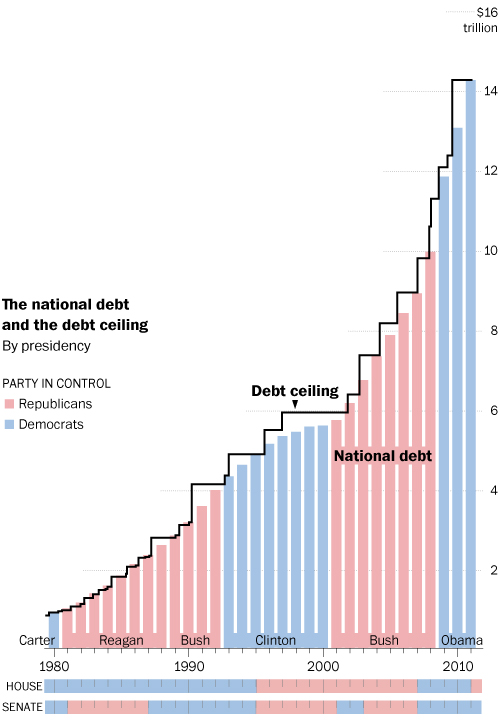
The Washington Post with Bloomberg have a brief article,  Who Raised The Debt Ceiling, with a very interesting graph.

Graph of who raised the debt ceiling in the past

Notice the rise of the debt start to rollover under Clinton. The Republicans may have had control of Congress at the time, but the leadership fought Clinton tooth and nail. They claimed his raising tax revenue would kill the economy and increase the deficit. Clinton got his way anyway with almost all the Democrats and a few Republicans voting for what he wanted. History tells us Clinton was right and the Republicans who fought him were completely wrong.


From the post 1993 Deficit Reduction: a Lesson on Tax Policy by Charles M. Kelly, I selected the following part.

1993 Deficit Reduction: A lesson on taxes, economic growth, and jobs—as reported by America’s premier CONSERVATIVE financial daily news publication:

The Wall Street Journal

     Conservative politicians always threaten the public that, if Congress or the President raises taxes on the wealthy, the economy will slow down, unemployment will go up, and workers’ wages will go down.

     Conservatives’ hidden agenda: we want to allow our wealthy supporters—the ones who benefited most from the economic policies that forced huge sacrifices onto American workers during the 1980s and 90s—to be able to keep more of their money.

     Reality: Raising taxes on the wealthy is much more likely to reduce the deficit and make more money available to proactively solve America’s problems—and save money in the long run. In addition, it may have absolutely no negative effect on economic growth, jobs or wages.

     Here’s what conservative politicians said about the 1993 deficit reduction legislation that raised taxes on the top 1.2% of our wealthiest citizens:

“Clearly, this is a job-killer in the short-run. The impact on job creation is going to be devastating.”

—Rep. Dick Armey, (Republican, Texas)

“The tax increase will…lead to a recession…and will actually increase the deficit.”

—Rep. Newt Gingrich (Republican, Georgia)

“I will make you this bet. I am willing to risk the mortgage on it…the deficit will be up; unemployment will be up; in my judgment, inflation will be up.”

—Sen. Robert Packwood (Republican, Oregon)

“The deficit four years from today will be higher than it is today, not lower.”

—Sen. Phil Gramm (Republican, Texas)

“The President promised a middle-class tax cut, yet he and his party imposed the largest tax increase in American history. We hope his higher taxes will not cut short the economic recovery and declining interest rates he inherited… Instead of stifling growth through higher taxes and increased government regulations, Republicans would take America in a different direction.”

—Sen. Robert Dole (Republican, Kansas)