Periodic Posts

Posts made periodically by a particular author. The periodicity may be totally random.


WAR IN UKRAINE. What – If Anything – Should the US Do?

Briahna Joy Gray has the podcast WAR IN UKRAINE. What – If Anything – Should the US Do? BJG Interviews Bernie’s Foreign Policy Wonk.

This week, Briahna Joy Gray spoke to Bernie Sanders’ foreign policy advisor, Matt Duss, about the escalating conflict in Ukraine.


Toward the end of this interview Matt Duss admits that his family background is from Ukrainian speaking Ukraines. It would have been very helpful if he had said that earlier. He thinks that our focus on Nazi elements in Ukraine is over done. As someone from a Jewish family, I disagree. Perhaps our family backgrounds have something to do with this disparity. In fact the situation of Jews in the Ukraine, never entered the discussion.

Volodymyr Oleksandrovych Zelenskyy “is a Ukrainian politician, actor, and comedian who is the sixth and current president of Ukraine, serving since May 2019”.

Zelenskyy grew up in Kryvyi Rih, a Russian-speaking region in south-east Ukraine.
.
.
.
Volodymyr Oleksandrovych Zelenskyy was born to Jewish parents.

I wonder what Zelenskyy feels about the Nazi elements of Ukrainian politics. I wonder if the Russian “invasion” actually makes him feel more secure about speaking out against the Nazi influence in the Ukraine.

Modern Monetary Theory, Explained!

Jon Stewart had the podcast Modern Monetary Theory, Explained! | The Problem With Jon Stewart Podcast | Apple TV+.


Almost great interviews. There are two huge mistakes in this, however. In the beginning they were all confused by not differentiating private sector debt from public sector debt. Cancelling the debt is meant for cancelling private sector debt. It is not intended to cover cancelling public sector debt. The conversation with the Kansas City Fed President bollixed up that entire conversation.

The second mistake was misunderstanding Keynesian economics by Stephanie Kelton, who should know better. The great contribution that Keynes made in economics is in explaining exactly why monetary policy does not work to get us out of a depression. He explained that government spending for fiscal policy was needed to get out of a depression. This Keynesian explanation is not in conflict with MMT at all.


Donbass and Crimea – an insider view from journalist Eva Bartlett

Rokfin has the podcast Donbass and Crimea – an insider view from journalist Eva Bartlett.

Behind the iron curtain of NATO media lies Today I speak with friend, colleague and outstanding on-the-ground journalist, Eva Bartlett. In 2019 Eva visited Donbass, Ukraine and Crimea. As always Eva brings out the heart of the situation from the people that are being “disappeared” by the criminal legacy media outlets in service to US/UK/NATO predator foreign policy. 1. Under Fire from Ukraine and Misperceived by the West, The People of the DPR Share Their Stories 2. Crimeans Tell the Real Story of the Referendum and Their Lives Since

An important report from the other side of the conflict.

Here is a link to the Blog that Eva Bartlett mentioned In Gaza and beyond.


Russian President Putin Statement on Ukraine

C-Span carried this talk and provided the translation Russian President Putin Statement on Ukraine,

Russian President Vladimir Putin announced after a Security Council meeting that Russia would recognize the independence of the separatist republics of Donetsk and Luhansk in Ukraine’s Donbas region.

Since we, in the USA, are being inundated by anti-Russian propaganda from our “intelligece” agencies and the corporate new media (as if there were any difference between the two), it wouldn’t hurt to consider the possibility that there is a point of view that you are not hearing. C-SPAN certainly can’e be branded as an outlet controlled by the Russian government.


How Can Spending Slay Inflation?

YouTube has the video of a Webinar How Can Spending Slay Inflation?

We’ll look in detail at the debate currently raging between traditional neo-classical economists and the perspectives of Modern Monetary Theory:
How can increased investment help to reduce inflation?
Where should government policy focus and why?
How quickly will the benefits flow through to ordinary people?


They dismissed rather than explain the relation of military spending to inflation. I think this is a serious missed opportunity. Fadhel Kaboub sticks to his explanation of the inflation of the 1970s. The OPEC oil embargo certainly made the inflation much worse. By concentrating on the oil price driven inflation, he misses what started the inflation, which was the guns and butter policy of LBJ during the Vietnam War. The OPEC oil price shocks were a reaction of OPEC to the inflation that was already going on, before they made it much worse. I think this distinction is important because the Vietnam War spending was something we could have controlled. Once OPEC raised the price of oil, we could only react, but not control. The Vietnam War explanation would be a good contrast to the explanation of the control of inflation during WW II


Banishment from the Financial System: the War on Dissent

Glenn Greenwald has the video Banishment from the Financial System: the War on Dissent.


Now I get to see the consequences of what I had approved of before. I thought it was good to put this kind of pressure on the KKK. Now I see what abuse this leads to. I have already realized that the use of the USA dollar to conduct economic war on countries will lead to the abandonment of the dollar as an international reserve currency. Bullies can only push so far before the victims stand up for themselves.

Before I read Michael Hudson’s book Super Imperialism: The Economic Strategy Of American Empire, I didn’t fully realize the damage the USA has done in the world, particularly starting with WW I and its aftermath ever since.

This is a very complicated issue. On the one hand, I think there are some kinds of economic support that should be stopped, like the Saudi Arabian funding of Osama bin Laden. On the other hand, I can see how this tactic can be used to squelch causes that I find are legitimate. I cannot figure out what rules that can be put in place that can be used to prevent harm but won’t also be used also to prevent legitimate dissent.


Fusion Breakthrough Once Thought Impossible Brings Energy Device Closer to Realization

Sci Tech Daily has the article Fusion Breakthrough Once Thought Impossible Brings Energy Device Closer to Realization.

Scientists have achieved a remarkable breakthrough in the conceptual design of twisty stellarators, experimental magnetic facilities that could reproduce on Earth the fusion energy that powers the sun and stars. The breakthrough shows how to more precisely shape the enclosing magnetic fields in stellarators to create an unprecedented ability to hold the fusion fuel together.

I stayed away from this article for a while because I assumed it was just the usual hype of seemingly hopeless pursuit of fusion power. Now that I read it, I see that it is more novel than I had assumed.


Inflation Misinformation

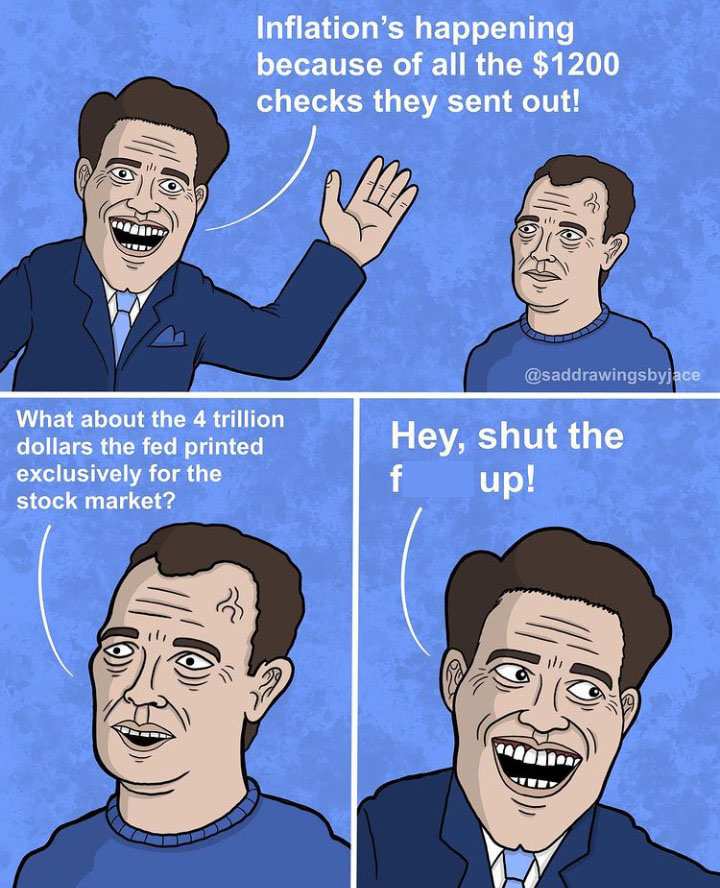
I came across this meme on Facebook. It is a shame that one side’s misinformation gets countered by the other side’s misinformation.


The $4 trillion the fed “printed” went mostly to the top 1%. They don’t use very much of that money to buy consumer goods, hence no CPI inflation. They did inflate where they do spend money, and that is partly the stock market. Most people think of rising stock prices as a good thing, so there were no complaints. When the government started directing more money to the 99%, they wanted to spend this money on consumer goods. With manufacturing and supply chain disruptions because of Covid, the supply of consumer goods was not able to be produced to match the consumer demand, hence inflation.

I am not saying that it was better to send money to the already wealthy. I am saying that a little analysis of the situation would have given planners a hint that they were going to have to have plans for controlling inflation. Perhaps besides controlling monopoly pricing power, they should have been thinking of ways to accelerate consumer goods supplies to meet the increased demand.


Seattle’s Democratic City Council revoking worker hazard pay during the still ongoing pandemic

Status Coup has the video Jordan talks with Seattle Council Member Kshama Sawant about Seattle’s Democratic City Council revoking worker hazard pay during the still ongoing pandemic.

Jordan talks with Seattle Council Member Kshama Sawant about Seattle’s Democratic City Council revoking worker hazard pay during the still ongoing pandemic


Seems like even the unions are not on the side of the workers.