Periodic Posts

Posts made periodically by a particular author. The periodicity may be totally random.


Both Greenspan and David Stockman call for repeal of all Bush II tax cuts

Greenspan Calls for Repeal of All the Bush Tax Cuts, 7 August 2010, New York Times.

At the beginning of the George W. Bush Presidency, then Federal Reserve Chairman Alan Greenspan implicitly endorsed tax cuts.

While Mr. Greenspan did not endorse a specific approach, his broad support for the tax cuts nearly a decade ago was pivotal in securing one of the Bush administration’s top domestic policy goals and in providing political cover for members of Congress.

Now, in response to accusations of political expediency, Mr. Greenspan says his approach has been consistent: supporting tax cuts when surpluses loomed, and endorsing revenue increases now that deficits are the leading worry. He also says his earlier endorsement of tax cuts was made with important caveats that were later ignored by policy makers and the public.

To begin with, he says he believed the tax cuts in 2001 were primarily needed to avoid the economic distortions caused by “surpluses as far as the eye could see,” as many economists at the time projected.

Greenspan seems to have feared that the projected surpluses would lead to the reduction of US Federal debt to zero.

That, in turn, caused the central bank to worry that one of its primary levers for the conduct of monetary policy — the purchase and sale of Treasury securities — would no longer be available.

“I was against deficits, but I was also equally against surpluses,” Mr. Greenspan said.

Now,

Mr. Greenspan is calling for the complete repeal of the 2001 and 2003 tax cuts, brushing aside the arguments of Republicans and even a few Democrats that doing so could threaten the already shaky economic recovery.

“I’m in favor of tax cuts, but not with borrowed money,” Mr. Greenspan, 84, said Friday in a telephone interview. “Our choices right now are not between good and better; they’re between bad and worse. The problem we now face is the most extraordinary financial crisis that I have ever seen or read about.”

This appears to be quite a shift for the Republican libertarian Greenspan.

___________

David Stockman–Bush Tax Cuts Will Make U.S. Bankrupt, 7 August 2010, NPR-All Thinks Considered. Stockman interview with Guy Raz.

The Stockman NPR  interview aired on the same day that the above Greenspan article was published.  Both men are trumpeting the same song.

RAZ: In the early 1980s, Stockman became a kind of Washington wunderkind, the vanguard of a new type of economic thinking, supply side, deregulation, low taxes to stimulate growth.
As the White House budget director, Stockman was an architect of what would come to be known as Reagonomics. But a few years into the job, he became disillusioned.
Mr. STOCKMAN: The military budget got out of control and the tax cuts went to special interests as much as they did to the broad public.
RAZ: And he noticed a problem. The government wasn’t collecting enough money to cover its costs and he started telling that to Reagan.
Mr. STOCKMAN: As time passed, he was less and less enthusiastic about what I had to say.
RAZ: So, in 1985, Stockman left. Now these days, he’s still a conservative and still a Republican, but he doesn’t think his party is taking a responsible position on taxes any longer. At the end of this year, the Bush era tax cuts are set to expire. Republicans want them renewed, Democrats want to keep the tax cuts for the middle class but not for the wealthiest 2 percent of Americans.
Now, Stockman says they’re both wrong and he says extending either of those cuts is tantamount to the government declaring bankruptcy.
Mr. STOCKMAN: We’ve had a rolling referendum on what we want in government and what we don’t ever since the first Reagan spending cut program, which I was part of in 1981. And it seems pretty clear to me that by 2010, we’ve decided a lot of things that caused (sic!) a lot of money, the American people won. I might not agree with that, but apparently they do.
So we’re spending $3.8 trillion in defense, non-defense, entitlements, everything else, and we’re taking in only 2.2 trillion. So we got a massive gap, you have to pay your bills. You can’t keep borrowing from the rest of the world at that magnitude year after year after year. So, in light of all of those facts, I say we can’t afford the Bush tax cuts.

Raz and Stockman make implicit reference to the so-called Laffer Curve.

RAZ: You seem to suggest that many of our economic troubles are the result of Republican economic policies over the past few decades. You are a Republican. You are a conservative. Why do you think Republicans are largely to blame?
Mr. STOCKMAN: Because the Republicans abandoned their old-time fiscal religion in favor of two theories, which I think are now proving to be both wrong and highly counterproductive and damaging.
One was monetarism, which said let the dollar float on the international markets. Let 12 men and women at the Fed decide whether to raise or lower interest rates and use the Fed to try to run this massive economy. What they’ve done instead is run the printing press, they’ve flooded the world with dollars. The whole monetarist policy has been a mistake.
The second thing was the perversion of supply side. Yes, there was a good idea that in certain circumstances, lower tax rates will encourage economic activity and savings. But when you make it a religion, when you make it a catechism and you say you cut taxes no matter what the circumstance, what the season, what the condition, then I think the whole idea has been perverted.
By getting off track over the last 30 years, the Republican Party has basically given out (sic!) its historic view that the key thing was financial discipline, financial responsibility and that we had to live within our means. Today, we have two free lunch parties, and as a result, we’re borrowing ourselves into grave danger with each passing month and year.
RAZ: Now, Republicans, David Stockman, in the Senate led by, obviously, the Minority Leader Mitch McConnell, they say they’re simply following, you know, the Reagan philosophy of supply-side economics, a policy that you pushed. Do you think they’re being disingenuous?
Mr. STOCKMAN: Utterly disingenuous. I find it unconscionable that the Republican leadership faced with a 1.5 trillion deficit could possibly believe that good public policy is to maintain tax cuts for the top 2 percent of the population who, after all, have benefited enormously from this phony boom we’ve had over the last 10 years as a result of the casino on Wall Street.

[Bold typeface added by me.]

-RichardH


Krugman–Bending The [Medicare] Curve [and the Health Care Reform Bill]

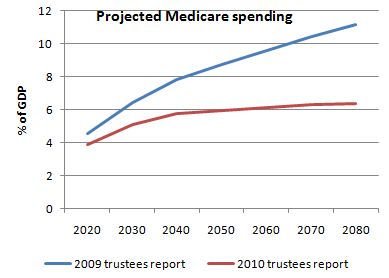
In his 5 August 2010 blog post, Paul Krugman writes Bending the Curve about the most recent Medicare Trustees Report projection that the recently-past Health Care Reform Bill will substantially lower the increase in Medicare spending as a percent of GDP over the next few decades.

DESCRIPTION
Krugman says, “In other words, the Medicare actuaries believe that the cost-saving provisions in the Obama health reform will make a huge difference to the long-run budget outlook. Yes, it’s just a projection, and debatable like all projections. And it’s still not enough. But anyone who both claims to be worried about the long-run deficit and was opposed to health reform has some explaining to do. All the facts we have suggest that health reform was the biggest move toward fiscal responsibility in a long, long time.”

-RichardH


Krugman–The Flimflam Man [Republican Representative Paul Ryan of Wisconsin]

In the 6 August 2010 NY Times, Paul Krugman writes The Flimflam Man.

[T]he innovative thinker [charlatan] du jour [is] Representative Paul Ryan of Wisconsin.

Mr. Ryan has become the Republican Party’s poster child for new ideas thanks to his “Roadmap for America’s Future,” a plan for a major overhaul of federal spending and taxes. News media coverage has been overwhelmingly favorable; on Monday, The Washington Post put a glowing profile of Mr. Ryan on its front page, portraying him as the G.O.P.’s fiscal conscience. He’s often described with phrases like “intellectually audacious.”

But it’s the audacity of dopes. …

Mr. Ryan’s plan calls for steep cuts in both spending and taxes. He’d have you believe that the combined effect would be much lower budget deficits, and, according to that Washington Post report, he speaks about deficits “in apocalyptic terms.” And The Post also tells us that his plan would, indeed, sharply reduce the flow of red ink: “The Congressional Budget Office has estimated that Rep. Paul Ryan’s plan would cut the budget deficit in half by 2020.”

But the budget office has done no such thing. At Mr. Ryan’s request, it produced an estimate of the budget effects of his proposed spending cuts — period. It didn’t address the revenue losses from his tax cuts.
The nonpartisan Tax Policy Center has, however, stepped into the breach. Its numbers indicate that the Ryan plan would reduce revenue by almost $4 trillion over the next decade. If you add these revenue losses to the numbers The Post cites, you get a much larger deficit in 2020, roughly $1.3 trillion.

… All it would do is cut benefits for the middle class while slashing taxes on the rich.

And I do mean slash. The Tax Policy Center finds that the Ryan plan would cut taxes on the richest 1 percent of the population in half, giving them 117 percent of the plan’s total tax cuts. That’s not a misprint. Even as it slashed taxes at the top, the plan would raise taxes for 95 percent of the population.

There is more in the article; read it all.

-RichardH


GOP Wrecks Economy To Win Votes

The article by Stephen Crockett is actually headlined GOP Eyes Big Gains Over the Economy.

The article is another restatement of the economics that makes the Republican plan so bad for the country.  The more different ways this can be explained, the more the chance that enough people will finally get it.  If enough people finally understand what the Republicans are doing, then the predicted Democratic losses in November will not happen.

Some of the paragraphs of wisdom include:

Jobs are not created by just having large pools of investment money available. There must be the opportunity to invest in a business that will have customers who can buy the goods and services before the investment money flows into job creation activities.

And this:

Tax cuts for the wealthy create huge investment money pools but not jobs. The United States has plenty of money sitting idle in corporate and personal coffers. Corporations have almost a trillion dollars sitting essentially idle in corporate accounts at this time.

And this:

The former middle class disposable income now controlled by the economic elite funds speculation and unsound “bubbles” in the economy instead of a healthy economy because sound businesses now lack paying customers.
Deregulation helps corporations charge excessive prices. Not enforcing anti-monopoly laws permits price gouging. Not capping interest rates concentrates wealth and reduces consumer spending.

And more.  Read the whole article.


Error Message—Google Research Director Peter Norvig on Being Wrong

In her 3 August 2010 post on Slate, Kathryn Schulz interviews Google Research Director Peter Norvig. Error Message.

There’s a story going back to the founding of Google: One of the venture capitalists came to [company founders] Larry [Page] and Sergey [Brin] and said “OK, the first thing you have to decide is, is this company going to be run by sales or by marketing? They said, “We think we’ll take engineering.” He laughed and said, “Oh, you naive college kids, that’s not the way the real world works.” And they said, “Well, we want to try it.” Ten years later, that experiment is still running; engineering is still the center of the company. And it seems like it’s worked.

And, like you say, it does create a very different attitude toward error. If you’re a politician, admitting you’re wrong is a weakness, but if you’re an engineer, you essentially want to be wrong half the time. If you do experiments and you’re always right, then you aren’t getting enough information out of those experiments. You want your experiment to be like the flip of a coin: You have no idea if it is going to come up heads or tails. You want to not know what the results are going to be.

Read on.

-RichardH


James K. Galbraith Champions the Beast Manifesto 1

On his 2 August 2010 blog in The Daily Beast, James K. Galbraith Champions the Beast Manifesto. Not only does he reiterate the frequently-made arguments for why “Jobs are Priority One,” but he also makes a strong case for expanding entitlement programs, now and in the future so that older Americans will not be forced to stay in jobs longer than they wish thereby making room for the younger unemployed to enter the work world. This will also ease the worries and financial burdens of children regarding the care of their elderly parents.

So what are the real effects of cutting Social Security and Medicare?

Medicare pays doctors’ bills for the old. It pays out at lower rates than does private insurance for working people. Cutting Medicare would mean two things: less health care for the elderly, and therefore more financial stress on their families. And more health care costs overall, as people substitute with private insurance for the public cuts. Both of these are very bad ideas.

Social Security pays to keep working people (and their dependents and survivors) out of poverty when they are old. It spreads its benefits to all who have worked, whether they have children who would otherwise support them or not. The payroll tax spreads the burden to all working people, whether they would otherwise be supporting elderly parents or not. Both of these transfers are fair, modest, and sustainable. Cutting Social Security would simply create more poor elderly—those who could not turn to their children—and more stressed working families—those with parents in need. Both of these are very also bad ideas.

In fact, the right response to the crisis is to expand, not cut, both Social Security and Medicare.

The reality is, we are never going to make up good new jobs for everyone who has been hit. (I’d love to be the next Harry-Hopkins-and-Harold-Ickes-combined, but I’m not going to get the job.) So let’s face reality, and make some tough decisions about who we want to be jobless: the relatively old or the very young. Seen this way, it’s an easy choice.

There are many older workers who’ve already worked hard jobs for many years. They would love to retire. But they don’t, because early retirement on Social Security is very costly: you lose benefits every month over your entire future life, unless you hang on to the regular retirement age. We should give these people a break, and lower, not raise, the full-benefit Social Security retirement age—say, to 62 for the next three years. This would give millions a chance to get out, if they want to.

Similarly for Medicare. There are many older workers who have health needs, and who work on only because they can’t afford to lose their employer-based insurance. Let them out! In the crisis, I proposed cutting the Medicare-eligibility age to 55 (and the Senate almost included this in the health care reform bill). It’s still a good idea, but something more moderate, such as opening a three-year window for early exits, would be better than nothing.

Encouraging early retirements would mean that young people—just out of school, with fresh skills, good health, and high energy—would get the jobs they need now. They would not be stuck waiting, or spinning their wheels in school, for years and years. Meanwhile, the retirees, supported by Social Security and Medicare, would provide a continuing stable support to total demand, creating jobs for others as they get older.

This is the way the economy should work. When we have older people, we must care for them, and the best way to do that is to give them the resources to support themselves. There is no “burden problem” as our economy is plenty productive for the working population to support the elderly in modest comfort, particularly if we include some of our truly wealthy in the tax base.

[Here is The Beast Manifesto but I think Galbraith’s blog post is more interesting.]

-RichardH


The Empty Chamber–Just how broken is the Senate? 1

In the 9 August 2010 issue of The New Yorker Magazine, George Packer writes a very long, comprehensive, illuminating, and depressing portrait of the current state of the U.S. Senate. The Empty Chamber.

I hope you will take the time to read the whole article.

Please note that some articles in the New Yorker disappear behind a subscriber firewall after as little as one week.  If you intend to read the article but don’t have time right now, I suggest you download it for future, more leisurely perusal.

-RichardH


Corporate Greed or Plain Capitalism 2

Bob Herbert’s column in The New York Tines is under the headline A Sin and a Shame.

The treatment of workers by American corporations has been worse — far more treacherous — than most of the population realizes. There was no need for so many men and women to be forced out of their jobs in the downturn known as the great recession.

Many of those workers were cashiered for no reason other than outright greed by corporate managers. And that cruel, irresponsible, shortsighted policy has resulted in widespread human suffering and is doing great harm to the economy.

He further goes on to say:

Productivity tells the story. Increases in the productivity of American workers are supposed to go hand in hand with improvements in their standard of living. That’s how capitalism is supposed to work. That’s how the economic pie expands, and we’re all supposed to have a fair share of that expansion.

What a way to misunderstand the world of capitalism.  Where is it written that the invisible hand will make capitalist private companies hire workers that they don’t need?

In no description of capitalism have I seen a rule that says it is good for companies to run inefficiently by employing people that they don’t need.  The whole point of competition is that it drives companies to become more efficient.

There used to be other factors that made it sensible for companies to pay decent wages to the workers that they needed. See the blog post Are the American people obsolete? Of course we used to have strong labor unions too.  Companies that were not unionized felt compelled to treat their workers well, lest they decide to form a union.  Now that the pressure of unions has diminished greatly, we see what unfettered capitalism can do.

If you cannot understand how a system works in a way that is consistent with its own internal driving forces, then you won’t ever be able to figure out what external forces to apply to fix it.  By trial and error you may be able to find something that seems to have a short term benefit, but why depend on luck?  Why not study capitalism and economics without a preconceived notion of “how it ought to work?”