SteveG’s Posts


Our Money System Does Not Create Dollars For Not-for-profit Ventures

New Economic Perspectives has the article Two Loaves.

Recently, I’ve been trying to zero in on a peculiar set of ingredients that seem to be baked into our economic pie―and which are depriving that pie of a sustenance we, as a collective society, need it to provide. The peculiar ingredients have to do with our monetary system. Specifically, the fact that we―whether intentionally or by happenstance―have put in place and operate a money system that seamlessly creates dollars, as necessary, for profit-making enterprise, but specifically does NOT create dollars for not-for-profit ventures.

The explanation of how this system operates may seem deceptively simple. However, it may require some deep thinking to accept its conclusion. I think I have a clue as to why this description is correct and how we got to the situation we are in.

When our monetary system was on the gold standard, we pretended that our money was redeemable in gold, and internationally it was. Banks could not make loans unless savers deposited money in a bank for the bank to lend. Fractional reserve banking allowed banks to lend more money than they actually had on hand. Banks held a fraction of the deposits as reserves to pay out any money that savers wanted to withdraw. This system worked well as long as the savers didn’t suddenly want back too much of the money they had deposited in the banks. The Federal Reserve Bank was created to smooth out situations where there were local demands from savers for more money than a local bank had on reserve.

The rules for how our government collected taxes and paid for services were written with an understanding of how money and banking worked. When President Nixon took the country off the gold standard, the way money was created changed drastically. The Federal Reserve System could now create money just by crediting Federal Reserve accounts with new money. However, our rules for government operation were never changed to take into account the changed system.

What we need to do now, is to figure out how to change the rules of government taxing and spending to take into account how the system operates now. As long as we have the rules based on the old system, we fool ourselves into thinking that there is a limited supply of money for the government to use to make the economy work for all of us. This makes us think that our money system cannot create dollars for not-for-profit ventures. As long as we think that is true, we won’t think about how to create those dollars for not-for-profit ventures.

Of all the Presidential tickets we now have to choose from, only the Stein/Baraka ticket understands the need for change before we can have a functioning economy that works well for all of us.

The Rivals: Paul Samuelson and Milton Friedman … 1

The web site Economic Principals: A WEEKLY COLUMN ABOUT ECONOMICS AND POLITICS,
FORMERLY OF THE BOSTON GLOBE, INDEPENDENT SINCE 2002
has the July 12, 2015 article The Rivals: Paul Samuelson and Milton Friedman … by David Warsh.

It is a fascinating tail about these two famous economists. I am not quite sure if I can call the following excerpt as conclusive, but it does give lots of credit to the ideas of Paul Samuelson, whom I favor, as opposed to the ideas of Milton Friedman whom I despise.

From a distance of thirty years, Robert Lucas, who had been a young econometrician at the time and who would later win a Nobel Prize, looked back at what had been the conventional wisdom then:

For the applied economist, the confident and apparently successful application of Keynesian principles to economic policy which occurred to the United States in the 1960s was an event of incomparable significance and satisfaction. These principles led to a set of simple quantitative relationships between fiscal policy and economic activity generally, the basic logic of which could be (and was) explained to the general public and which could be applied to yield improvements in economic performance benefiting everyone. It seemed an economics as free of ideological difficulties as say, applied chemistry or physics, promising a straightforward expansion of economic possibilities. One might argue as to how this windfall should be distributed, but it seemed a simple lapse of logic to oppose the windfall itself. Understandably and correctly, non-economists met this promise with skepticism at first; the smoothly growing prosperity of the Kennedy-Johnson years did much to diminish these doubts.

Nothing like a good dose of confirmation bias to help you decide what to believe. Of course I have my own explanation of how Lyndon Johnson and his conduct of the Viet Nam War ruined it all.


Elections security: Federal help or power grab?

Politico has the article Elections security: Federal help or power grab?

The federal government wants to help states keep hackers from manipulating the November election, amid growing fears that the U.S. political system is vulnerable.

This article and the national discussion so badly misses the whole point about election security. It is not the possible tampering by Russia that we should fear, It is the actual tampering by the oligarchs and their hired politicians that we should fear. There is a simple solution that I have proposed that would solve the problem without very much federal government intervention, except to enact some minimal anti-tampering requirements for the software/hardware that will pass muster for an election to be safe.

See my previous post Standardize Electronic Voting Technology. Notice the federal agency that I think is best to take on this issue.


WATCH: Jill Stein comes on Salon Talks: “Stand up and fight for the greater good”

Salon has the article and video WATCH: Jill Stein comes on Salon Talks: “Stand up and fight for the greater good”

In one of Salon’s most popular Facebook Live interviews to date, Stein urged millennials to take a stand

Another great interview. It dispels even more of the myths that the corporate media is trying to create against Jill Stein. If you watch enough of these, you will finally start to get the truth about Jill Stein.

I think she still missed an opportunity to answer the great unanswered question. How will her program create jobs that the Obama administration failed to create? Obama subsidized companies to increase what they supplied to an economy that was not buying all that companies were already able to produce. What Jill Stein will do is to have government do the buying of product, so that the companies will need to increase the supply. The greatest incentive a company can receive to produce more goods and hire more workers is to create customers for their products. People with no money cannot be customers. The government that creates money can be as big a customer as it needs to be.


Finance is ruining america

The Atlantic has the story Finance is ruining america.

Raising tax rates on the rich might not seem particularly feasible right now. But it has happened before: In 1916, top tax rates jumped to 15 percent from 7 percent; the next year, they jumped to 67 percent. Those tax rates changed in part because of war, but remained high throughout the 20th century as Americans decided that excessive wealth wasn’t good for society.

Some politicians, including Bernie Sanders and Hillary Clinton have proposed increasing taxes for the very wealthy, signaling a return to a time when extreme wealth was not accepted in American society. Such policy isn’t just a way of getting more revenue to the government; it could help alleviate poverty in America, too.

If you would rather hear someone talk about this story, you can watch the first half of Episode 975 of The Kaiser Report.

In this episode of the Keiser Report, Max and Stacy discuss how finance is ruining America. In the second half, Max interviews Ronald Reagan’s budget director, David Stockman, author of ‘Trumped: A Nation on the Brink of Ruin’… And How to Bring It Back.

I don’t know about the second half of the above video. I have little faith that David Stockman understands how the economy works in these matters. So I doubt that he has a viable solution. If I have the time, I may watch the second half to see that I am right. Of course, I will approach it with an open mind 🙂

OK, I goaded myself into listening to Stockman, and it isn’t at all what I expected. His talk of the warfare state is quite on point. He does go astray in choosing Trump over Clinton, because Trump might even be independent enough to quell the warfare state. Of course, he ignores Stein/Baraka who have come out strongly and categorically against the warfare state.


Democracy. Capitalism. Socialism. Choose Any Three of the Above

Naked Capitalism has published the post Democracy. Capitalism. Socialism. Choose Any Three of the Above by Steve Roth. Roth concludes with the following thought about people who want to eradicate one or more of the three choices:

But regardless of their relative political power, all of these ill-considered, utopian, faith-based, tribalistic anti-isms are a bane on the body politic. At this point in our evolution, capitalism, socialism, and democracy are necessary for any country’s prosperity, economic freedom, and economic well-being. And they all need improvement — just as we’ve been fitfully improving things for hundreds, even thousands of years.

When I voted for Barack Obama, I thought I was voting for a balanced politician. I liked his supposedly leftist positions, but I also thought that he understood the benefits of capitalism well enough to not want to abolish it. Little did I know that he appreciated capitalism so much that he could not see its flaws that needed correction.

I also like Roth’s explanation of what a politico/economic system is for.

Assume for the moment: the dream-goal of a polity, or at least of an economy, is to deliver widespread or even universal thriving and prosperity, economic security, and economic well-being.


How Capitalism Perpetuates Immigration

Truth Out has the op-ed How Capitalism Perpetuates Immigration by Richard D. Wolff. I’ll quote but one example from the article.

Modern times offer more examples. The US repeatedly undermined basic living conditions in its de facto colony, Puerto Rico, driving millions to move to the US mainland. There, they repeatedly encountered all manner of discriminations, abuse and scapegoating.

Teaching people about these sorts of things in the off years between elections is what will have people prepared to know which politicians are proposing real solutions, and which ones are trying to distract us from the real solutions.


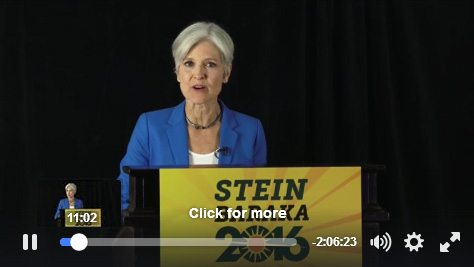
Jill Stein responds to the first Presidential debate in real time

For those of you 88 million people who wasted their time and gave a ratings to boost to the “official” debate, here is what over 1.2 million of us have done instead. We watched a debate with three of the four viable Presidential candidates – Jill Stein, Hillary Clinton, and Donald Trump. Over 32 thousand of us have shared it on our Facebook pages.

Click on https://www.facebook.com/drjillstein/videos/1302970866409767/ to see for yourself. This should answer almost all the questions you might have about Jill Stein.

The video may take a bit of time to load, so please have patience.

Jill Stein At The Debate

For those regular readers of my blog, you will probably realize that I was ecstatic when she mentioned William K. Black, the author of The Best Way To Rob A Bank Is To Own One. That link isn’t the best one on this web site – here is a list of all the references to William Black on this blog.

When she was asked about Stephanie Kelton, I almost feinted. See my posts The Economy: Does More Government Help or Hurt – Stephanie Kelton and Watch Out, MMT’s About, As Bernie Sanders Hires Stephanie Kelton to find out who Stephanie Kelton is.