SteveG’s Posts


Veterans, CBS News wants to hear from you

On the CBS Facebook page, there is the following post:

Veterans, CBS News wants to hear from you — do you think the resignation of VA secretary Shinseki is fair or politically motivated?

My initial response was

What does CBS think about its reporting on this issue? Has it reported enough depth of facts so that we can answer the question posed? Was Shinseki working on fixing the problem before it blew up? Was anybody fighting for more resources for the VA? (What did Bernie Sanders do? What was the House’s response to Bernie Sanders? Is it true that we cannot afford more resources for the VA? When a country is sovereign in its own currency, has huge unemployment, has idle factories, has corporations not investing their cash, and has plenty of natural resources, is it true that the deficit is a constraint on what we can afford?)

What was in CBS’s coverage of the Memorial Day celebrations to give us a hint as to whether people were just speaking platitudes or they were actually backing up their words of thanks with actions of thanks?

Will the news media ever take responsibility for their role in what the public does and doesn’t know?

To another comment,

The top man at any large institution such as the VA will not be aware of day-to-day operations at specific locations. He’s the sacrificial lamb.

I replied as follows:

If Shinseki had come out and said, “Well this behavior was a complete surprise to me.”, that might have been honest, but it would not have been an indication that he was a good manager.

When people’s jobs are on the line to meet a goal that cannot be met with the resources at their disposal, how do you expect them to react?  Can you expect a certain amount of cheating the measurement system?

There is a management style called “managing by walking around.”  This means that no matter what formal methods you have of keeping track of the organization, a manager learns a lot by walking around, observing the organization at work, and speaking directly to random employees that you meet while walking around.

At the last company I worked for of thousands of employees, the top guys had a habit of eating in the cafeteria and setting their tray down in a random empty spot at a table of random employees and talking to the people around them.  It made us feel better about the company to know that they did that.

You can put your two cents worth in, too.


VA Secretary Eric Shinseki resigns

CBS News has the story VA Secretary Eric Shinseki resigns.

Facing a growing outcry over the scandal at Veterans Affairs medical facilities, VA Secretary Eric Shinseki offered his resignation to President Obama on Friday, and the president accepted the offer.

“A few minutes ago, Secretary Shinseki offered me his own resignation,” the president said in a statement in the White House briefing room. “With considerable regret, I accepted.”

If Obama had wanted to avoid this resignation, he would have made the case that Shinseki was key to the solution and was not the problem. If facts stood in the way of making this case, then resignation was inevitable. It shouldn’t have taken this long to figure out what was what.

If the facts were on Shinseki’s side, then Obama really botched this situation.  I have no idea what the facts are regarding whether or not Shinseki was actively working to solve this problem before it blew up in his face.  If he had not been working on fixing the problem, then by my definition he was part of the problem whether or not the problem began before he took office.

This is a replay of what Governor Deval Patrick went through with the problems in the Massachusetts state DCF (Department of Children and Families) and its leader.  If the leader was not part of the problem, in other words she was aggressively trying to fix the problem, then Deval Patrick should have made the case as his very first statement addressing the issue.  Since he did not, one is left to assume that the head of DCF  was not actively working on the problem when it blew up in their faces.  If that assumption is incorrect, then Deval Patrick had the responsibility to tell us why.  If the assumption is correct, then there is a deficiency in Deval Patrick’s management style.

I have a suspicion that the problems in both institutions have to do with chronic underfunding by the legislature.  Who is holding the legislature’s accountable, as they point fingers at everyone else?  What has the press got to say about their responsibility to dig deeper into the causes?  What do the voters have to say about their responsibility to choose the elected representatives better?

How does an effective leader of an agency that is woefully underfunded handle that problem?  Of course, the head tries to do the best possible job with the resources available.  There is more that such a leader must do.  Should the leader constantly harp on the fact that the agency is underfunded for the responsibilities thrust upon it?  How should that leader carry out that part of the responsibility?  Should the leader refuse to accept responsibilities that the agency does not have the resources to handle? Should the leader make clear how the agencies priorities are arranged to do the most good with the resources at hand?  Should the leader make clear the risks involved with the priorities that are set as best as is possible?  Or should the leader cover up the fact that there are problems so that the higher ups can feel good thinking that there are no problems?

How did the leaders of these two agencies perform with regard to what a good leader should do?


Blood Sugar and Alzheimer’s Disease

I was checking out the implications of high blood sugar levels and came across the article Diabetes and cognitive decline. Below is an example of one of the things mentioned in the article.

A study related to cognitive function in women was published in the February 2007 edition of the Journal of the American Geriatrics Society. The researchers examined older women (average age, 72 years) with different levels of cognitive function and found that the strongest factor associated with good cognitive function was lack of diabetes. Women without diabetes were almost twice as likely to have good cognitive function than women with diabetes. Lack of high blood pressure and lack of smoking were also associated with better cognitive function.


Also on the Alzheimer’s Association web page in the article Blood Sugar, I found the following table:

Current guidelines on blood sugar

  • Based on a “fasting” blood test taken at least 8 hours after eating
  • Regular testing should begin at age 45 or earlier in individuals with risk factors in addition to age
Fasting blood sugar

Status

Health impact

Less than 100 milligrams per deciliter (mg/dL)

Normal

Healthy level

Between 100 and 125 mg/dL

Prediabetes or borderline diabetes

Increased risk of cardiovascular disease and future diabetes

126 mg/dL or higher, measured on two different days

Diabetes

Risk of damage to the eyes, kidneys, blood vessels, heart and nerves as well as cognitive decline and dementia

If your blood sugar is higher than normal, you should talk to your doctor about the best treatment strategy.


As if I needed one more thing to worry about in my diet – no salt, no fat, no sugar, no simple carbohydrates. I wonder what impact starvation has on the brain.

One should also remember the statistical dictum that “correlation is not the same thing as causation.” Meaning that high blood sugar and mental decline may be correlated but that does not mean that high blood sugar causes mental decline. There is always the possibility that aggressive measures to lower blood sugar may be counterproductive in decreasing mental decline. It is possible that high blood sugar levels are the body’s way of fighting off mental decline. Working to decrease blood sugar level could be fighting the body’s natural defense mechanism. I am not suggesting that the possibility that I am mentioning here is at all likely to be true, but it a cautionary tale on mixing up correlation and causation.


The Perfect Crime: What’s Killing All the Bees?

I found this introduction on Facebook.

GARDENERS BEWARE: Many of the plants you buy at Home Depot and Lowe’s may be treated with bee-killing neonictinoids. Because there’s no clear labeling, many good-intentioned gardeners end up poisoning the very bees they are trying to help! (*Home Depot has indicated it is working on safer alternatives, but Lowe’s has not yet responded).

That’s just one of the many things you’ll learn from our fascinating photo essay featuring beekeepers and experts! Check it out The more you learn, the more you can help protect our bees!

Help SPREAD this post as part of Bee Week! TELL US >> What alternatives to pesticides do you use in your garden?

The link above takes you to the article The Perfect Crime: What’s Killing All the Bees?

Article on what's killing the bees

We are going to check with some of the local growers to see if their plants are free of these pesticides.


You’re invited: Elizabeth Warren and Thomas Piketty interview

flyer for Warren/Piketty Conversation

Below is an email that Moveon.org generated for me to announce the above event that I will be watching on Monday night

Hi,

Senator Elizabeth Warren and Professor Thomas Piketty, author of the #1 New York Times bestselling book Capital in the Twenty-First Century, are two of the leading voices on economic inequality–and they’re teaming up for a one-of-a-kind conversation that we’re invited to!

This Monday, June 2, at 8:30 p.m. ET (7:30 CT/6:30 MT/5:30 PT), MoveOn is teaming up with Sen. Warren and Prof. Piketty to broadcast their dialogue for the first time. And when they talk, they’ll be answering questions submitted by MoveOn members. Right after the screening, Sen. Warren will join a special call with participants.

I’m going to watch the conversation with Sen. Warren and Prof. Piketty on Monday night–will you join me? Click here to RSVP and submit your questions.

Thanks!


Here are the questions I wrote in my response to the invitation.

Modern Monetary Theory explains that the government’s collection of taxes doesn’t have to have anything to do with funding the government’s expenditures. Expenditures could be financed by the creation of our sovereign currency by keystrokes by the Fed if it weren’t for certain procedural impediments placed on the Treasury by Congress.

Can you please address the policy objectives of taxing the rich without making the mistake that it is necessary to do so to fund government expenditures? Can you also explain that it would be better to prevent the rich from taking so much in the first place by reregulating certain of their practices and jailing the ones that violate the law than it would be to tax them after they have already taken so much?


Koch Brothers Exposed: 2014 Edition

Brave New Films has the article Koch Brothers Exposed: 2014 Edition.

I hope you’re ready for a wild ride. Billionaires David and Charles Koch have been handed the ability to buy our democracy in the form of giant checks to the House, Senate, and soon, possibly even the Presidency. The last time we exposed the Koch Brothers’ dealings to the world we here at Brave New Films wound up in their crosshairs. They produced online ad campaigns attacking us, but, it takes more than a banner ad to slow us down.

We’ve reissued Koch Brothers Exposed in an updated version, Koch Brothers Exposed: 2014 Edition, to shine a light on them. We’ve delved even deeper into where their money is going, who their money is hurting, and how much they are making during this whole process leading up to the 2014 Elections.

For my fellow MIT graduates who were willing to accept the new David Koch research center at MIT, I ask you to watch the entire film. I hope you will have a change of heart.

Here is a trailer for the film.


You can watch the film for free as I did, but after seeing it, I decided to contribute some actual money.


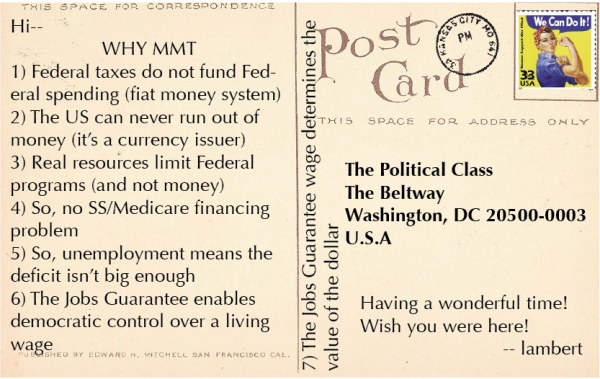
MMT on a Postcard

Naked Capitalism has the article MMT on a Postcard by Lambert Strether.

I’ll show the postcard below, but that is only a brief summary of MMT. The article that I linked to above gives an excellent, concise explanation of what is on the postcard, and a lot more.

MMT on a Postcard

There may be no better brief introduction to MMT than this article.


Climate Change Debate – Last Week Tonight with John Oliver (HBO)

If we have to have a televised debate on this, and we shouldn’t, this is how John Oliver would do it.

John Oliver hosts a mathematically representative climate change debate, with the help of special guest Bill Nye the Science Guy, of course.


The Daily Kos had the article John Oliver’s 97% to 3% climate change debate goes viral getting 2.5 million hits & Guardian review. When I posted the above video the numbers were over 3 million.


Why Have Private Equity Limited Partners Done a Lousy Job of Protecting Their Interests?

Naked Capitalism has the article Why Have Private Equity Limited Partners Done a Lousy Job of Protecting Their Interests? by Yves Smith.  The issues raised in this article are going to be a continuing focus of the Naked Capitalism blog.

If you are an investor, this information is going to be vital to the health of your investment portfolio.

But investors are going to find themselves caught between professing they didn’t know how bad things were, which is tantamount to admitting that their due diligence and oversight was lax or trying to cop that the revelations are no surprise. But the “nothing to see here” position reflects even worse on the investors, since it meant they were at least dimly aware that some practices didn’t pass the smell test, but they chose not to act on their suspicions, out of reluctance to ruffle their precious relationship with the general partners, when many of those general partners, despite their well-cultivate charm, are out only for maximizing their own return.

This trend in pension fund investing is the fly in the ointment to my previous post Saving Social Security: A Better Approach.  The idea of running Social Security like a well run private or state level pension fund presupposes that these other pension funds are still well run.  We need to modify our definition of what a well run pension fund means.  It means running with the old-fashioned responsibility that well run pension funds used to embody.  It means avoiding the irresponsible behavior described in Why Have Private Equity Limited Partners Done a Lousy Job of Protecting Their Interests?


The Financialization of Big Business – Costas Lapavitsas on Reality Asserts Itself (4/8)

The Real News Network has published the fourth part of this 8 part series, The Financialization of Big Business – Costas Lapavitsas on Reality Asserts Itself (4/8).

JAY: Okay. Now, let’s just make this really clear, what you’re saying, ’cause I think it’s very important. Part of the growth of this mitigation of risk is ’cause the system itself is so fragile, so volatile, that you have to do these risk-mitigation plays ’cause nobody actually believes that the economy can do–banks don’t even believe each other’s books anymore.

LAPAVITSAS: That’s correct. And why didn’t you have derivatives in the ’50s and the ’60s on the same scale? Because during that time of controlling finance and different type of capitalism, as we discussed it, exchange rates were fixed, or certainly they were more stable, and interest rates were under control. And therefore the scope of derivatives was much, much less. When you decontrol the system and you go into financialization, you create automatically the need and the scope for that.


If people are not aware of how the system has changed as described in these interviews, then people might be looking at the system as a continuum from years past. If people make analyses based on what the system used to be, they are likely to make huge mistakes. One example mentioned in the interview is the fairy tale about how the farmers use derivatives to manage their risk. That may have been the prime use of derivatives years ago, but it is only 10% of the derivatives market now.

We have to stop thinking of the main purpose of the derivatives market being what is only 10% of the activity now. We have to start thinking about how the current use of derivatives impacts the costs of commodities to the actual consumers of these commodities.

The previous three parts of this interview were covered in my previous post The Rise of the Big Banks – Costas Lapavitsas on Reality Asserts Itself (3/8).


I have begun to read Profiting Without Producing: How Finance Exploits Us All by Costas Lapavitsas. I think this is going to be a very worthwhile book to read. As someone interested in politics, society, and even investing, there is a lot of eye opening information here.

If you are the type of person to be driven around the bend by the mention of Marx, then don’t bother. You will miss a lot, but you wouldn’t believe it anyway.


May 28, 2014

I am having second thoughts about my recommendation of the book Profiting Without Producing: How Finance Exploits Us All by Costas Lapavitsas.

Too much of the book is devoted to comparing and contrasting the ideas of all the people who have written about the topic. The author wants you to understand the subtleties of the difference in interpretation of the different previous authors. He wants you to understand that though the discussion in the book may seem to have similarities to what these other authors wrote or meant, there are subtle, but important, differences in how this author interprets them.

What I really would like is a concentrated explanation of what his point is and the conclusions he has reached. Once I digest that, I may or may not be interested in the compare and contrast. It is too hard to wade through the compare and contrast if you don’t have a firm understanding of the topic in the first place.

What I am doing now is to skip over the substantial compare and contrast sections, hoping to pick out the expository parts about the theory so that I can understand the point of the book. It is hard to know what to skip so that I don’t miss too much.