SteveG’s Posts


Jon Stewart Explains Indefinite Detention

The lame stream media won’t do it, so we have to depend on Jon Stewart of The Daily Show (Comedy Central), The Real News, and Aljazeera (US anti-terrorism bill: Liberty vs security).

If the following video does not play for you, try the link to Arrested Development.


If the second part of the video below does not play for you, try the link to Arrested Development – One-Way Train to Gitmo.


Sometimes, only the court jester can finally get through to people.


US anti-terrorism bill: Liberty vs security

The Real News posting Inside Story Americas – US anti-terrorism bill: Liberty vs security provided access to the video below. (Do not forget The Real News fund drive.)


Note the typical argument in favor of giving up our civil liberties. The defender of these extraordinary powers goes on and on in a breathless tirade about the severe dangers we face from the present set of terrorists. People who argue in this way don’t want any body else to get a word in edgewise, because someone might ask, “These terrorists may be as big a threat as you suggest, but is it possible that there is even a bigger threat than what these terrorists pose? What about the threat of giving up our civil rights to the great powers within our own country who might choose to end our democracy in favor of a dictatorship?”

You even hear the answer to this implied question in this video. The people who dismiss the need for our constitutional protections cannot see any immediate danger if we eliminate the constitutional protections. Of course, to even say they do not see the threat in the present circumstances is an implicit admission that such a threat is conceivable in distant future under different circumstances. In those circumstances it would be too late to claw back the protections we are giving up today.

Our citizens who demanded the addition of the Bill Of Rights to the Constitution written by our founding politicians, saw the possibilities. They wanted written protection because they knew that they could not depend indefinitely on an unwritten social contract.

As any good lawyer will advise, “If you want behavior from a contractor, you had better put it in writing. Do not depend on oral contracts.”

Now is the time to sign the petition presented in my previous post, Bill Of Rights RIP.


I suggest people look ahead for people who might use these new powers badly, because I know that many people’s memories don’t reach back to the far distant past of three years ago. Imagine if Dick Cheney had clear legal authority to do some of the awful things that his administration did. Without even the tiniest worry about the legal consequences of his actions, there is no telling what he might have done. It shouldn’t be that hard to imagine it, though.


Who can fix the US economy?

The Real News article Who can fix the US economy? provided access to an interesting video. (Do not forget The Real News fund drive.)

Uploaded by AlJazeeraEnglish on Dec 15, 2011 With high unemployment and widening inequality in the US, the 2012 presidential hopefuls battle over financial strategy. Inside Story US 2012 discusses with Tim Dickinson, Rick Perlstein; and Mark Calabria.


I was a little surprised that they included Mark Calabria from The Cato Institute, a place full of whackos if there ever was one. They handled him almost as well as Faux News would handle any liberal they would allow on their network.

Nobody corrected him, but Mark Calabria is totally wrong to suggest that Keynes would be in favor of high income tax cuts as a way to stimulate the economy. Low income tax cuts may be better than high income ones, but they are still not the best stimulus. Massive hiring of people by government instigated work projects is something that Keynes would have favored and something that Obama did not try. It is not just government spending that Keynes promoted, it was a specific kind of spending. Tax cutting is a form of government spending, but it is not the form that Keynes advocated.

By the way, for a long time I thought that existential was a fancy word that had a meaning so vague I didn’t really comprehend what it meant. At some point I realized what a simple word it was. An existential question is a question about whether or not the entity under consideration can continue to exist. What can be more stark and not-vague than that?


Bradley Manning Heads for Trial; No One Charged for Murdered Civilians

The Real News provided the article Bradley Manning Heads for Trial; No One Charged for Murdered Civilians. It contains the video below.


I do not know how you could be unaffected by this video. However, if you somehow manage to remain dry eyed, consider the previous post Bill Of Rights RIP to realize that watching this video could subject you to the same treatment as Bradley Manning. If I say I am sorry for posting this and turn you in for watching it, do you suppose they’ll go easy on me?

Tell me, can you vote to re-elect a President that lets this kind of stuff go on? He has the power to stop it, yet he does nothing and even encourages it.


Bill Of Rights RIP

Here is an email I received to petition the White House once more. This time, the deadline for action is really near – and I do mean deadline in the most literal sense of the word – if you miss it, the Bill Of Rights may be dead.


Here is the message that I sent via this call to petition.

Dear Mr. President,

I urge you to veto the National Defense Authorization Act. While you seem to believe it limits your powers, my concern is that it gives unconstitutional powers to presidents, including the power to imprison people without charge or trial. You should use your Constitutional power to veto this dangerous bill.

I don’t know how I could possibly vote for you in 2012 if you fail to veto this bill.

Sincerely,
Steven Greenberg


Americans face Guantánamo detention after Obama climbdown

The UK Guardian article Americans face Guantánamo detention after Obama climbdown, does say:

But on Wednesday the White House said Obama had lifted the threat of a veto after changes to the law giving the president greater discretion to prevent individuals from being handed to the military.

Critics accused the president of caving in again to pressure from some Republicans on a counter-terrorism issue for fear of being painted in next year’s election campaign as weak and of failing to defend America.

I don’t know if this version of the story is a little overwrought or not.  You can read The Raw Story article Obama will not veto National Defense Authorization Act.

When it comes time to vote for President in 2012, I don’t know how I am going to be able to vote for Obama.  In the last election, I used the threat of not voting for him as a way to nudge him in a different policy direction.  Now that he has an established record, there is no nudge room left.  I don’t know if I could sleep at night if I were to cast a vote for him again.


The Bipartisan Political Alliance That Will Turn The Fight Over Medicare On Its Head

The Talking Points Memo article The Bipartisan Political Alliance That Will Turn The Fight Over Medicare On Its Head talks about an alliance between a Senator and a Representative.

Sen. Ron Wyden (D-OR) is teaming up with Paul Ryan, the House’s top budget guy and the author of the GOP’s controversial budget which proposes phasing out traditional Medicare and replacing it with a private plan.

There is a lot of verbiage in the article that makes it a little confusing as to which of the two politicians has moved the most off of his own original plan.

It always makes me nervous when Wyden pulls a stunt like this.  I voted for him when I lived in Oregon.  He was known for being a strong advocate for seniors before he was elected to the Senate.  Some of the things he has done since then with regard to Medicare and Social Security make me wonder, “What on earth is Ron thinking?”

Most of the surprises from Ron Wyden since his  election as  Senator have not been pleasant for me, who supported him.

He was doing so well with his threatened filibuster of the terrible internet bills. See Senator Wyden Filibuster Of SOPA/PIPA Censorship Bills.  Then he goes and disappoints with this needless cave on Medicare.


Did they really detect the Higgs Boson?

The io9 article Did they really detect the Higgs Boson? discusses this question and has links to even more details and background information.

As for why we should care, the article offers these two reasons:

This is a big deal because 1) The Higgs Boson is the last undetected particle in the Standard Model of physics, and 2) The Higgs field is what gives other particles their mass.

The author gives his opinion on whether or not the the Higgs Boson has really been found.

But particle physicists like to be more careful before they say something has been officially “discovered.” They normally demand a 5-sigma detection — with less than a one in a million chance of being wrong. It makes sense to set a high bar, but for my part, I’m convinced that the Higgs is real and that we know its approximate mass. The remaining work will be to make it official.


Stop Arguing About Economic Theory And Politics

Political arguments over economic theory seem to argue over whose economic theory is right. This argument really does not take into account what economic theories are all about.

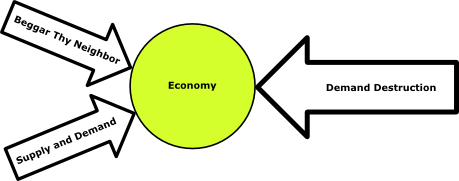
For the purposes of this discussion I happened to choose the theories mentioned in the  post Eurocrisis: “Democracy is Not a Given”.  The figure below shows, graphically, how these theories relate to each other.


Macro economic theories focus on particular forces that move the economy. In any historical period when one theory seems to explain where the economy is going, the particular force of that theory may be so dominant, that other forces don’t matter much.

In a  particular historic moment, if one force dominates, you still have to figure out which force it is so that you pick the right theory to apply to explain what is happening.

In real life, there are many forces pushing in different directions. You can see from the figure that you could actually pick the wrong force, supply and demand instead of all three, and get pretty much the right result.  That might be okay for a while, but as the sizes of the forces change over time – beggar thy neighbor runs out of steam, you might have a hard time figuring out what is going wrong if you base your thinking on assuming that your wrong original choice was right.

Since there are many more forces that can be identified than the three that I have shown, it may be hard to say which one or ones, if any, are dominating. If you want to consider all possible forces and apply them in the proper strength, the calculation of where the economy is going to go becomes very difficult. This is where you might want to resort to computer modeling so you can have the computer make the difficult calculations.

A computer model is only as accurate as the completeness of the forces included in the model and their accurate measurement. The model also has to have an accurate representation of the economy, which is the object that these forces are moving.

Now imagine that the economic policy of the federal government is determined by the political process. Do you think the average lawyer or business person in Congress is capable of doing these calculations, or even understanding them?

Let us look at a similar situation decided by Congress successfully. One example that I can think of is the NASA moon missions. The Congress and President Kennedy decided on a destination. They created legislation, set up an agency to carry it out, and provided a budget. Congress did not legislate the size of the rocket, how many stages it should have, nor the details of the decade long research that would have to go into deciding these things.

As with a space mission, you cannot decide how to direct economic policy without first figuring out what the destination should be. The economic destination has to do with things like the rate of improvement of the lifestyles you want for your citizens, how competitive you think you have to be compared to other world economies, the level of economic security that people should feel, the cleanliness of the environment they should enjoy, and the sense of justice that is right.

Once you know where you want to go, then you can set up agencies filled with experts who can figure out how you can get there. You need to give the agency a budget. You also need to figure out how you are going to measure progress to your destination. You then set the agency to its task, and leave the details to them. Of course you keep monitoring progress and make adjustments to the agency to make sure it is working. However, you do not meddle in technical details if you do not have the expertise to do so.

If we all have a clear picture of the expertise that is needed to make these detailed decisions, then it is easier to know if the person who wants to meddle is qualified. It is also easier for the person who wants to meddle to know if she or he has adequate expertise to do it.

I think it is less than helpful for the general public to be arguing over whether Keynesian economic theory is right or the Austrian Theory is right. It is not the right question to even be trying to decide. The real question for the public to decide is whether or not we have the right destination in mind and whether or not we are making good progress toward that destination. It takes a fair amount of expertise to even get those issues right.