SteveG’s Posts


Halberstam’s ‘Best-Brightest’ Blunder

Halberstam’s ‘Best-Brightest’ Blunder is a very interesting article from Consortium News.

The Best and the Brightest by David Halberstam shaped the American narrative of the Vietnam War, making it a cautionary tale about the folly of action-oriented intellectuals who surrounded President John F. Kennedy and whose hubris supposedly plunged the nation into a destructive war. But is Halberstam’s widely embraced storyline correct? In this analysis of the 1972 book, James DiEugenio argues that Halberstam got the history fundamentally wrong, missing Kennedy’s resistance to a wider war and ignoring the fateful change in U.S. policy after JFK’s assassination in 1963.

This article really makes you wonder about what we really know and what we don’t.  Either this guy is right and I was horn-swoggled by Halberstam’s book or the exact opposite.

This has tremendous importance even to this day.  When Obama touted his intellectual prowess over the village idiot that preceded him, I always had the nagging questions in the back of my mind, “but what about the people in the Kennedy/Johnson administration as described in The Best and The Brightest? If these smart people could have been so wrong, how do we know that Obama’s smart people will do better?”

This article does not completely negate some of those questions.  After all, some of the smart people in the Kennedy/Johnson administration did make some awful decisions.  The “fact” that Kennedy was smart enough to try to get around these people at least makes the case some educated people can figure out how to use their knowledge of history to the world’s advantage.  If I were a prejudiced person, I would gladly lay all the blame on that darn Texan, Lyndon Johnson, instead of the Cantabridgian Kennedy.


May 20, 2011

I just found Part 2 of the article. The closing paragraphs of the article say:

Halberstam’s book covers up this fact: that while the powers-that-be are indeed often overrated, Kennedy was not one of them. That was a truth too radical for someone like Halberstam, who was never the kind of writer who pushed the envelope.

Yet, what makes his iconic book even a worse travesty is that he never tried to amend it, even after more declassified documents revealed that Kennedy was intent on withdrawing and that Johnson reversed that policy. That failure, I think, speaks to Halberstam’s intent.

In my view, Halberstam’s deception was purposeful. Therefore, this is not just an obsolete book. It is an intentionally misleading one.

The closing sentence about the author of this article reads:

James DiEugenio is a researcher and writer on the assassination of President John F. Kennedy and other mysteries of that era.

I leave it up to you to decide if this description has any bearing on the credibility of the article.

Harry Belafonte Discusses President Obama


There is a level of profound wisdom in Belafonte’s remarks that I rarely hear.

I would have one nuanced difference in what he has to say. In his remarks about what he learned in the story told to him by Eleanor Roosevelt, he keeps mentioning the need to make explicit the threat to Obama of not promoting the liberal ideals that we wish he would promote more forcefully.

I would change that to the need to make more explicit the support to Obama that is there if he would promote the ideals that we wish he would promote. He needs to see that there is intelligent and effective promotion of the ideals besides his own voice. We need to give him the courage that would come from knowing he is not alone in fighting the battle.

Another way to look at this is that there are powerful forces pulling Obama in the wrong direction. He needs the help of his supporters to create a larger force to pull him in the correct direction. So it is not an issue of punishment that his supporters need to think about. They need to think about providing the countervailing force. For it to be effective, this force must be visible to everyone, not just to Obama.

This political blog is my feeble attempt to do just that.


The Rich Don’t Create Jobs, Customers Do

Here are some quotes from the article on truthout.org.

If I had extra money I wouldn’t just hire people to sit around and read the paper. And if I had more customers than I could handle that — the revenue generated by meeting the additional demand from the extra customers — is what would pay for employing more people to meet the demand.

If you ask around you will find that every business tries to employ the right number of people to meet the demand. Any business owner or manager will tell you that they hire based on need, not on how much they have in the bank.

This makes a nice complement to my previous post Higher Marginal Tax Rates Spur Economic Growth.


What is the Internet hiding?


As web companies strive to tailor their services (including news and search results) to our personal tastes, there’s a dangerous unintended consequence: We get trapped in a “filter bubble” and don’t get exposed to information that could challenge or broaden our worldview. Eli Pariser argues powerfully that this will ultimately prove to be bad for us and bad for democracy.

MoveOn.org showing of this video.


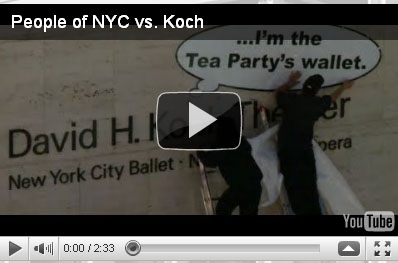
Rename the David H. Koch Theater

An email from BraveNew Foundation asks:

What would you rename the David Koch Theater if democracy and the arts couldn’t be bought?

Considering the large amount of money that the Koch brothers have given MIT to build a new building, I have come up with my response to the next year’s alumni fund campaign: Put my contribution on the Koch brothers’ tab. They can afford it better than I can.


Americans Are Under-Taxed

A few quotes from the article This Fact May Not Sit Well: Americans Are Under-Taxed by Kevin G. Hall, McClatchy Newspapers make the point.

Americans on average saw 17.3 percent of their income go to federal taxes in 2009 and 2010. The last time the percentage was this low was 1975, and during the late 1960s.

If you exclude social insurance taxes on wages – for Medicare and Social Security – the share of taxes as a percentage of income drops to 9.4 percent in 2009 and 9.3 percent in 2010, the lowest since 1950.

“It’s hard to argue that we’re overtaxed, and we’re low by world standards,” said David Wyss, the chief economist for the New York ratings agency Standard & Poor’s.


Higher Marginal Tax Rates Spur Economic Growth

The article by Ken Morris provides a good explanation for why higher marginal tax rates (MTR) spur more economic growth.

During the period from 1951 through 1963, (MTR: 91 percent), the economy grew at the annual rate of 3.70 percent. By comparison, the growth rate these past seven years, with MTR at 35 percent, was 1.70 percent.

The article gives plausible reasons why the higher MTR was a cause not a just a coincidence.

Morris cites Ray Kroc’s founding of the McDonald’s restaurant chain as a case in point.  The high marginal tax rates encouraged Kroc to take very little salary and to reinvest the companies profits in growth of the company.  This was a way of avoiding paying lots of taxes, but it created a growing company, jobs, and wealth for many.

To make the case for lower MTR being bad for job growth he postulates that:

A billionaire making $100 million a year is unlikely to increase spending if given another $10 million. One can argue the point, but logically speaking, it’s hard to refute. Their windfall is likely to get socked away with all those other tens of millions in excess cash.

Another economist, Robert Frank, has made the point that all this extra cash doesn’t even lead to greater happiness for the wealthy.  As this economist pointed out, if a wealthy person wanted to make a lavish birthday party for his children, years ago he could hire a famous entertainer for tens of thousands of dollars.  With today’s excess wealth this same lavish party would cost millions to hire the same entertainer.   The cost of lavish things has just risen to meet the ability of the wealthy to pay without providing any extra benefit for the money. 

The number of jobs that could have been created for middle class people with the amount of money now needed to give a lavish party has risen because inflation for the middle class is not  nearly as bad as inflation for the wealthy.  More total happiness would be created with a more even distribution of wealth.

Some of the points from this video include:

“Because satisfaction depends more on relative consumption, most people will adapt quickly to an across-the-board reduction in consumption.”

“By simply changing what we tax, we can eliminate enough waste from our current system to pay down debt and provide a high level of public services.”

“A tax on any activity has two effects:

“1. It generates revenue.

“2. It discourages the activity.

“The current tax system taxes mostly useful activities, such as savings and job creation.

“If we instead taxed only harmful activities, we could raise all the revenue we needed without requiring any painful sacrifices.”

Real waste is in the private sector. Government waste in public sector trivial compared to waste in private sector.

“Private waste occurs not because consumers get overcharged, but because they get caught up in wasteful ‘positional arms races’.”


ElBaradei Suggests War Crimes Probe Of Bush Team

Quotes from the AP report ElBaradei Suggests War Crimes Probe Of Bush Team.

The Iraq war taught him that “deliberate deception was not limited to small countries ruled by ruthless dictators,” ElBaradei writes in “The Age of Deception,” being published Tuesday by Henry Holt and Company.
.

.

.

“I was aghast at what I was witnessing,” ElBaradei writes of the official U.S. attitude before the March 2003 invasion, which he calls “aggression where there was no imminent threat,” a war in which he accepts estimates that hundreds of thousands of Iraqi civilians were killed.

In such a case, he suggests, the World Court should be asked to rule on whether the war was illegal. And, if so, “should not the International Criminal Court investigate whether this constitutes a `war crime’ and determine who is accountable?”