SteveG’s Posts


Obama Puts Bark In Consumer Watchdog: Elizabeth Warren

The McClatchy news story Obama Puts Bark In Consumer Watchdog: Elizabeth Warren, says:

President Barack Obama’s decision to appoint Harvard Law School professor Elizabeth Warren on Friday to oversee the creation of the new Bureau of Consumer Financial Protection cheered consumer advocates and Democrats Thursday, while dismaying Republicans and business groups.

That is the glass half full version of the story.  For the glass half empty version we have to go to OpEdNews, Triumph of the Money Party!!! Warren’s role downgraded, reports to Geithner, which starts out with:

The White House snatched back one of the few bones it’s thrown to the people outraged at the looting of the United States Treasury by failed financial concerns – the big banks and Wall Street. The promised appointment Elizabeth Warren  as head of the new agency to protect consumers from the financial services industry has been seriously downgraded. Instead of running the Consumer Finance Protection Agency, Warren’s role has been diminished to that of special assistant to the president and adviser to Treasury Secretary Tim Geithner.

The OpEdNews story predates the one in the McClatchy news.  My response to OpEdNews was:

There is a way of looking at this move by Obama in a charitable light. I am not saying this charitable way of looking at it is more correct than the name calling going on here, but it is a possible alternative.

Of course she is opposed by the banking crooks. That is exactly why she is needed. It is possible that Obama realizing he does not have the political muscle to get her approved the normal way, this is his way of sneaking her in the back door. Once she sets up the agency, it would be harder to argue that she shouldn’t head it. Getting Warren’s foot in the door may be Obama’s getting her in a position from which she can shove it open later. By giving Geithner this so-called subordinate, this may be Obama’s warning to him to shape up or ship out.

Also this will postpone the fight over her appointment until after the election. If the Progressives do not abandon Obama now, the political pundits might be proved wrong. The Democrats might still have control over both houses after the election.

Do you want to hold out for the hope of this positive spin on the story, or do you want to make sure that only the negative outcome is possible?

An addendum to my OpEdNews response was:

By the way, do you want Obama to openly admit his stealth plan so that you can support him? Maybe he has a way of communicating to progressives in a way that the Republicans won’t hear.

How plainly do you want him to spell out his negotiating bottom line so that the opposition has all the advantages?

Do you go into the car dealer saying, my absolute bottom line is to pay $20,000 for this car, but my first offer is $18.000? Do you think you are going to get the car for anything like $20,000 or less? When did you fall off the turnip truck?

In response to the author’s claim is that all he wants people to do is to tell the truth about the redistribution of wealth to the wealthy, I had this to say:

One style of motivation is to focus on what people do right and don’t make too big a deal of the things they do that do not live up to your expectations.

Apparently the other style of “motivation” is to find something to fault in whatever people do and never mention the things they do that you like.

In reality, there needs to be a balance. However, I favor a preponderance of the first style. Especially with people who I think can be or are motivated to do good.

So, sure, tell people what you want them to do – talk about the redistribution of wealth to the wealthy. However, castigating them for every thing that doesn’t quite go the way you want seems very counter-productive to me. Even worse is the attribution of evil motives to those people rather than considering that they may have a different tactical approach than you do.

That castigation and evil motive attribution kind of behavior might motivate you, but it doesn’t motivate me. In applying the golden rule, I try to treat others as I would have them treat me. I much prefer that tack until proven that something else needs to be tried. I don’t start off with the stick approach, which much on OpEdNews seems to do.

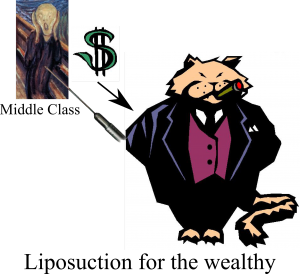
What About All Those Progressive Wins On Tuesday?

I am sure you have heard about all the upsets by the Republican Tea Party on the right in Tuesday’s primaries.

Those of you in Massachusetts probably also heard lots of news reports about the progressive win in New Hampshire.  What’s that, you heard not a peep?  What’s wrong with those left leaning media that are always shilling for the Democrats?  Did they let you down?

You can read some news and see a video interview on the PCCC web site.

WE DID IT! Bold progressive Ann McLane Kuster defeated Joe Lieberman’s presidential campaign co-chair Katrina Swett in Tuesday’s New Hampshire congressional primary. PCCC members made thousands of phone calls and chipped in nearly $100,000 toward her people-powered victory.

Perhaps some of my readers from New Hampshire can tell us more.

Since I live out in the red part of Massachusetts, I didn’t see anything in the local Worcester paper.  However, I do watch the Boston television stations, and I heard nothing.

There is a Boston Globe article Democrats pick Kuster in NH’s 2nd District.  Still there is not quite the enthusiasm about the national implications of a progressive winning the campaign.  If Kuster had been a Tea Party candidate, can you imagine the publicity?  Maybe it is just that the media cannot believe that people would actually vote for Tea Party candidates, so it  is news when they do.

“We report that the only exciting candidates are from the Tea Party, and we let you decide.  What could be more fair and balanced than that?”


Redeploy the Tax Cut That Was For The Wealthy To The Middle Class

President Obama and the Democratic leadership had the plan of letting the Bush tax cuts for the wealthy expire.  Somehow the Republicans managed to scare a few people into thinking that this expiration would harm the economy that is in recession.

My idea was to make it explicit that the money from the expired tax cuts could be redeployed in more economically stimulative ways than giving the money to the wealthy.

The longer President Obama and the Democratic leadership delays in taking up this idea, the more they lose even conservative Democrats from their cause.

I can see that my first way of phrasing the plan was not clear enough.  Obama has to change his plan so that he takes the money from the tax cut to the wealthy and uses it instead to raise the tax cut to the middle and lower classes.  This clearly sinks the idea that letting the tax cut expire will harm the fragile economy.

In the hands of the wealthy, this tax cut money either gets loaned back to the government in the purchase of treasury bonds or it gets invested in creating jobs in other countries.  What better way to stimulate the economy than to give the money to the people who will spend it locally to create jobs here?

For such a canny politician as Obama proved to be in the Presidential campaign, you wouldn’t think that it would take someone like me to lead him by the hand to the obvious solution.

Steve Leading Donkey To Water

By the way, if the picture is too small on your screen to see exactly what kind of animal I am leading to water, hover your mouse over the picture and read the title.

If they lose the argument over this tax policy issue, it would make me wonder what happened to their political smarts.


On September 17, The Worcester Telegram & Gazette published my  letter to the editor.


Local Muslims Proud To Be Part Of America

I am thrilled to present this link to the article Local Muslims Proud To Be Part Of America by Thomas Caywood of the Worcester Telegram & Gazette Staff.

I also found the discussion in the comments about the article to be heartening.  I was glad to participate in the discussion.

It makes me realize that there is hope in all parts of our state. It also makes it all worthwhile to participate in these discussions even when I often find myself in the position of  holding the minority view


Analysis: No let up in G20 reforms after Basel agreed

The commentary Analysis: No let up in G20 reforms after Basel agreed by Huw Jones from Reuters is an encouraging sign.

A deal on bank capital rules won’t see world leaders take their foot off the reform pedal but will instead clear the decks for them to focus more squarely on an even harder issue — tackling too-big-to-fail banks.

One of the excuses that was used to justify deregulation in the United States was the need for U.S. banks to compete with foreign banks that did not have to live with the same type of regulations we had here.  (Of course not enough people here asked, “If the other banks are allowed to do crazy and dangerous actions, why would we want to be like them and let our banks do the same?”)

However, considering how foolish we were to emulate the others’ folly, it helps if the others end their folly along with us.

“The Basel Committee and the FSB [Financial Stability Board] are developing a well-integrated approach to systematically important financial institutions which could include combinations of capital surcharges, contingent capital and bail-in debt,” the two bodies said in their statement on Sunday.

The other thing to remember is that tough regulation is not only about punishing the guilty.  It is also about preventing the crooks from having an unfair advantage over the law abiding.  When the crooks have an unfair advantage, their are two unhappy free market responses.  Either the business’s run by ethical people are driven out of business because they cannot compete against the unfair advantage, or the ones with only weak ethics are driven to follow the practices of the totally unethical so they can save their businesses.  This should not be the kind of situation we want to allow or encourage.

How do I know the market will react this way?  I first observed this during the dot com bubble when I was a mutual fund investor.  There were mutual fund managers who were managing funds that were growing by 90% a year by investing in companies in the bubble.  These managers were getting huge financial bonuses and their mutual funds were growing larger.

The prudent managers who could not match this impossible performance were drummed out of the business and their mutual funds shrank in size.  It is a miracle that their were any prudent managers left to pick up the pieces after the bubble burst and those other risky funds collapsed.

I always told my friends who were taking chances, “It is not how much money you make on paper, it is how much money you get to keep in the long run.”


Time for This Big Dog to Bite Back

Frank Rich makes a lot of sense in his column Time for This Big Dog to Bite Back.

As many have noted, the obvious political model for Obama this year is Franklin Roosevelt, who at his legendary 1936 Madison Square Garden rally declared that he welcomed the “hatred” of his enemies in the realms of “business and financial monopoly, speculation, reckless banking, class antagonism, sectionalism, war profiteering.” As the historian David Kennedy writes in his definitive book on the period, “Freedom from Fear,” Roosevelt “had little to lose by alienating the right,” including those in the corporate elite, with such invective; they already detested him as vehemently as the Business Roundtable crowd does Obama.

Though F.D.R. was predictably accused of “class warfare,” his antibusiness “radicalism,” was, in Kennedy’s words, “a carefully staged political performance, an attack not on the capitalist system itself but on a few high-profile capitalists.” Roosevelt was trying to co-opt the populist rage of his economically despondent era, some of it uncannily Tea Party-esque in its hysteria, before it threatened that system, let alone his presidency. Only the crazy right confused F.D.R. with communists for taking on capitalism’s greediest players, and since our crazy right has portrayed Obama as a communist, socialist and Nazi for months, he’s already paid that political price without gaining any of the benefits of bringing on this fight in earnest.

F.D.R. presided over a landslide in 1936. The best the Democrats can hope for in 2010 is smaller-than-expected losses. To achieve even that, Obama will have to give an F.D.R.-size performance — which he can do credibly and forcibly only if he really means it. So far, his administration’s seeming coziness with some of the same powerful interests now vilifying him has left middle-class voters, including Democrats suffering that enthusiasm gap, confused as to which side he is on. If ever there was a time for him to clear up the ambiguity, this is it.


House G.O.P. Leader Signals He’s Open to Obama Tax Cut

The New York Times ran the story House G.O.P. Leader Signals He’s Open to Obama Tax Cut.

“If the only option I have is to vote for some of those tax reductions, I’ll vote for them,” Mr. Boehner said, in response to questioning by the television show’s host, Bob Schieffer, who pointedly asked if Republicans were willing to hold the tax breaks for most Americans “hostage” to insist on continuing the lower rates for the highest earners.

“I think raising taxes in a very weak economy is a really, really bad idea,” Mr. Boehner said, adding, “I think there is a growing chorus on Capitol Hill to extend all of these tax rates.”

In recent days, Mr. Boehner has called for extending all of the Bush tax cuts for two years and freezing government spending at 2008 levels.

If the Obama administration and the Democratic leaders in the Congress had any sense, they would point out to Mr. Boehner that “raising taxes in a very weak economy is [only] a really, really bad idea”, if you do not plan to redeploy that money to some other kind of stimulus.  Also, “freezing government spending at 2008 levels” is a very, very bad idea in a weak economy.  Cutting taxes and spending is the wrong approach.  Raising some taxes and increasing spending to compensate is a better approach.  They really need to explain why their approach is better.

It seems Boehner could not resist throwing in his usual song and dance,

In addition to the lower marginal income tax rates, aides said that Mr. Boehner would like to continue the current moratorium on the federal estate tax, which is also due to expire on Dec. 31.

The one-year elimination of the estate tax has allowed some extremely wealthy Americans to leave enormous inheritances without paying any federal tax. Republicans have long criticized the estate levy as double taxation because the assets were generally taxed once as income when they were first earned.

The money passed on in an estate may be largely unrealized capital gains that have never been taxed.  The recipient already gets to step up the cost basis of stocks to the current market price on the day of receipt which wipes out the tax liability on the untaxed capital gains.

The Republicans are really good with playing tax hocus pocus to try to convince us that the wealthy bear an unfair tax burden when the exact opposite is true.  The wealthy get unfair tax breaks that the less wealthy don’t get.


A G.O.P. Leader Tightly Bound to Lobbyists

The article A G.O.P. Leader Tightly Bound to Lobbyists in The New York Times gives you an idea of who Representative John A. Boehner Republican of Ohio actually represents.

This type of lobbyist connection, whether with Republicans or Democrats, is what has caused a lot of our recent economic problems.  Boehner’s personal experience as a small business owner does not equip him with the ability to know how to deal with the big time frauds represented by the likes of Goldman Sachs,  Citigroup, R. J. Reynolds, and Altria.  These are the companies whose lobbyists he deals with and are the major contributors to his campaigns.

Connections with S&L financial frauds and their lobbyists are what helped lead to the downfall of House Speaker Jim Wright, Democrat from Texas.  The current housing bubble was caused by financial frauds in Goldman Sachs and Citigroup.  We already have too many people in Government that are protecting these companies now. We don’t need to put another protector of their interests in power as House Speaker.

In talking about the fraudulent nature of the financial companies, I am depending somewhat on what I learned from reading William Black’s book.  It is good to have some skepticism about what any one individual says, but until I find something that contradicts the main premise of his ideas, I will continue to rely on what Black says as opposed to relying on the people who went to jail or merely performed questionable actions that Black describes.

This also means not relying too much on people who continue to carry water for those frauds. If you don’t know who I am talking about, let me mention Larry Summers and Tim Geithner.  Past members of the club include Alan Greenspan and Henry Paulson.  They are no longer in official power, but Greenspan still has his opinions published in the press.


The Best Way To Rob A Bank Is To Own A Politician

Bill Moyers interviewed William Black in April 2009.

The financial industry brought the economy to its knees, but how did they get away with it? With the nation wondering how to hold the bankers accountable, Bill Moyers sits down with William K. Black, the former senior regulator who cracked down on banks during the savings and loan crisis of the 1980s. Black offers his analysis of what went wrong and his critique of the bailout.

The title of Black’s book about the S & L crisis is “The Best Way To Rob A Bank Is To Own One.”

I am in the process of reading that book now. In this interview by Bill Moyers, it was very interesting to hear Black bring the insights from his own experience and apply them to the current crisis.

If you are investing in the financial industry, stop immediately.

(Disclosure, I do own stock in AINV, CINF, and PSEC.  Is this following my own advice above?  I don’t know.  Is this a case of cognitive dissonance?  Again, I don’t know.  Someone, please help me before I invest again.)

It is also interesting to compare what Black had to say about Japan’s economic woes and what Paul Krugman had to say in the article alluded to in my post Things Could Be Worse, Let The Republicans Show Us How.