Jill Stein Double Or Nothing Trailer
This trailer does not end on a Bernie Sanders ad. Keep watching.
This trailer does not end on a Bernie Sanders ad. Keep watching.
People of all political stripes know the difference between wasting, spending, and investing. People who plan for the future invest.
The Atlantic has the story Finance is ruining america.
Raising tax rates on the rich might not seem particularly feasible right now. But it has happened before: In 1916, top tax rates jumped to 15 percent from 7 percent; the next year, they jumped to 67 percent. Those tax rates changed in part because of war, but remained high throughout the 20th century as Americans decided that excessive wealth wasn’t good for society.
Some politicians, including Bernie Sanders and Hillary Clinton have proposed increasing taxes for the very wealthy, signaling a return to a time when extreme wealth was not accepted in American society. Such policy isn’t just a way of getting more revenue to the government; it could help alleviate poverty in America, too.
If you would rather hear someone talk about this story, you can watch the first half of Episode 975 of The Kaiser Report.
In this episode of the Keiser Report, Max and Stacy discuss how finance is ruining America. In the second half, Max interviews Ronald Reagan’s budget director, David Stockman, author of ‘Trumped: A Nation on the Brink of Ruin’… And How to Bring It Back.
I don’t know about the second half of the above video. I have little faith that David Stockman understands how the economy works in these matters. So I doubt that he has a viable solution. If I have the time, I may watch the second half to see that I am right. Of course, I will approach it with an open mind 🙂
OK, I goaded myself into listening to Stockman, and it isn’t at all what I expected. His talk of the warfare state is quite on point. He does go astray in choosing Trump over Clinton, because Trump might even be independent enough to quell the warfare state. Of course, he ignores Stein/Baraka who have come out strongly and categorically against the warfare state.
Naked Capitalism has published the post Democracy. Capitalism. Socialism. Choose Any Three of the Above by Steve Roth. Roth concludes with the following thought about people who want to eradicate one or more of the three choices:
But regardless of their relative political power, all of these ill-considered, utopian, faith-based, tribalistic anti-isms are a bane on the body politic. At this point in our evolution, capitalism, socialism, and democracy are necessary for any country’s prosperity, economic freedom, and economic well-being. And they all need improvement — just as we’ve been fitfully improving things for hundreds, even thousands of years.
When I voted for Barack Obama, I thought I was voting for a balanced politician. I liked his supposedly leftist positions, but I also thought that he understood the benefits of capitalism well enough to not want to abolish it. Little did I know that he appreciated capitalism so much that he could not see its flaws that needed correction.
I also like Roth’s explanation of what a politico/economic system is for.
Assume for the moment: the dream-goal of a polity, or at least of an economy, is to deliver widespread or even universal thriving and prosperity, economic security, and economic well-being.
Truth Out has the op-ed How Capitalism Perpetuates Immigration by Richard D. Wolff. I’ll quote but one example from the article.
Modern times offer more examples. The US repeatedly undermined basic living conditions in its de facto colony, Puerto Rico, driving millions to move to the US mainland. There, they repeatedly encountered all manner of discriminations, abuse and scapegoating.
Teaching people about these sorts of things in the off years between elections is what will have people prepared to know which politicians are proposing real solutions, and which ones are trying to distract us from the real solutions.
For those of you 88 million people who wasted their time and gave a ratings to boost to the “official” debate, here is what over 1.2 million of us have done instead. We watched a debate with three of the four viable Presidential candidates – Jill Stein, Hillary Clinton, and Donald Trump. Over 32 thousand of us have shared it on our Facebook pages.
Click on https://www.facebook.com/drjillstein/videos/1302970866409767/ to see for yourself. This should answer almost all the questions you might have about Jill Stein.
The video may take a bit of time to load, so please have patience.
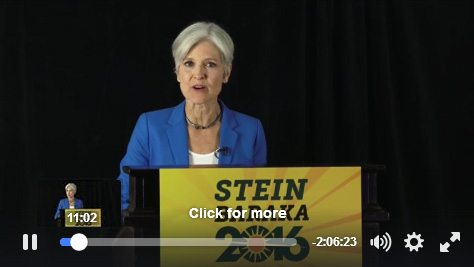
For those regular readers of my blog, you will probably realize that I was ecstatic when she mentioned William K. Black, the author of The Best Way To Rob A Bank Is To Own One. That link isn’t the best one on this web site – here is a list of all the references to William Black on this blog.
When she was asked about Stephanie Kelton, I almost feinted. See my posts The Economy: Does More Government Help or Hurt – Stephanie Kelton and Watch Out, MMT’s About, As Bernie Sanders Hires Stephanie Kelton to find out who Stephanie Kelton is.
Paul Romer has the post Trouble with Macroeconomics, Update.
So ask yourself about the relative cost of:
- A paper that ridicules post-real macroeconomics and hurt’s some feelings
- A persistent equilibrium in which many economists are afraid to publish things that they believe to be true
In the paper, I refer to Voltaire as the true spirit of the enlightenment. Voltaire understood that the cost of 1 is not so large and that the cost of 2 is extraordinarily high.
After reading this post and much of the underlying article to which it refers, I can respond in the spirit of the post and the article.
Paul Romer’s article is great. I can’t understand a word that is in it, but I am sure it agrees with everything I have been saying for years. 🙂
After reviewing the quote that I used in this post, I decided to go back and look at the reference to Voltaire. I actually found some words that I could understand. Emphasis in the excerpt below has been added by me.
9.1 The Norms of Science
Some of the economists who agree about the state of macro in private conversations will not say so in public. This is consistent with the explanation based on different prices. Yet some of them also discourage me from disagreeing openly, which calls for some other explanation.
They may feel that they will pay a price too if they have to witness the unpleasant reaction that criticism of a revered leader provokes. There is no question that the emotions are intense. After I criticized a paper by Lucas, I had a chance encounter with someone who was so angry that at first he could not speak. Eventually, he told me, “You are killing Bob.”
But my sense is that the problem goes even deeper [than] that avoidance. Several economists I know seem to have assimilated a norm that the post-real macroeconomists actively promote – that it is an extremely serious violation of some honor code for anyone to criticize openly a revered authority figure – and that neither facts that are false, nor predictions that are wrong, nor models that make no sense matter enough to worry about.
A norm that places an authority above criticism helps people cooperate as members of a belief field that pursues political, moral, or religious objectives. As Jonathan Haidt (2012) observes, this type of norm had survival value because it helped members of one group mount a coordinated defense when they were attacked by another group. It is supported by two innate moral senses, one that encourages us to defer to authority, another which compels self-sacrifice to defend the purity of the sacred.
Science, and all the other research fields spawned by the enlightenment, survive by “turning the dial to zero” on these innate moral senses. Members cultivate the conviction that nothing is sacred and that authority should always be challenged. In this sense, Voltaire is more important to the intellectual foundation of the research fields of the enlightenment than Descartes or Newton.
I think I was right in the conjecture that he was trying to say things with which I agree.
After years of writing and supporting software to model the behavior of integrated circuits, I came to the conclusion that you needed to cross-check the simulated results by comparing them to more simplified models and your intuition about how the circuit ought to behave. If there were a discrepancy, then you had darn well better find a way to understand the cause of the discrepancy. Your intuition could be wrong, your simplified model could be wrong, the detailed model could be wrong, and/or the software could be wrong. You should not invest millions of dollars producing a real chip until you understood which of the above possibilities were actually occurring.
Naked Capitalism has the silly article Rethinking Macroeconomic Theory Before the Next Crisis.
I just cannot understand all this flailing about while ignoring two fundamental issues. The first is taking into account criminal intent in the behavior of major players in any definition of rational expectations. The second is manipulation of economic and political systems to concentrate wealth the hands of the few. There is no laissez-faire economic system anywhere. Models that assume the opposite of reality have little chance in being useful except to the con artists that promote them. Maybe we should look into the corruption of academia in the fields of economics, business, and finance.
All the talk about any other details is a useless exercise when everyone refuses to see the elephant in the room.
Since Naked Capitalism does not show you other comments before you write your own, I had no idea that many of the other comments would agree with my analysis.
Naked Capitalism has the article “There Ought to be a Law….” Why Prison is the American Way.
The Washington, D.C.-based Centre for Justice and Reconciliation describes it this way: “Restorative justice repairs the harm caused by crime. When victims, offenders, and community members meet to decide how to do that, the results can be transformational.”
I bet this is something that is on Jill Stein’s mind about transforming this country. I can probably figure out why she doesn’t talk about ideas like this on the campaign trail. What she does talk about is already visionary enough. If she talked about this, people would absolutely know that she was crazy. What a pity.
Naked Capitalism has the article Report: New Data Disproves US Corporations’ False Narrative on Taxes.
While the statutory tax rate on corporate income is 35 percent, estimates of the rate corporations actually pay put the effective rate at about half the statutory rate. Driving this divergence between what corporations are supposed to pay and what they actually pay is a combination of offshore profit shifting and tax avoidance. Multinational corporations pay taxes on between just 3.0 and 6.6 percent of the profits they book in tax havens.
The false narrative is also a mainstay of the Republicans and the Libertarians. The Libertarians have even developed and nice, internally consistent philosophy that has only one problem. The facts don’t support their beliefs.
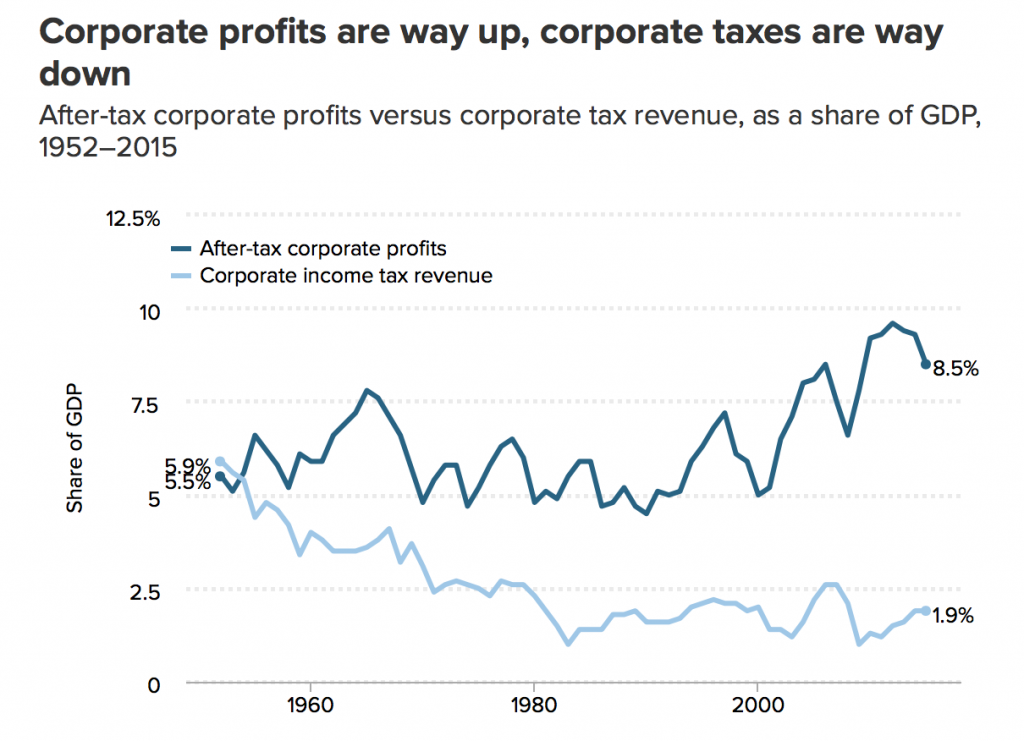
The title of the original article from American’s For Fair Taxes is actually Corporate Tax Chartbook: How Corporations Rig the Rules to Dodge the Taxes They Owe.