Yearly Archives: 2009


President Barack Obama Back to School Event

Follow this link to read the prepared remarks that the President gave to the school children of the nation on September 9, 2009.

Our son-in-law Chuck, Sharon, and I were discussing many of these topics yesterday without any knowledge of what the President was going to say. Much of what the President said matches pretty closely with the message that we would have liked to deliver if we had been asked to make the speech.

I like President Obama, not because I agree with what he thinks, but because he agrees with what I think.

George H. W. Bush Address to Jr. High School Students 10/01/1991

Reagan Address to Jr. High School Students 11/14/1988


Whose Idea Are Death Panels, Anyway?

I am reading a fascinating book by Robert H. Frank, The Economic Naturalist’s Field Guide: Common Sense Principles For Troubled Times.

Starting on page 95, he discusses a case where Baylor Hospital in Plano, Texas turned off the ventilator of a fully conscious, but terminally ill cancer patient. It took her 16 minutes to die of suffocation as observed by several of her family members who were helpless to do anything about it.

True to its word, Baylor disconnected her ventilator on December 12, invoking a law signed in 1999 by George W. Bush, then governor of Texas. The law relieved doctors of an obligation to provide life-sustaining treatment ten days after giving formal notice that such treatment was found to be medically inappropriate.

Here we have the idea of death panels with no need to even convene a panel. Talk about your efficiency.  This is a marvel of brilliant Republican thinking.  I don’t even care if it turns out at the time that the Texas legislature may have been dominated by Democrats.  In many cases a Texas Democrat would be considered to be a Republican in most other parts of the country.

It’s a good thing I put in that last proviso.  Follow this link to see where I got the following statistics:

In 1999 in the Texas state legislature there were 78 Democrats and 72 Republicans in the House.  There were 15 Democrats and 16 Republicans in the Senate.   The total was 93 Democrats and 88 Republicans.


Preventing People From Hearing The President

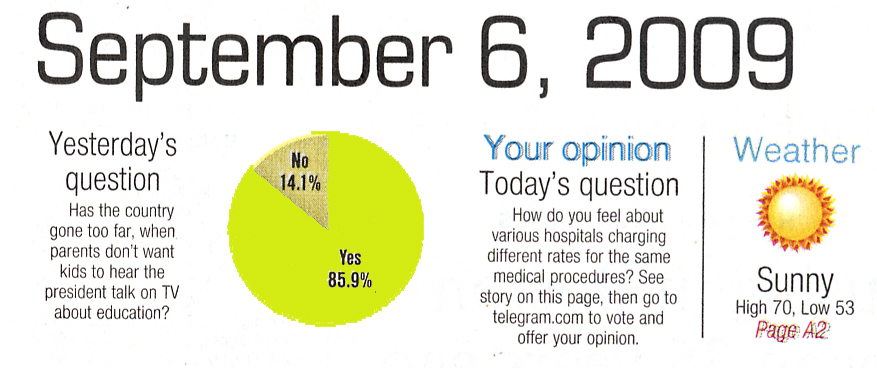
As seen in this scan, yesterday’s Worcester T & G poll found that 85.9% of respondents thought that the country has gone too far when parents don’t want kids to hear the president talk on TV about education.

2009-09-06-PollResult

Could the readership suddenly have come to their senses? Naw, it must be some kind of anomaly.

It’s one thing to decide you don’t want your or your children to hear the President.  It is quite another to intimidate local school superintendents and school boards to prevent other people’s children from hearing the President. What happened to the cry for First Amendment rights?  I wonder how far it would go if someone brought suit charging violation of civil rights for such obstruction?


How Do You Know The Government Can Spend …

Your Money More Wisely Than You Can?

If you thought that the equity in your house was a second source of income, then maybe the government knows how to spend your money better than you do.

If you put all of your 401K into your company’s stock, then maybe the government knows how to spend your money better than you do.

If every year you reallocated the funds in your 401K to last year’s best performing funds, then maybe the government knows how to spend your money better than you do.

If you thought the stock market was a great investment when it was up, but not when it is down, then maybe the government knows how to spend your money better than you do.

If you took your money out of your retirement accounts to pay for a vacation, then maybe the government knows how to spend your money better than you do.

If you have never invested in the stock market but you thought you could do better than putting any money into Social Security, then maybe the government knows how to spend your money better than you do.

If you’d rather the government run a deficit to fight a war, but not to provide health care, then maybe the government knows how to spend your money better than you do.

If you are upset that the cost of Medicare is rising, but you don’t think that health care costs should be brought under control, then maybe the government knows how to spend your money better than you do.

If you think the rich get more pleasure out of spending $10 Million for their young children’s birthday parties than they would get from breathing clean air, then maybe the government knows how to spend your money better than you do.

If you think the rich are happier spending their tax cuts competing for a $10Million mansion than they would if they could pay $5Million for the same mansion if none of them got tax cuts, then maybe the government knows how to spend your money better than you do.

Do you think I can compete with Jeff Foxworthy and his redneck jokes?

Can you write better “government can spend your money jokes” than I have?

It shouldn’t be hard.  Post your own ideas here.


Misdirected Anger Over Zero COLA for Social Security

Follow this link to a recent letter to the editor of the Worcester T & G that asked:

Can it be true? Did I just read that the federal government wants to cut Social Security benefits for American retirees …

I remember reading the story, but I apparently did not remember what the headline said.  Here was my response.

William,

You ask if it can be true.  You ask “Did I just read that the federal government wants to cut Social Security benefits for American retirees”

Well, you have been duped again by the Worcester T & G or whatever other media you read.  This may be the impression you got from reading the headline, but you might have gotten a different impression if you had read the whole story.

There is just enough of a hint of truth to the headline that the T&G can claim they weren’t lying, but they are definitely trying to distract you from understanding.

There will be no COLA (Cost of Living Adjustment) this year because the cost of living has actually dropped due to the recession.  In their wisdom, the lawmakers prevented Social Security from reducing your payment when the COL drops.  They can only raise it when the COL rises.

It turns out that the cost of Medicare is rising.  You know, the thing that Obama is trying to bring under control?  Because Social Security deducts the cost of Medicare from your check, your check will be smaller next year.

If the T & G keeps you in the dark about what is really going on, how will you know what needs to be fixed?

Follow this link to the original article.  The headline on the web site reads, No cost of living hike for Social Security. If this is what appeared in the print addition, then I guess it wasn’t as misleading as I had thought.

The article did go on to say:

Nevertheless, monthly payments would drop for millions of people in the Medicare prescription drug program because the premiums, which often are deducted from Social Security payments, are scheduled to go up slightly.

Given the current state of the debate, I knew that the rising cost of Medicare would be used as an excuse to not reform the rising cost of Medicare. Do we live in a topsy-turvy world or what?  As Yakov Smirnoff would say, “Only in America”.


Al Franken Discusses Health Care Reform

I have been saying that the trouble with Obama is that nobody can explain health care reform as well as he does. Well, I learned from the above video that Al Franken does a pretty good job. I’d like to think he learned how to be that effective when he studied at MIT. Of course it is probably the other way around, he went to MIT because he was that effective at learning and explaining.


How Does Krugman Still Get It So Wrong?

Sorry, Richard, I read about 6 pages of the Krugman article, but it was just too painful to continue to read.  One has to wonder who is judging the awarding of Nobel Prizes in economics?

I find it particularly disturbing for him to tell us the history of “How Did Economists Get it So Wrong?” and completely leave out his own role in all of this.  Moreover, he continues to demonstrate that he still doesn’t get it.  I don’t know if he doesn’t get it because he misreads history or he misreads history because he doesn’t get it.

Later, Friedman made a compelling case against any deliberate effort by government to push unemployment below its natural level (currently thought to be about 4.8 percent in the United States): excessively expansionary policies, he predicted, would lead to a combination of inflation and high unemployment – a prediction that was borne out by the stagflation of the 1970s, which greatly advanced the credibility of the anti-Keynesian movement.

Does Krugman remember the influence of OPEC in the 70s and the holdover from the guns and butter policy of the Johnson/Nixon years during the Vietnam War?  OPEC’s actions were also largely dictated by ideological issues over the Middle East (Israel and the Palestinians).  Of course our decades of interference in Iranian internal politics and our dealing with the Shah after he was deposed had no impact on economics? To ignore these issues as major causes of the economic problems is what puts economists in such a bad light.  The economic theories I studied in my undergraduate years always had the proviso, all other things being the same. Well, all other things were not being the same. You have to go beyond your undergraduate school simplifications and get into the complications one ought to appreciate in graduate school on your way to getting a PhD.

And by the 1980s, finance economists, notably Michael Jensen of the Harvard Business School, were arguing that because financial markets always get prices right, the best thing corporate chieftains can do, not just for themselves but for the sake of the economy, is to maximize their stock prices.

Does Krugman forget that the corporate chieftains achieved many of their miracles by cooking the books?  Has he ever heard the dictum the results you get depend on what you are measuring?. If you only measure consistency of results from quarter to quarter than of course, by hook or by crook, you are going to get this consistency. (A lot of it by crook, by the way.)

So they were willing to deviate from the assumption of perfect markets or perfect rationality, or both, adding enough imperfections to accommodate a more or less Keynesian view of recessions.

Has Krugman forgotten that much of Keynesian economics tells us that it can happen that individual players making entirely rational decisions for themselves can in aggregate create catastrophic conditions for the economy as a whole?  How can you win a Nobel Prize and forget the fundamental point that you learned in undergraduate school?

And as long as macroeconomic policy was left in the hands of the maestro Greenspan, without Keynesian-type stimulus programs, freshwater economists found little to complain about.

What does he mean without Keynesian-type stimulus programs.  The massive budget deficits during boom times that Reagan/Bush/Bush promulgated were fiscal stimulus.  That is why the Fed had to work so hard to counter these policies.  I saw this at the time, how come Krugman is still blind to this?  It was pretty obvious at the time  that the fiscal and monetary policies of the times were working at cross purposes.  How rational was that?

How did they miss the bubble? To be fair, interest rates were unusually low, possibly explaining part of the price rise. It may be that Greenspan and Bernanke also wanted to celebrate the Fed’s success in pulling the economy out of the 2001 recession; conceding that much of that success rested on the creation of a monstrous bubble would have placed a damper on the festivities.

Does Krugman see that the massive fiscal stimulus of the huge budget deficits left little room for any more Keynesian stimulus?  This forced the Fed to carry the entire burden. Does he also forget that after 2001, the Clinton administration was the first administration of either party since the mid 1960s that was able to bring the deficits down?  Thus ending fiscal stimulus when not needed and going back to policies advocated by Keynes.

Could none of these economists see that George W. Bush’s reversal of the Clinton policy was leading us right back into the same old mess that we had spent 8 years digging out from?

Who is going to take responsibility for opening Krugman’s eyes?  If Richard is such a Krugman fan, perhaps he can use his influence.  First he will have to remember a little of the history that he lived through since graduation in 1965.

One cannot be any more thankful that Obama is not listening to Krugman than I am.

Other Economists in the Room

Before I read the article Richard mentions in Krugman – How Did Economists Get it So Wrong?, I post this rebuttal by Jane Smiley.

Jane Smiley is a Pulitzer Prize-winning novelist and essayist.  Lest you say, What does she know and how does that stack up against a Nobel Prize winning economist?, I’ll throw the following into the mix.

I have just started to read The Economic Naturalist’s Field Guide: Common Sense Principles for Troubled Times by Robert H. Frank.  This is a collection of his columns printed in the New York Times.  He starts off the introduction to the book with:

In an essay written in 1879, Francis Amasa Walker tried to explain why economists tend to be in bad odor amongst real people. Walker, who went on to become the first president of the American Economic Association, argued that it was partly because economists disregard the customs and beliefs that tie individuals to their occupations and locations and lead them to act in ways contrary to predictions of economic theory.

Lest you wonder if Robert Frank knows anything, here is his curriculum vitae from the back cover flap of his book:

Robert H. Frank is the Henrietta Johnson Louis Professor of Management and Professor of Economics at Cornell University’s Johnson Graduate School of Management and a regular economics columnists for the New York Times. His previous books include The Economic Naturalist, Falling Behind, The Winner-Take-All Society, Luxury Fever, and Principles of Economics (with Ben Bernanke).  Frank’s many awards include the Leontief Prize for Advancing the Frontiers of Economic Thought.

I am only up to page 27, but already his insights seem more on the mark than anything Krugman has ever written.  He is a devotee of the field of Behavioral Economics which attempts to take a realistic look at how people actually behave rather than how traditional economists thought that they ought to behave.

If you need further proof of the irrationality of homo econimicus, just think about the opponents of health care reform.


Krugman–How Did Economists Get it So Wrong?

Nobel economist Paul Krugman wrote in the 6 September 2009 New York Times Magazine, How Did Economists Get it So Wrong?. It is a discussion of the re-emergence of Keynesian macroeconomics.

On 4 August 2009, SteveG kindly posted Krugman Lectures on the Depression containing URLs to three audio lectures (mp3) plus slides, which I emailed to him, given by Krugman at the London School of Economics (LSE) this summer. I am reposting those links here for your convenience.

Part I--The Sum of All Fears
Audio: http://tinyurl.com/kj43gf
Slides (pdf): http://tinyurl.com/n6gevo

Part II--The Eschatology of Lost Decades
Audio:  http://tinyurl.com/mjvq65
Slides (pdf):  http://tinyurl.com/lcavs7

Part III--The Night They Reread Minsky
Audio:  http://tinyurl.com/m4hww2
Slides (pdf):  http://tinyurl.com/m92wpj

The New York Times Magazine article covers some of the material in the LSE lectures; therefore for those of you who don’t have the time, the technology, or the inclination to listen to the 3+ hours of lecture,  you might wish to read the article and decide afterward whether you want the more thorough analysis.

In the interest of full disclosure, SteveG is not as impressed as I am with Krugman nor with Paul Samuelson; please see SteveG’s full post on the Krugman lectures plus SteveG’s additional post, How Milton Friedman Fooled the Economists, for his opinion.