In the March 2010 issue of The Atlantic, Joshua Green wrote Management Secrets of the Grateful Dead.
The Grateful Dead Archive, scheduled to open soon at the University of California at Santa Cruz, will be a mecca for academics of all stripes: from ethnomusicologists to philosophers, sociologists to historians. But the biggest beneficiaries may prove to be business scholars and management theorists, who are discovering that the Dead were visionary geniuses in the way they created “customer value,” promoted social networking, and did strategic business planning.
I confess that, unlike many of my friends, I was never a fan of The Dead, preferring instead Janis Joplin and The Rolling Stones. Their music was just okay, their singing was not. Theirs was a cheerful, white-bread band whose concerts were the embodiment of Peace, Love, and Pot. Their songs were interminable but for their stoned, ecstatically-twirling audience, it was Nirvana.
They were a phenom. Their fans (‘Deadheads’) were absolutely devoted to them. The colorful and fanciful promotional art for them (and for all the San Francisco bands) was gorgeous.
And yet, Green reports that The Dead were great businessmen. “Without intending to—while intending, in fact, to do just the opposite—the band pioneered ideas and practices that were subsequently embraced by corporate America.” They treated their most loyal fans royally. Telephone hotlines announced pre-publicity schedules, ticket prices were capped, the most loyal could secure great seats, they didn’t discourage individuals from taping concerts which would increase the band’s familiarity and fame. The Dead were early “social networkers” and built a large and loyal community. Coupling the community loyalty with closely controlling their merchandise and franchise, The Dead could capitalize on their growing audience and generous personae. Business Professor Barry Barnes said, “The Dead were masters of creating and delivering superior customer value.” The Dead was one of the most profitable bands ever, which Barnes attributes to their “strategic improvisation.”
Green also links to a 1994 Wired article The Economy of Ideas: A framework for patents and copyrights in the Digital Age. (Everything you know about intellectual property is wrong.) by John Perry Barlow, internet guru and former lyricist for the Grateful Dead. Green couples The Dead’s generosity (or lack of greediness) with Barlow’s earlier insight [Barlow’s words below],
Familiarity has more value than scarcity. With physical goods, there is a direct correlation between scarcity and value. Gold is more valuable than wheat, even though you can’t eat it. While this is not always the case, the situation with information is often precisely the reverse. Most soft goods increase in value as they become more common. Familiarity is an important asset in the world of information. It may often be true that the best way to raise demand for your product is to give it away.
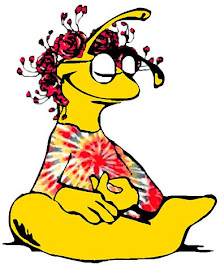
The Grateful Dead has made its extensive archives available to and through The Grateful Dead Archives at the University of California at Santa Cruz. “Go Slugs!”

The Grateful Slug
And you might be interested in Dead Central, a blog for the UCSC Grateful Dead Archive and the source of the above image of the Deadhead Banana Slug (talk about “mellow yellow”!).
Enjoy.
-RichardH