Yearly Archives: 2011


Texas’ Fast-Growing Debt Tops That Of U.S. Government’s

The article Texas’ Fast-Growing Debt Tops That Of U.S. Government’s shows one way to get around Constitutionally mandated balanced budgets.

For all the controversy over the national debt ceiling, here’s a surprise: Since 2001, the debt load in conservative Texas has grown faster than the federal debt.

Local borrowing accounts for almost 85 percent of public debt in Texas, because the government is so decentralized.

Still, the trend is undeniable. While Texas lawmakers have refused to raise taxes — and often criticize Washington for borrowing and spending — the state has been paying for much of its expansion with borrowed money.

Texas doesn’t appear to be overextended. In a May report, Standard & Poor’s gave the state an AA+ rating, citing its outperforming economy, strong cash management and constitutional limits on debt.

The Texas state government finds it east to stay within its constitutionally mandated balanced budget limits.  The state just pushes off the task of coming up with the money onto the local governments within the state.

You don’t suppose that if we had a federal balanced budget constitutional amendment, the state and local governments would be forced to pay for what the federal government could no longer fund?


Who Raised The Debt Ceiling

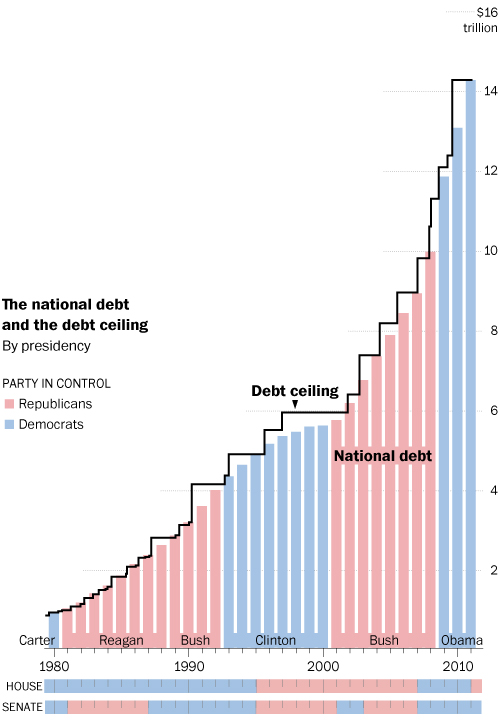
The Washington Post with Bloomberg have a brief article,  Who Raised The Debt Ceiling, with a very interesting graph.

Graph of who raised the debt ceiling in the past

Notice the rise of the debt start to rollover under Clinton. The Republicans may have had control of Congress at the time, but the leadership fought Clinton tooth and nail. They claimed his raising tax revenue would kill the economy and increase the deficit. Clinton got his way anyway with almost all the Democrats and a few Republicans voting for what he wanted. History tells us Clinton was right and the Republicans who fought him were completely wrong.


From the post 1993 Deficit Reduction: a Lesson on Tax Policy by Charles M. Kelly, I selected the following part.

1993 Deficit Reduction: A lesson on taxes, economic growth, and jobs—as reported by America’s premier CONSERVATIVE financial daily news publication:

The Wall Street Journal

     Conservative politicians always threaten the public that, if Congress or the President raises taxes on the wealthy, the economy will slow down, unemployment will go up, and workers’ wages will go down.

     Conservatives’ hidden agenda: we want to allow our wealthy supporters—the ones who benefited most from the economic policies that forced huge sacrifices onto American workers during the 1980s and 90s—to be able to keep more of their money.

     Reality: Raising taxes on the wealthy is much more likely to reduce the deficit and make more money available to proactively solve America’s problems—and save money in the long run. In addition, it may have absolutely no negative effect on economic growth, jobs or wages.

     Here’s what conservative politicians said about the 1993 deficit reduction legislation that raised taxes on the top 1.2% of our wealthiest citizens:

“Clearly, this is a job-killer in the short-run. The impact on job creation is going to be devastating.”

—Rep. Dick Armey, (Republican, Texas)

“The tax increase will…lead to a recession…and will actually increase the deficit.”

—Rep. Newt Gingrich (Republican, Georgia)

“I will make you this bet. I am willing to risk the mortgage on it…the deficit will be up; unemployment will be up; in my judgment, inflation will be up.”

—Sen. Robert Packwood (Republican, Oregon)

“The deficit four years from today will be higher than it is today, not lower.”

—Sen. Phil Gramm (Republican, Texas)

“The President promised a middle-class tax cut, yet he and his party imposed the largest tax increase in American history. We hope his higher taxes will not cut short the economic recovery and declining interest rates he inherited… Instead of stifling growth through higher taxes and increased government regulations, Republicans would take America in a different direction.”

—Sen. Robert Dole (Republican, Kansas)

The President Is Missing

This opinion piece,  The President Is Missing, by Paul Krugman was brought to my attention by LlandaR. In the article Krugman says:

What’s going on here? Despite the ferocious opposition he has faced since the day he took office, Mr. Obama is clearly still clinging to his vision of himself as a figure who can transcend America’s partisan differences. And his political strategists seem to believe that he can win re-election by positioning himself as being conciliatory and reasonable, by always being willing to compromise.

I can believe that Paul Krugman is on to part of the problem, but I think that the bigger problem is that President Obama does not understand the situation and the stakes.  That is why I have called for an intervention from economists such as Krugman, Kuttner, Stiglitz, Galbraith, Romer, Reich, etc.  They have to find out what Obama understands about the damage that highly unequal wealth distribution does to the chances for an economic recovery.  If he doesn’t understand the issue, how can he be expected to take a strong stand?

Earlier today, I posted the graphic that shows Wealth and Tax Distribution. While the wealthy top percent or so do earn an inordinate fraction of the income, the Republicans point out that they pay an even higher percentage of the income taxes. However, the Republicans never tell you how income does not include such items as unrealized capital gains.  That is why I felt a measure of wealth versus taxes was a better indicator of the disparity.

Another post I made today, The L Curve Of Income, points out that:

In Bill Gates’ best year he increased his net worth by $50 billion!

Now the naysayers are going to claim unrealized gains don’t count because they could go away almost as easily as they came.  It is true that there is year to year volatility, but the long term average increase in the value of the American stock market is on the order of 10% to 12% per year.  So the wealthy may have their ups and downs, but all they have to do is invest in an index mutual fund to make an average of 10% to 12% a year in increased wealth.  As long as they leave it unrealized, they pay no taxes on it.


Wealth and Tax Distribution

You hear conservatives tell you that the wealthy pay a larger percent in taxes than their income would merit. What you don’t hear is that a lot of their increase in wealth is not counted as income. I thought I would try to find a plot of wealth versus taxes. Here is one example that I cannot vouch for, but since it is in nice colors, it must be true.

Wealth -Tax Distribution


American Dream House Meeting Agenda

I have decided that I will be able to attend an American Dream House Meeting on Saturday, July 15, 2011.

The email that I have just received has a link to the agenda for the meeting and a link for organizing a rapid response Congressional action on Monday.


“Dangerous Precedent” Being Set in Debt Ceiling Debate, Galbraith Says


Professor James Galbraith of The University of Texas, says we’ve entered “a tragic moment” in history where our elected officials are more apt to put ideology before the good of the entire country.

“This is not the way we should be perusing these issues,” he tells Aaron in the accompanying interview. “We run the risk, first of all, of turning our government into a series of blackmail negotiations, where the full faith in credit of the United States government … becomes a kind of football for the various political agendas: the Republican agenda but also the President’s agenda on a long term deficit deal.”


D.C. Politicians “Totally Wrong” About Spending, Galbraith Says


But Washington politicians have it “totally wrong,” according to Galbraith who believes austerity measures amount to “a wanton piece of cruelty” on lower income Americans. Furthermore, he argues America’s long-term deficit problems are “completely disconnected” from current U.S. borrowing costs, which he notes remain relatively (and historically) low.

“My view is we’re in a tragic moment where public policy is doing real harm on a pretense of accomplishing something that’s absolutely not going to be accomplished,” Galbraith says.

Over the years I have read and enjoyed some of what Prof. Galbraith has written. This is the first time I have seen him and heard him speak. What a refreshing point of view.


Raise The Ceiling or Lower The Floor

Raise the ceiling or lower the floor political cartoon

I received this cartoon in an email from RootsAction At Our Limit campaign

The politicians in Washington have it all wrong. Republicans and Democrats are focused on the debt ceiling – and are preparing to make cuts to Medicare and Social Security while keeping huge tax cuts for billionaires. We’re saying no way. We want to talk about what most Americans need in the budget – and how we can pressure Democrats to hold the line and push our needs forward.