A store employee at the Clackamas Town Center mall used his knowledge of the shopping complex to hustle his mother out of the building during Tuesday’s shooting rampage and then twice went back inside to guide other shoppers to exits and safety.
This is particularly scary to us. We used to frequent the Clackamas Town Center when we lived in Oregon. We often ate at the Food Court, too.
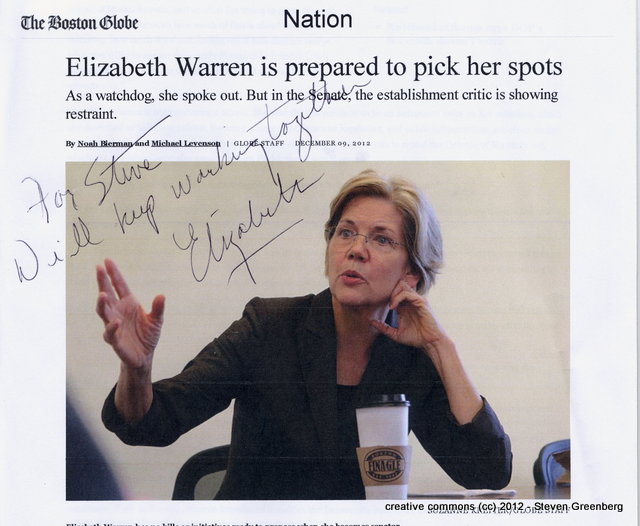
Since we were going to Kate Donahue’s annual Christmas party in Westbooro where Elizabeth Warren was scheduled to appear, we decided to print out the article and get her autograph on it.
EPSTEIN: Well, they do set up this bidding process, and it’s a race to the bottom, and it’s become—as the New York Times series makes clear, it’s become part of the normal culture of doing business now.
How do you stop it? Well, one way you stop it is you take a proposal from a couple of the economists and the president of the Federal Reserve Bank of Minneapolis about 15 years ago, who said that there ought to be a federal law outlawing this kind of tax competition. Everybody would be better off, and even the states realize that. It’s like an arms race. When you get into an arms race, you know that everybody’s worse off. So you ought to have a law against it.
I have been thinking for a long time that the only way to stop this race to the bottom inside the country is to prevent it on a national level. I am glad to see this idea is getting some publicity.
With the constitutional mandate that only the Federal Government can regulate interstate commerce, I would think such a law would be a natural.
If we can do it within a country, there is no reason we couldn’t have international negotiations for nations to take back power from corporations.
New Economic Perspectives has the article Paying for Lunch – MMT Style, MMT being Modern Monetary Theory, and the paying for lunch has to do with the common aphorism, “There is no free lunch.” The article starts of with some criticisms of MMT before it gets to the definition below:
Many of the key ideas of Modern Monetary Theory go back to the years during and immediately following the Great Depression and the Second World War, when great thinkers and public servants applied bold, creative thinking and practical problem solving to the daunting economic and organizational challenges of their times, and helped their societies overcome systemic failure, triumph over threats and adversity, and achieve renewed optimism and growing prosperity. One of those thinkers was Abba Lerner, who developed the concept of functional finance, which he described this way in his paper “Functional Finance and the Federal Debt”:
The central idea is that government fiscal policy, its spending and taxing, its borrowing and repayment of loans, its issue of new money and withdrawal of money, shall be undertaken with an eye only to the results of these actions on the economy and not to any established traditional doctrine what is sound and what is unsound.
Lerner then articulated two “laws of functional finance”, which I think still very well capture the spirit of the MMT approach to economic policy. The two laws are given as follows:
The first financial responsibility of the government (since nobody else can undertake that responsibility) is to keep the total rate of spending in the country on goods and services neither greater nor less than that rate which at the current prices would buy all the goods that it is possible to produce.
…
The second law of functional finance is that the government should borrow money only if it is desirable that the public should have less money and more government bonds, for these are the effects of government borrowing.
Read the rest of the article to get the full impact. It might blow your mind.
When the discussion of Susan Rice starts, the video cuts to a 2008 interview of Rice by Paul Jay.
JAY: You talk to anyone who knows the situation, they know more troops in Afghanistan is—unless there’s hundreds of thousands of troops in Afghanistan for years to come, it’s not going to significantly change the situation without dealing with warlords and dealing with reconstruction.
SUSAN RICE, SENIOR FOREIGN POLICY ADVISER TO SEN. BARACK OBAMA: Not by itself. I mean, I mentioned very—I said, coupled with the economic and political steps.
JAY: So what would be concrete steps?
RICE: Well, we have underinvested in Pakistan and Afghanistan, but particularly Afghanistan, with respect to the counterterrorism effort. We haven’t done the socio and economic investments in infrastructure and education in alternatives to poppy.
Later in the interview with Wilkerson, he refers back to the snippet of the Rice interview that he had just chosen to show us and remarks:
JAY: When I interviewed her in New Hampshire, I was primarily focused on candidate Obama’s position on the Afghan War, essentially to expand it, and I asked her, well, doesn’t there—if you’re going to expand, don’t you really have to expand solving problems facing the Afghan people in a serious way? A lot of rhetoric’s been thrown around about doing something to win the hearts and minds of Afghanistan, the Afghans, but very little in terms of real money and real on-the-ground action. She kind of said, oh, yeah, yeah, yeah, and kind of dismissed it. Her main argument was about increasing troop levels.
I don’t know about you, but I didn’t hear Rice say what Paul Jay says that she said. If he wanted to make this point, couldn’t he have chosen a better snippet from the interview? I presume that since he did the choosing of the snippet, that a better snippet to make his point could not be found.
I have a perverse conspiracy theory for you. The Republicans actually want Susann Rice as Secretary of State. They are making the silly charges about her remarks on Libya so as to back Obama into a corner where he has to stick by Rice in order to not look like a weakling. If they really didn’t want Rice, they would focus on the issues raised by Jay and Wilkerson in this interview.
The other side of this odd conspiracy may be that the Obama side has realized that they cannot get Rice approved for Secretary of State and therefore feel the need to save face by pointing out her flaws as justification for dumping her.
This political business can get so convoluted it makes you dizzy.
Let’s start with the obvious but important: on entering the Oval Office in January 2009, President Obama inherited a seemingly impregnable three-decade-long “Wall of Mistrust” in Iran-U.S. relations. To his credit, that March he directly addressed all Iranians in a message for Nowruz, the Iranian New Year, calling for an “engagement that is honed and grounded in mutual respect.” He even quoted the thirteenth century Persian poet Sa’adi: “The children of Adam are limbs of one body, which God created from one essence.”
And yet, from the start he was crippled by a set of Washington misconceptions as old as that wall, and by a bipartisan consensus for an aggressive strategy toward Iran that emerged in the George W. Bush years when Congress ponied up $400 million for a set of “covert operations” meant to destabilize that country, including cross-border operations by special forces teams. All of this was already based on the dangers of “the Iranian bomb.”
.
.
.
With an Obama 2.0 administration soon to be in place, the time to solve the immensely complex Iranian nuclear drama is now. But as Columbia University’s Gary Sick, a key White House adviser on Iran during the Iranian Revolution and the Tehran hostage crisis of 1979-1981, has suggested, nothing will be accomplished if Washington does not start thinking beyond its ever-toughening sanctions program, now practically set in stone as “politically untouchable.”
Reading this full article might get you thinking outside the box in which the administration seems to be locked.
Many of you will probably react with anger over the mild suggestions in this article, possibly due to the propaganda you have been fed by our own mefdia and politicians.
I am not naive enough to think that Pepe Escobar may not have his own agenda. Yet, long before I read this article, I have been thinking that the U.S. position on Iran has been unnecessarily and unproductively bellicose. This article just explains the reasons why I have felt the way that I have.
I do not want you to think I am hiding anything here, so I will feed you some information that may reinforce your biases. But remember that what is being reinforced for you may be a bias.
According to TomDispatch.com, where I think this article may have first been published:
Summing it all up, Conason ends with the following:
Unless and until the Republicans start talking about real numbers that can actually add up, there is nothing to be gained from pretending to negotiate. Nor should the president start negotiating with himself, as he has sometimes done in the past. Instead, he ought to make sure that the opposition understands what will happen when they fail to act responsibly. After Jan. 1, he will bring them an offer they cannot refuse to restore cuts for the 98 percent — and they will be held accountable for any consequences caused in the meantime by their stalling.
The preceding points in the article give some details of the failure of Republican arithmetic. The Republican proposals actually hide more than they reveal about what they really want to do to us.
Yes, America does face a cliff — not a fiscal cliff but a set of precipices we’ll tumble over because the GOP’s obsession over government’s size and spending has obscured them.
The three cliffs are:
The child poverty cliff.
The baby-boomer healthcare cliff.
Healthcare costs are already 18% of GDP. Between now and 2030, when 76 million boomers join the ranks of the elderly,those costs will soar. This is the principal reason why the federal budget deficit is projected to grow.
The Affordable Care Act offers a start but it isn’t nearly adequate to limit these rising costs. The President and the Democrats have to lead the way in using Medicare and Medicaid’s bargaining power over providers to get lower costs and to move from a fee-for-service system to a fee-for-healthy outcomes system of healthcare.
But we can’t avoid the fact we have the most expensive and least effective system of health care in the world that’s spending 30 percent more on paperwork and administration than on keeping people healthy. The real healthcare cliff can only be avoided if we adopt a single-payer healthcare system.
The environmental cliff.
For people obsessed with the deficit, read the section on The baby-boomer healthcare cliff. It is a good explanation of what the real problem is, what Obama has tried to do to solve it, and what more needs to be done. All the rest of the malarkey coming from the Republicans is just noise.
Well, what’s happening is that we are scheduled, unless something is done, basically to do to ourselves gratuitously what has been happening to some of the European economies.
We’re going to have substantial spending cuts, substantial tax increases at a time when the economy is still very weak. And, of course, that’s a recipe for sliding back into recession.
So, we set ourselves up with the land mine in the road in front of our economy, which is not based on anything real. It’s just based on our political mess.
I find the following exchange typical of many interviews you hear from the so called news media.
GWEN IFILL: Among the critics of his plan are those who say that it doesn’t do anything or speak at all to the question of entitlement reform or at least cutting the costs of entitlement.
PAUL KRUGMAN: That’s a very weird thing. It does, in fact. It actually cut a substantial amount from Medicare spending.
It actually — of course, the Affordable Care Act, Obamacare, does a lot to curb the long-run growth of Medicare costs.
So, there’s actually a lot in there. He’s actually done more to bring down the cost curve for Medicare than anyone has ever done before.
But in Washington, that is considered not serious because he’s not actually taking benefits away from people who need them. So, it’s a really weird thing. It’s only considered serious if you inflict pain on vulnerable people.
Obama is actually very serious in the real sense. It’s just the notion he hasn’t done anything on entitlement reform is totally unfair. He’s done more than anyone has ever done before.
GWEN IFILL: Well, talk about one part of the Republican, if you want to put air quotes around it, plan, as you replied, and that’s the idea of raising the eligibility age for Medicare. Why isn’t that something that might actually be a big first step?
Gwen Ifill’s follow-up question seems to indicate that she didn’t pay attention to a thing that Paul Krugman said in his previous answer. Krugman just got through telling Ifill about the first big steps to rein in Medicare costs that is in Obamacare. Then Ifill asks why a minor step of raising the eligibility age for Medicare might not be a big first step. What part of “He’s done more than anyone has ever done before” did Ifill not understand?
U.S. Senator-elect Elizabeth Warren, the Harvard University law professor and critic of Wall Street, is poised to join the Senate Banking Committee after she’s sworn into office in January.
Two Democratic aides briefed on the matter said Senate leaders intend to assign Warren to the Banking Committee, although a final decision on committee assignments won’t be made until the new session of Congress convenes.
Let’s hope that this really comes to pass. According to the article:
“We certainly plan to reach out to Senator-Elect Warren,” said James Ballentine, executive vice president of congressional relations and political affairs at the American Bankers Association.
If the American Bankers Association is taking this report seriously, maybe they have given up trying to block this assignment. I hope you weren’t drinking anything when you read that last sentence. If you were, you might want to wipe your computer screen.