Yearly Archives: 2012


What Is Republican Economist Glenn Hubbard Thinking Department?

Apropos of my questioning of Glenn Hubbard’s intelligence and/or integrity (see Romney’s “Recovery Plan” Could Bring On Another Recession) comes the post Hoisted from Comments: Simon van Norden: What Is Republican Economist Glenn Hubbard Thinking Department? So i am hoisting what has already been hoisted, and it was already too complicated for me to figure out which words were coming from which mouth (or keyboard).

Hoisted from Comments: Simon van Norden: What Is Republican Economist Glenn Hubbard Thinking Department?

Hoisted from Comments: Simon van Norden:

Matthew O’Brien Schools Republican Economist Glenn Hubbard…: To understand the integrity of Hubbard’s argument, consider his claim that

[U]ncertainty over policy–particularly over tax and regulatory policy–slowed the recovery and limited job creation. One recent study by Scott Baker and Nicholas Bloom of Stanford University and Steven Davis of the University of Chicago found that this uncertainty reduced GDP by 1.4% in 2011 alone.”

Note the phrase “this uncertainty: he’s talking about uncertainty “particularly over tax and regulatory policy.” Now read the analysis by Baker, Bloom and Davis http://www.epi.org/files/2011/PolicyUncertainty.pdf. From their abstract

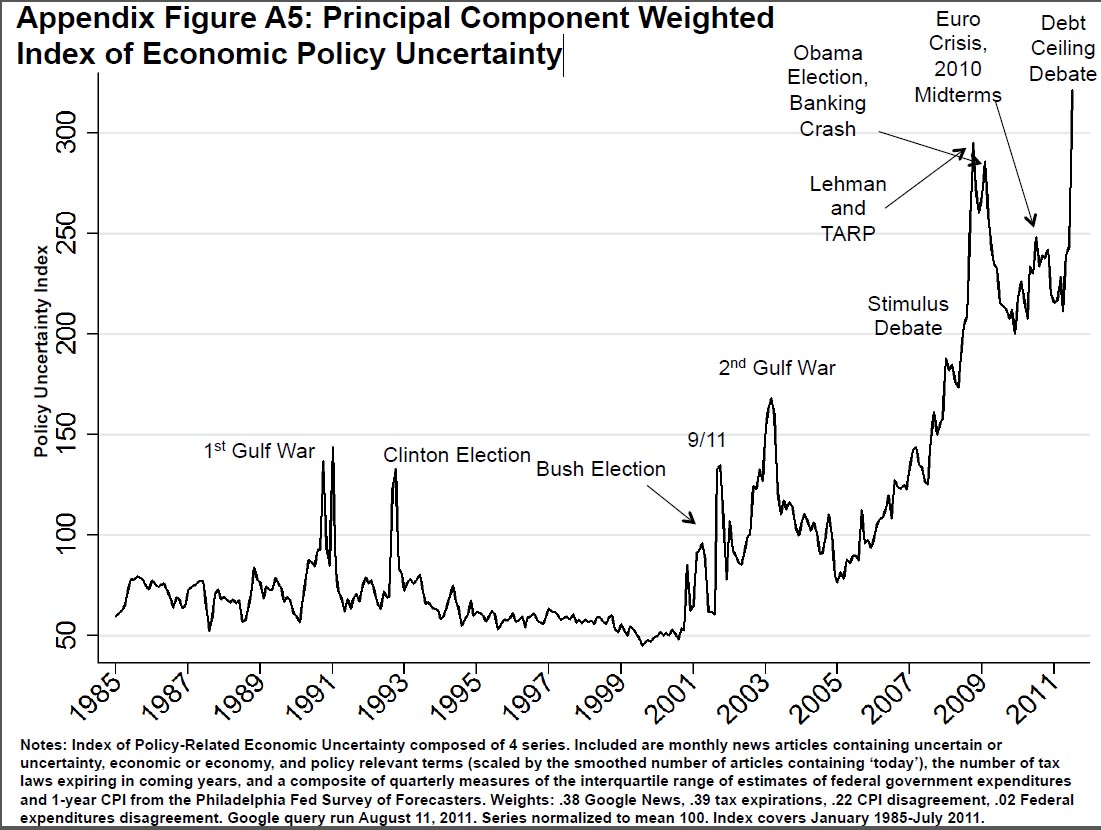
The index spikes around presidential elections and major events such as the Gulf wars and the 9/11 attack. Index values are high in recent years and show clear jumps associated with the Lehman bankruptcy, the 2010 midterm elections, the Euro crisis and the U.S. debt-ceiling dispute.

Uncertainty over regulatory policy? No mention. Uncertainty over tax policy? No mention. What Hubbard seems to be doing is interpreting the uncertainty created by elections (and the debt-ceiling showdown) as uncertainty about regulatory and tax policy (as opposed to, say, government spending.)

As I have said, uncertainty over where is the next customer for my products in my warehouses going to come from is a major cause of corporations not investing the surplus money that they have. Well, they may be investing it in non-productive financial games and derivatives, but certainly not in much hiring or factories.

The other thing worth realizing is that uncertainty might be bad for the economy, but erasing all uncertainty by definitively picking the wrong policy would be even worse. So considering the possibilities, a little uncertainty, bad as it is, might be better than the alternative.


To be fair to Glenn Hubbard, I show this image from the the analysis by Baker, Bloom and Davis http://www.epi.org/files/2011/PolicyUncertainty.pdf.

Chart from Policy Uncertainty study

The index does include stories about tax policy, but those are not the issues that the authors highlight on the chart.

From earlier in the report, we have:

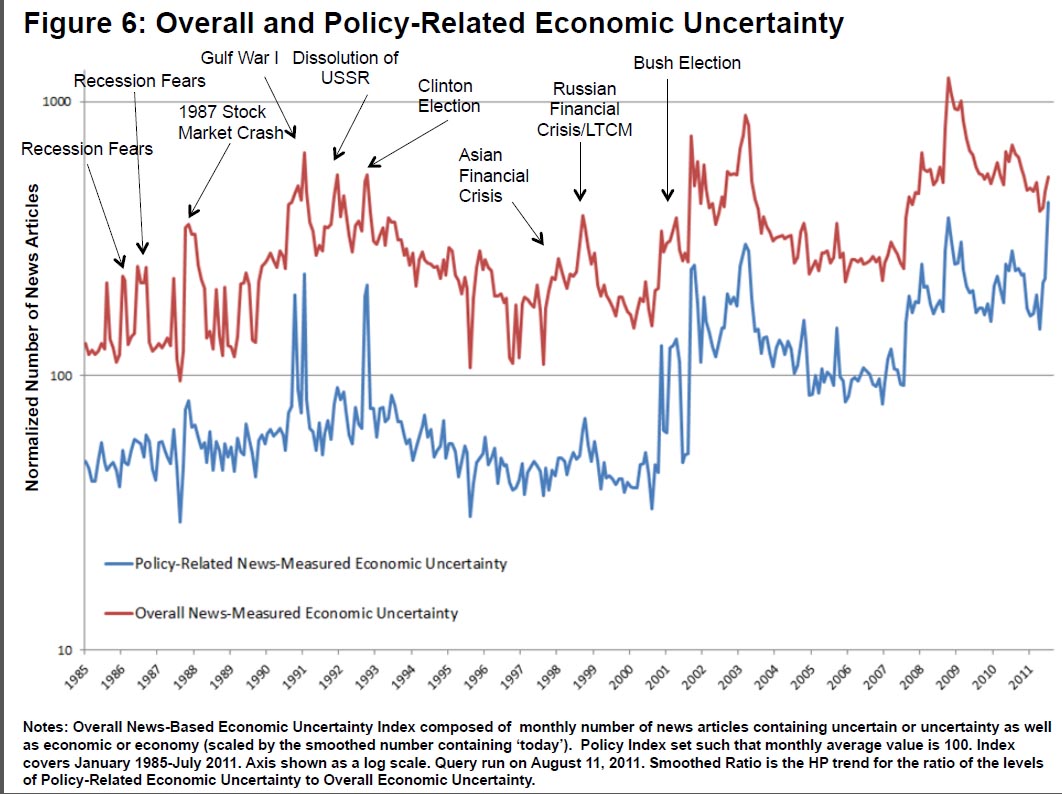
In summary, Figures 6 and 7 make three points. First, according to our news-based approach, overall economic uncertainty is considerably higher in the past 10 years than in the previous 15 years covered by our sample period. (See Table 1 as well.) Second, policy-related uncertainty has increased more rapidly than overall uncertainty. As a result, it accounts for a larger share of economic uncertainty in the past decade, more than 50% since 2005 and peaking at an astonishing 80% in July 2011 during the debt-ceiling debate. Third, policy uncertainty accounts for most of the high-frequency movements in economic uncertainty since 9/11, and a considerably larger share than in earlier periods. These results imply that policy-related concerns are an increasingly important aspect of overall economic uncertainty, and that by July 2011 they appear to be the major driving force behind movements in overall economic uncertainty.


Policy Uncertainty Figure 6

Policy Uncertainty Figure7

So far I have only included talk of the measures of uncertainty, but what about the impact on the economy?

Of course, this approaches identifies relationships between variables from our Cholesky ordering and differences in the timing of changes in each variable. So, for example, it could be that policy uncertainty causes recessions, or that policy uncertainty is a forwardlooking variable that rises in advance of anticipated recessions. With these caveats in mind, the VAR estimates provide evidence at least of important co-movements between our index of policy-related uncertainty and economic activity, with some suggestive evidence on causation.

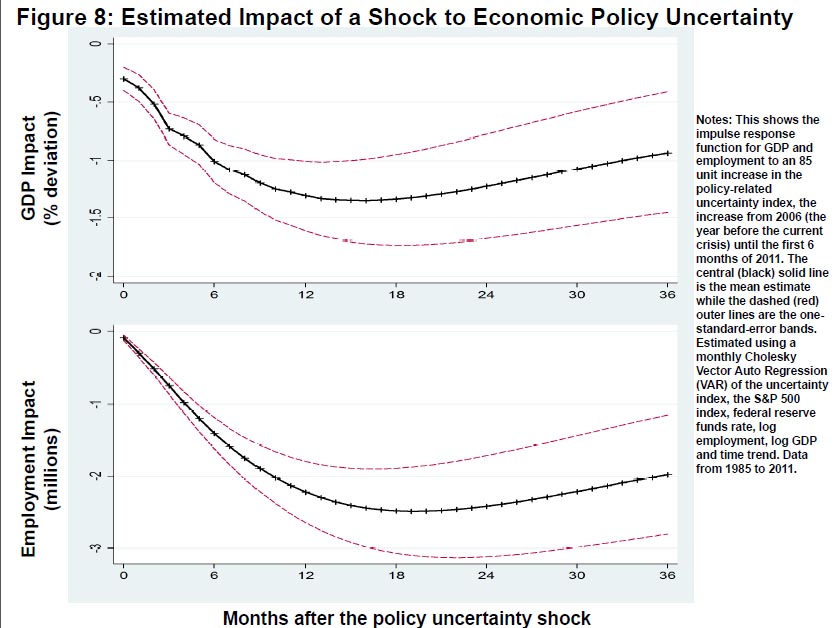
Looking at Figure 8, we see that an 85 point rise in policy uncertainty (the rise in our policy uncertainty index from 2006 to the first six months of 2011) is followed by a persistent fall in real GDP with a peak negative impact of about -1.4% at 15 months. Similarly, it also followed by a persistent fall in employment, with a peak effect of about 2.5 million at 18 months. These appear to be substantial effects, lending support to recent concerns over the damage of policy uncertainty on economic activity.

These effects of political uncertainty on growth and employment appear to be robust to controlling for other related factors. For example, if we add controls for broad economic uncertainty using the index in Figure 6 or from Bloom et al. (2009), we find that the impact of political uncertainty still yields a drop in real GDP of almost 1%. Similarly, using our Google News-based index of policy uncertainty, or changing the functional form by using the log of the uncertainty index (to get proportional increases) again leads to significant negative impacts on GDP and employment.


Policy Uncertainty Figure 8

I admit that I did not use a fine toothed comb on the report, but from my cursory reading, I see no attempt to look specifically for the effect of demand destruction on the ensuing economic behavior. You would think that this would be an obvious thing to consider, except for the complete absence of any discussion of this from most of the main stream press. I guess it is not so obvious to business news reporters. Covering business and covering the economy require different skills from a reporter. I am not sure the business reporters have the skills to understand the economy.


Israel’s Fading Democracy

The New York Times has the opinion piece Israel’s Fading Democracy by Avraham Burg.

The emotional extortion compels Jews to pressure the Obama administration, a government with which they actually share values and worldviews, when those who love Israel should be doing the opposite: helping the American government to intervene and save Israel from itself.

As a Jewish child you either learn to resist emotional extortion, or …

I guess I don’t know what the … is, because I did eventually learn the lesson.  I hope there are enough Jewish people in this country who were also able to learn the lesson and still want to save Israel from itself.  Of course we might want to save the United States from itself first.


Major Banks Help Clients Hide Trillions in Offshore Tax Havens

The Real News has the video Major Banks Help Clients Hide Trillions in Offshore Tax Havens.


According to these number a ¼ or more of the annual gross national product of the world is hidden away in tax havens.

I wonder how much of this money is invested in non-productive financial derivatives with a notional value that is 14 times the gross national product of the world.


Democrats File Lawsuit to Reinstate Voting Rights in Ohio

First, I’ll give you the Obama campaign response from  the news story.

According to Faux Noise, Mr. Obama responded to the Romney campaign by saying “Mitt Romney and his campaign have completely fabricated a claim that the Obama campaign is trying to restrict military voting in Ohio. In fact, the opposite is true. The Obama campaign filed a lawsuit to make sure every Ohioan, including military members and their families, has early voting rights over the last weekend prior to the election.”
.
.
.
“Along with the DNC and Ohio Democratic Party, this campaign filed a lawsuit to reinstate equal, early-voting rights for all Ohioans — rights the Republican-controlled legislature arbitrarily stripped away this past year,” said Obama’s campaign manager, Jim Messina, in an email to supporters.

Then, I will give you the headline to the story, Mitt Romney slams Obama lawsuit targeting military voting law.

The Republicans have a knack for passing laws to screw one set of citizens and then blaming people who complain of being against the set of citizens who were not screwed.  Cute trick.  I wonder how many people are silly enough to buy this tactic.

I suppose the Democrats could have avoided being branded this way if they just let the Republicans get away with restricting early voting.

And I suppose the new media could have avoided playing into the Repubilcans’ hands by choosing the shorter headline that I used instead of the one they did use.


Romney foolishly said the Federal Reserve should not do more monetary stimulus

Reuters has the article Romney says new Fed stimulus would risk inflation.

Republican presidential front-runner Mitt Romney on Monday said the Federal Reserve should not go ahead with another round of monetary stimulus to boost the U.S. economy, because it would risk kicking up inflation.
.
.
.
“Another round of quantitative easing is not the solution for the economy, and could mean inflation down the road,” Romney told Faux Noise. “It’s not the right thing to do.”

Of course the Fed wouldn’t have to do monetary easing if the Congress would agree to a stimulus plan that included direct government spending on all the things that Elizabeth Warren would have the government spend it on.

Be that as it may, worrying about inflation at some unknown distant point in the future while the Fed has been unable to produce enough inflation now is a silly thing to be thinking about with the current problems we have.  If the fed were able to produce its target rate of inflation, it would certainly be able to take action if the inflation rate exceeded its target.  Given how hard it has tried to boost inflation and how unsuccessful it has been, if it finally does manage to create some inflation, all it would have to do is stop its current efforts or perhaps reverse them, to stop inflation from getting out of hand.

Given how hard the Fed has tried to boost inflation and how little inflation we have – we actually have deflation in the housing market – can you imagine the even higher deflation in the housing market that we would have had had the Fed not intervened?

Why is some inflation in the housing market good and large deflation extremely bad?  For years, people have made plans based on a fairly small, but dependable rate of inflation in the housing market.  The banks have always factored this into their plans as well.  The inflation is what allowed homeowners to sell a fairly illiquid asset, real estate, when they had to in order to move to where the jobs are.  This inflation is also what allowed homeowners to build their equity so that they would have something on which to retire.  This equity buildup due to inflation was magnified to the homeowner because of the leverage they were using with the borrowed mortgage money to finance the purchase of the real estate.

Take this all away, and even deflate the asset on which they borrowed money and you have leverage working against the homeowner.  They cannot move to a better job market because they would have to raise money in order to pay off their mortgage on a home that was worth less than the mortgage on it.  Not only is the falling house price not adding to their nest egg for retirement, it is actually shrinking their retirement nest egg.

Excess equity in a house is also a resource you can use if there should be unexpected disasters such as unexpected illness, sudden death of the wage earner, divorce, or loss of a job and long term unemployment.  If you are underwater in your mortgage instead of having excess equity, not only is the house not a resource you can tap, it is actually an extra burden to bear.

With all these actual or imaginable problems facing the middle-class, they are desperately trying to cut their spending and trying to save money in ways that compensate for the housing problem.  This is why businesses have not enough freaking customer to keep their existing employees and factories busy.  Giving companies even more than the trillions of cash they are already sitting on is not going to make the middle-class become better customers.

As a matter of fact, companies taking trillions of dollars out of the economy and parking them in non-productive financial derivatives until the economy turns around is one of the many factors keeping the economy from turning around.

So taking money out of the hands of the corporations and putting it back into the economy would be a good thing to do.  This means raising taxes on corporations and the wealthy individuals that control them.  It makes absolutely no sense to do the opposite by lowering their taxes and allowing them to pull even more money out of the economy.  This pulling money out of the economy may be the very reason that the Fed’s pouring money in is having such little effect.

That the Republicans can pretend that they don’t see these realities  and then propose solutions that will make matters much worse, makes you want to apply Greenberg’s Law of Counterproductive Behavior.  What are the Republican’s trying to do?  The answer involves the book The Shock Doctrine. You may actually have to read more than what I have posted about the book to see the connection.  The short answer is that they are trying to shock the middle-class into accepting lower wages, poorer working conditions, and cuts to government investment in the education and health of the people.  With globalization, they intend to make money from customers elsewhere.  Or maybe they just think they can steal the existing customers from their competitors faster than their competitors can steal customers from them.  Somehow, they intend to have enough customers without having to pay living wages to workers.  Can they not see that a person who is a worker in one context is a customer in another?

You have to ignore this identity of worker and customer to think that Mitt Romney’s idea of business management being blindly applied to macroeconomics would be successful.


Romney’s “Recovery Plan” Could Bring On Another Recession

The New Yorker has the article Romney’s “Recovery Plan” Could Bring On Another Recession which echoes my thoughts when I first read the plan.

In today’s Wall Street Journal, the Columbia economist Glenn Hubbard, who is one of Mitt Romney’s top economic advisers, has an op-ed piece entitled “The Romney Plan for Economic Recovery.”
.
.
.
When Hubbard eventually gets to laying out Romney’s alternative, there is nothing new either, just a reiteration of the existing policy plaform: a vague promise to cut federal spending and reduce the budget deficit, an even vaguer plan to cut taxes but in a “revenue-neutral fashion,” and a commitment to repeal Obamacare and Dodd-Frank. Judging by this piece, and by recent statements from Romney himself, the G.O.P. campaign still doesn’t have a recovery program worth the name. Indeed, if we are to believe the evidence of our eyes and ears, he remains committed to immediate spending cuts that could well bring on another recession.

Companies are sitting on trillions of dollars of cash which they do not spend on new factories and hiring employees because there are no freaking customers to keep busy the factories and employees that they already have.  What kind of nutbag CEO would invest in more workers, when they have too many?

Glenn Hubbard, dean of Columbia Business School, and former chairman of the Council of Economic Advisers under President George W. Bush, is an economic adviser to Gov. Romney. Somebody should ask Glenn Hubbard to give us the detailed explanation of the economic theory that would cause economic expansion give the situation with corporate free cash that I describe above.

They would have to invent a special kind of Nobel Prize to award him if he were able to cite such a theory. If not, he should be fired as dean of Columbia Business School. What could he be doing for the students at that school when he can spout such foolishness about economics? Either he is totally unqualified to be guiding curriculum on economics, or he would be showing students that it is OK to say anything to get your man elected.

We have had enough of this “say anything to make money” from the people trained in our business schools to last an eternity. We certainly don’t need any more of it from the likes of Glenn Hubbard.


Obama “Planned Parenthood” Ad


Dawn: “I think Mitt Romney’s really out of touch with the average woman’s health issues…”
Alex: “This is not the 1950s. Contraception is so important to women…it’s about a woman being able to make decisions…”
Dawn “I don’t remember anyone as extreme as Romney.”
Mitt Romney: “I’ll cut off funding to Planned Parenthood.”
Alex: “I don’t think Mitt Romney can even understand the mindset of someone who has to go to Planned Parenthood.”
Mitt Romney: “Planned Parenthood. We’re going to get rid of that.”
Dawn: “I think Romney would definitely drag us back.”


Given the statistics of contraceptive usage, you wonder what fraction can be siding with Romney on this issue. Women, at least, would have to be deluding themselves to believe Romney is on their side. I have no doubt that a lot of delusion is going on.


Why Are Small Countries Better at Economics?

I just have to post a link to the blog post Why Are Small Countries Better at Economics? by Ryan Louis Cooper.

My liking of the post started with a great statement about famed physicist Richard Feynman.

Yet today the Fed announced that though not only are they missing their employment target and their inflation target, they’re still not going to do anything. It’s as if we put Richard Feynman in charge of NASA, and he started talking about creationism and homeopathy. Barring mental illness, clearly something else is at work.

The point of the blog post is:

This rough inverse correlation between size of economic unit and quality of outcome (USA, Eurozone = failures; Sweden, Australia, Canada, Israel = successes) suggests that this is about power and money. In smaller countries, where banks don’t have the kind of money and sheer size to command the complete attention of the world media when they get in trouble, the power gap between them and the regulators is small.

But, he finally gets to the heart of the matter as to why this is true:

All incumbent creditors will act to keep inflation as low as possible, it seems. If that means years of depression, so be it.

All the troubles with underwater mortgages and foreclosures would be helped by a little inflation that would slowly get the value of the houses to be greater than the money owed on them.  That would save the home owners.  Of course, if the home owners repaid their loans with money that was lower in value, that would eat into the profits of the banks.

So it is not a question of whether or not it is possible to get the economy going again.  It is a question of how we share the pain.  If we put all the burden on the borrowers and none of it on the lenders, then we are in for a long slog.  Even the lenders could go under, too, trying to protect the value of their loans, but they would rather take their chances that they might not.  Are the banks being realistic to ever think they will get all of their principle back in uninflated dollars?  Can you get blood out of a stone?


Porn star Jenna Jameson endorses Mitt Romney

Yesterday, I read the story Porn star Jenna Jameson endorses Mitt Romney.

Porn star Jenna Jameson chose a familiar stage to make her endorsement for the 2012 presidential election Thursday night. At a San Francisco strip club, the former adult actress and stage performer said she was ready for a Romney presidency.

Today, I found The New Yorker story Jenna Jameson Clarifies Her Endorsement of Romney.

Concerned that her endorsement of former Massachusetts governor Mitt Romney for President would lead to “cheap, easy jokes and innuendo,” porn star Jenna Jameson held a press conference today to explain her headline-making decision.

I just thought it was important to publish this clarification.