Only In America Would We React This Way To Obamacare
JaneS sent this to me in email. I just had to post it.
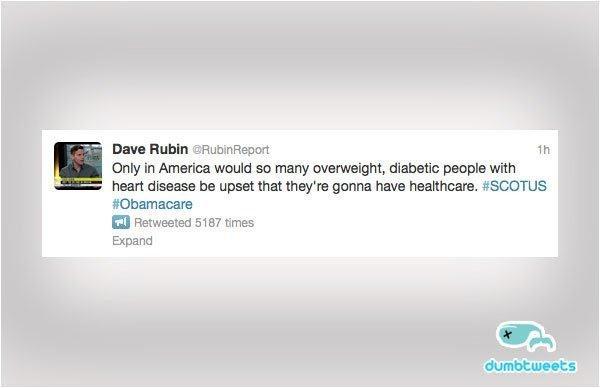
I expect Mitt Romney and Scott Brown to tell us the sky is falling.
JaneS sent this to me in email. I just had to post it.
I expect Mitt Romney and Scott Brown to tell us the sky is falling.
The Los Angeles Times and CBS News have the simplest and most concise telling of the story that I have found so far, Supreme Court upholds healthcare law as tax measure.
The U.S. Supreme Court upheld the constitutionality of President Obama’s healthcare law Thursday, ruling the government may impose tax penalties on persons who do not have health insurance.
If you want to get ahead of CBS News, see how fast you can read the 193 page decision.
You don’t suppose any of the media will cover the story of how they all read “the body language” of the Supreme Court Justices to mis-predict the outcome?
So the Supreme Court isn’t completely hopeless after all. Despite the poor presentation of the Obama administration, the court did manage to find its own reasons why this law is Constitutional. (I have to walk that last statement back. Upon reading some of the 193 page decision, I see that the tax angle was part of the Government’s case.)
On page 15 of the decision, I found:
The Government advances two theories for the proposition that Congress had constitutional authority to enact the individual mandate. First, the Government argues that Congress had the power to enact the mandate under the Commerce Clause. Under that theory, Congress may order individuals to buy health insurance because the failure to do so affects interstate commerce, and could undercut the Affordable Care Act’s other reforms. Second, the Government argues that if the commerce power does not support the mandate, we should nonetheless uphold it as an exercise of Congress’s power to tax. According to the Government, even if Congress lacks the power to direct individuals to buy insurance, the only effect of the individual mandate is to raise taxes on those who do not do so, and thus the law may be upheld as a tax.
Reader RichardH thinks I should post this, and I agree.

The Boston Globe has the story Elizabeth Warren blasts Mitt Romney as she introduces President Obama in Boston.
Democratic Senate candidate Elizabeth Warren lambasted Republican Mitt Romney Monday as she introduced his general election opponent, President Obama, at a Boston fund-raiser.
Teeing off on the former Massachusetts governor, Warren told a full house at Symphony Hall: “Mitt Romney tells us, in his own words, he believes corporations are people. No, Mitt, corporations are NOT people. People have hearts. They have kids. They get jobs. They get sick. They love and they cry and they dance. They live and they die. Learn the difference.”
Obama also attacked Romney during his 40-minute speech, but his remarks lacked the bite of the line uttered by Warren.
“Mitt, learn this,” she added. “We don’t run this country for corporations; we run it for people.”
.
.
.
“She has been a fierce advocate since before I knew her,” Obama said. “She is going to be an outstanding senator from Massachusetts.”
There is probably more video of her remarks on the web. I just haven’t found it yet.
Rachel Maddow offers a critique of Scott Brown’s latest political theater productions. After which Elizabeth Warren talks about real issues.
The Republicans must realize what shaky ground on which they stand with regard to the number one issue on most people’s minds, jobs and the economy. This is why they invent as many other things as they can that they think will divert people from realizing how many people they know who are unemployed.
Elizabeth Warren doesn’t seem to have any trouble focusing on what matters.
It is up to you, the voter, to decide what kind of politics you will reward with your vote. Are you going to let one side off the hook for their disastrous ideas on how to run an economy and a society by letting them divert your attention away from the issues that really matter? Or are you capable of keeping focused on the bread and butter issues that affect you on a daily, if not hourly, basis?
They distract, you decide.
The Yahoo! Daily Ticker has the video and article Ford’s Success Rests Upon a Strong Middle Class, Says CEO Alan Mulally.
Finally, a business leader who understands on which side his bread is buttered. Who better to state this than the CEO of Ford?
Mulally says, Middle class is really being squeezed
. Can you think of a well known candidate for U.S. Senate in Massachusetts who has been saying the same thing for years? If you don’t want to believe Elizabeth Warren because she is only a law professor who has studied the middle class for decades, perhaps the CEO of Ford might be more convincing.
This video tries to explain an issue that you may not have understood the full impact of.
Van Jones, a leading progressive activist and former member of the Obama administration had this to say:
When I first heard about all these young people graduating with a bunch of debt, first I thought “So?” I graduated with a bunch of debt from law school, and kids have to deal with that. It’s part of life. But here’s what I found out. The cost and price of education is going up, up, up. These young people are taking on extraordinary amounts of debt and they have no protection, no ability to get the banks to work with them on this. So they go into default very fast, and their credit rating is destroyed, and the banks are not helping them.
Apparently a lot of people including our Senator Scott Brown had the same misapprehension as Van Jones did. Brown has said so in public comments he made. Unfortunately, he makes up his mind on 20 or more year old experiences, and is not open to learning anything new in the way that Van Jones is.
Rebuild the Dream has a web page where you can find out how to contact your Senator about this. Maybe you can give Senator Brown the education he cannot get for himself.
I think I may have finally realized why I am not making any progress in explaining how I think the economic mess needs to be corrected.
Here is my letter addressed to a middle-class proponent of austerity.
It is my fault for failing to acknowledge the point you are making.
You are right in blaming some of the problems of the faltering economy on the excessive borrowing of the middle-class.
It is a mistake for me to argue my side, without first agreeing to the part the middle-class played.
When I do that, I lose the audience for hearing that the ultra-wealthy played an equal or even larger part in the debacle. My real point is that I do not want the discussion to focus on the price the middle-class has to pay for past excesses without having a discussion of the part that the other party to the excesses has to pay.
My problem with Germany is that they played a large part in encouraging the excesses of the other countries to borrow money to buy goods and make profits for Germany.
Now Germany wants to keep everything they gained by their taking advantage of the naivete of the other countries, and they want the other countries to pay for it with resources they just do not have. This formula cannot work, and nobody is going to come out a winner if this is the way that the solution is sought.
Both sides have to come together and admit they both played a part in the mess. It will take both sides to give up some of the gains they made during the bubble, to create a non-bubble, stable economy. So far, only the middle-class is weak enough to be forced to give up their gains. But economic reality will force the lower rungs of the ultra-wealthy to give up their gains, too.
Only when society wakes up to the fact that there is no solution until we get together to solve the problem will this nightmare end.
In trying to make a strong case for Keynesian solutions, I have failed to emphasize that I do understand that both sides of the economic struggle for gain have made huge mistakes. This leads me to make strong arguments only against the one side that refuses to take responsibility for their mistakes. I assume that it is a foregone conclusion that the side that is taking all the hits right now does deserve some of it. I see that I have to pay more attention to making clear the part that I am assuming.
In the article Higher Taxes Are Already Here: Rick Newman, Adam Task interviews Rick Newman.
In many interviews, Adam Task seems to have a clear view of the big picture. Occasionally he does interviews where he plays along with the interviewee, and does not challenge their point of view. This seems to be one of these occasions.
I cannot fault the analysis of what the average voter may be thinking and why they react the way they do. I actually think the interview does show great insight there.
The problem comes in part from the analysis of how we got to this situation. More importantly, the analysis falls down in trying to describe how the problem must be solved. I agree on their analysis that the attempted path to the solution will most likely take the form they describe. Where they fall down is in describing what the true solution ought to be.
It is the game plan of Karl Rove and his wealthy sponsors to starve the government of revenues so that the size of the government will have to be cut. This in turn will force such moves as cutting government employees pension, thus breaking the promise made to them when they were hired and dangled in front of them during their whole working careers. Cutting government employee pensions will remove the last vestiges of what a well society looks like, so that it will be easier to sell the idea that the current race to the bottom in the private sector is just the way things ought to be.
The current fiscal problems of the states are due to the faltering economy and the the blockage by the Republicans in the U.S. Congress of any attempts by President Obama to tide the states over by giving the states any more stimulus money.
The trillions of dollars in tax giveaways to the wealthy at the federal level makes it look like their are not enough resources to go around to support the necessary functions of government. This and the fact that the top 1% have garnered over 90% of the economic growth that occurred before the bubble burst is the proximate cause of our current problems.
The attempt by the top 1% to keep the gains they made during the bubble and make everyone else pay for it seems to be working. They have convinced the middle-class tax payers to take it out on the middle-class government employees rather than ask the wealthy to contribute to the rescue of the country.
In the end, nobody is going to walk away from this unscathed. The sad part of this is that it is all so unnecessary.
In recent posts about Krugman and Stiglitz, there is a description of what the true solution will eventually be. The middle-class has been convinced by Karl Rove and his minions, that we must suffer for the excesses of the ultra-wealthy. Apparently we believe that our suffering is payback for our own excesses. This may be true to some degree, but we fail to notice that the ultra-wealthy don’t feel that they have any duty to pay for their own excesses.
As if on cue, Paul Krugman has seemingly responded to one of my readers who is convinced that the average Greek citizen deserves whatever travails that austerity brings.
The Krugman article is Welcome to the 1930s. He starts with the following paragraphs:
Martin Wolf is shrill (and rightly so). “Before now, I had never really understood how the 1930s could happen,” the Financial Times columnist wrote in an op-ed published on June 5.
“Now I do. All one needs are fragile economies, a rigid monetary regime, intense debate over what must be done, widespread belief that suffering is good, myopic politicians, an inability to co-operate and failure to stay ahead of events.”
Krugman ends with the following paragraphs:
Second — and this goes deeper — I suspect that we’re seeing the old Joseph Schumpeter “work of depressions” mentality: the notion that all the suffering going on somehow serves a necessary purpose and that it would be wrong to mitigate that suffering even slightly.
This doctrine has an undeniable emotional appeal for people who are themselves comfortable.
It’s also completely crazy given everything we’ve learned about economics these past 80 years.
But these are times of madness, dressed in good suits.
In a completely unscientific poll, I ask my readers if they believe that “all the suffering going on somehow serves a necessary purpose and that it would be wrong to mitigate that suffering even slightly?”