Monthly Archives: August 2013


Obama Answers Your Questions On Housing

I received email notifying me of the presentation.

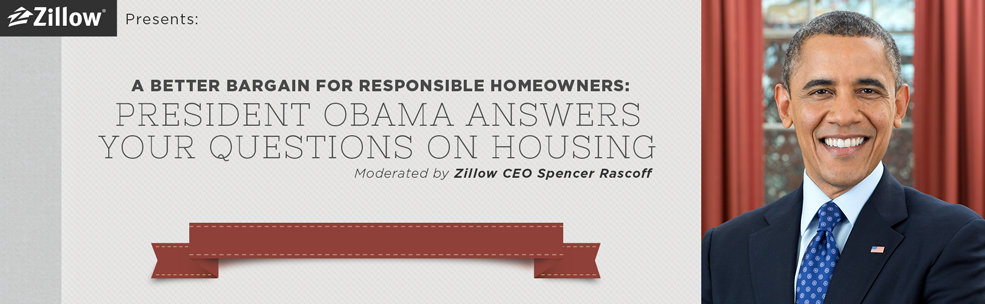
Yesterday, President Obama spoke in Phoenix about his plan to build a better foundation for homeownership.

Today he’s taking your questions online about that plan and what it means for homeowners, and those who want a home of their own. It’s part of an online chat with Zillow — the online real-estate marketplace — and Yahoo!.


If you follow the above link to the video, you will find it fairly content free.

If I could find a way to pose a question for this session it would be, “If semi-privatizing Fannie Mae and Freddie Mac proved to be such a disastrous policy, why do you think fully privatizing these housing agencies is a better idea?”

This is where you ask your question. Actually this place gives you links to where to ask your question, one of them being the method I used below.

Previously, I had followed this route. If you can figure this out, maybe the image below answers the How question.


Why Jeffrey P. Bezos Bought The Washington Post

The Washington Post has the article Bezos could use Amazon model of customer targeting to reboot the newspaper industry.

The article starts with the following:

Amazon.com founder Jeffrey P. Bezos’s purchase of The Washington Post promises not just an ownership change for the 135-year-old institution, but a potential transformation of the fusty mechanics of the newspaper business.

It remains to be seen whether the experiences of an Internet behemoth can be successfully applied to a legacy newspaper — and whether Amazon-style customer targeting would be palatable at a news organization.

I was thinking that the author of this article, coming from a traditional newspaper background, was missing the point a little bit.

My whole purpose for reading this article was the thought that Bezos would put into action the idea I posted in my 2010 post, Monetizing Internet Content. Toward then end of The Washington Post article came these paragraphs:

One move that Bezos might take at the outset is to end the paper’s new online subscription program, which limits how many stories readers can access without paying for a subscription, according to Stone, a journalist who has covered Amazon for more than 14 years.

“What is less customer-focused than a pay wall?” he asked. “You’re making it harder for people to read your story at the same time that there’s an abundance of competition.”

Now, I think they are on to something.  Of course, these paragraphs still haven’t contemplated the use of my idea exactly, but they do comprehend what is the problem with paywalls.  I expected Google would be the one to implement my ideas, but I see that Amazon is another company that has all the necessary technology.

It will be exciting to see whether or not The Washington Post company or Amazon will become a major seller of micropayment subscription plans that give the reader access to a wide assortment of articles from many newspapers and magazines.


The Wall Street Ties of Larry Summers and Timothy Geithner

Truth Out has the article The Wall Street Ties of Larry Summers and Timothy Geithner by By Zaid Jilani.

In this article Jilani refers to another article, Speaking To Corporate Execs, Larry Summers Mocks Opponents Of Outsourcing As “Luddites”,

Summers lectured as the closing keynote speaker for the event, and was introduced by Surya Kant, the North American president of Tata Consultancy Services (which is listed on the event’s website as a sponsor of his speech), a Mumbai-based company that specializes in outsourcing. According to excerpts of his remarks released by event organizers, the former chief economic adviser actually championed outsourcing:

For executives planning their strategies in light of the “new normal” economy, renowned economist Larry Summers has some important advice: “There are those today who would resist the process of international integration; that is a prescription for a more contentious and less prosperous world…We should not oppose offshoring or outsourcing.”

With the unemployment rate at 9.4 percent, Summers compared critics of the outsourcing of American jobs to “luddites who took axes to machinery early in England’s industrial revolution.” Unfortunately, the full of text of Summers’ remarks is mysteriously missing from the website — particularly odd given the fact that most of the other keynotes are posted online.

I suppose you could find a benign interpretation of Summers’ remarks, but I cannot imagine other former economic advisers to president Obama making similar remarks, Christine Roemer comes to mind.

While I can agree that, in principle, outsourcing and offshoring could have the beneficial effects expected of international integration, in the current environment, it is less likely to be beneficial.  The current environment includes Republican legislation that prevents our trade negotiators from considering environmental and labor impacts of trade negotiations.  With the war on unions and workers being waged in the US by the Republicans, it is unlikely that any interests other than those of big business will be promoted in any international trade pacts we can negotiate.


Is Uncommon Knowledge, Knowledge or Just Uncommon

The Boston Globe has a regular feature called Uncommon Knowledge. I just wrote a letter to columnist who writes this feature to tell him what disturbs me so much about this feature.

Dear Mr. Lewis,

Have you given any consideration to the possibility that the premise of this column, Uncommon Knowledge, leads you to search for the most counter-intuitive research results that you can find regardless of the quality of the research or the probability that the results you quote are correct?

Have you considered writing a column with a more beneficial premise that would encourage people to value quality research that either produced useful results or furthered knowledge and understanding?

The damage your column does in promoting silly research with shoddy methods and implanting false ideas in people’s minds is not something a self-respecting journalist ought to aspire to.

I should have also pointed to the possibility that the research he quotes may be legitimate, but his interpretation and selection of results from that research may be motivated by his need to fulfill the premise of the title of the feature.


August 4, 2013

I received a response from Kevin Lewis.

Thanks for reading the column, and thanks for writing. Notwithstanding your sarcasm, I can appreciate your criticism. Of course, it would be helpful if you could cite specific studies that you find objectionable, and why. In any case, rest assured that there is plenty of research for me to pick from — so I’m not just picking any old counter-intuitive study — and that I have enough expertise to filter out second-rate research. For more information, please check out http://www.nationalaffairs.com/authors/detail/kevin-lewis


August 5, 2013

Here is my response to Kevin Lewis.

Does my BSEE from MIT and MSEE from Northeastern qualify me any more or less for judging quality research?  People take away both good and bad from even the best educational institutions. That’s why credentials alone don’t prove much.

I just got the pun of “Uncommon Knowledge” as opposed to “Common Knowledge”.  However, the subhead reinforces the unpunlike meaning that I worry about. “And other surprising insights from the social sciences”.  If it isn’t surprising, is it not worth reporting?

Sunday’s example of the column may not be the most fertile grounds for my criticism, which is a long term concern of mine.  However, I will do the best I can with the material at hand.  All the examples in Sunday’s column seem to be in the line of things that are not really surprising as opposed to things that sound like easily dismissed, non-intuitive findings that make the researchers look silly. I have found those types of example in other columns.  That’s why I have stopped being a regular reader of your column.

I can start with – “Disgusted? Take this” – Is it really that surprising that experiments on what goes on in our brains might be affected by suggestions that are give to our brains.  Placebo, indeed.  Maybe the pill was a placebo, but the suggestion might not be.  Maybe there is more in the paper you cite to address this, but your selection from the paper merits a “Dah? Hardly surprising.”

Let’s look at “I feel a little too close to you”. “Pairs that had monitored closeness during the session tended to sit further apart on the bench.”  I would hardly call telling people to monitor closeness as backfiring when they then sat farther apart. “Dah? Hardly surprising.”

Or “Poverty: the coaching solution” – “However, a growing body of research, including new results from a decades-long study, suggests that the handicap can be ameliorated through early intervention.”  After about 50 years of success with the Head Start program this is hardly surprising.  Reporting this as if the researchers had never heard of Head Start makes them look silly.

What concerns me is the presence of politicians (demagogues) who want to take advantage of research summaries like you present to denigrate government sponsored research.  Perhaps the most famous example of this is the legendary Senator William Proxmire who awarded his “Golden Fleece Award” 168 times.  According to WikiPedia, “The Golden Fleece Award (1975–1988) was presented to those public officials in the United States who, the judges feel, waste public money.”

This feeling of the judges, in my opinion, was mostly based on a refusal to consider why certain research was being done and the benefits that would be derived from it. They took advantage of titles that were meaningful to the scientists in the field of study, but sounded odd to the uninitiated.

Nowadays, it is the Republicans who want to sell the idea of “the government is a big waste of money”.  I don’t mind reporting wastes of money that are actual wastes of money.  What I object to is pretending valuable research is a waste of money.

With a background in science, I would hope you would not want to feed this anti-intellectualism that is so rampant in our country.


August 6, 2013

The response I received focused on my concerns of what politicians and demagogues do with necessarily short research summaries. Kevin Lewis responded:

I think we’re on the same team here. One of the main reasons I do what I do is to make social science more salient to policy-makers. In fact, much of my audience, especially beyond the Globe’s readership, is involved in policy. And many of them are libertarians and conservatives who appreciate and respect social science.

I answered back:

I am happy to see that we are on the same side of this issue.

I have some ideas on what needs to be done, but I have no idea how to do it.  I’ll leave that up to your journalistic talents.

The summaries you publish in The Boston Globe are by the limitations of space necessarily very short.  It will be difficult  to cram into them what I think is missing.  Perhaps you can figure out a way.

Besides conveying a result, I think it is important to explain why the research topic is important in a larger context and why the particular result could be of value.  The value can be from how the result leads to practical applications or implications, or how the research expands important knowledge upon which future research can be built.

I am hoping that if you keep this intention in mind as you write the column, that it will help you to better realize what you are hoping to accomplish with what you write.

Here is an example I can think of to clarify what I am saying. Think of all the ridicule that the demagogues heap on scientific articles about the life of the fruit fly. To the uninitiated, the fruit fly seems to be a silly and irrelevant thing to study.  When you read about how studying the fly gives a highly accelerated view of the mechanisms of evolution, and what practical results have depended on such research, then a person is less likely to sneer at such research.

Daily Show Take on Fast Food Wage Increase

Here is another one suggested by JaneS. Sorry for the brief commercial at the beginning.


Add your name to say you stand with fast food workers and support raising the minimum wage!

John Oliver gives you some more evidence about what Elizabeth Warren claims is the message of the Republican Party, “I’ve got mine, the rest of you are on your own.” Neil Cavuto compares today’s workers with his own teen years when the value of the minimum wage was actually higher than it is today. He does not think that today’s workers should be paid as well as he was.


Why The IRS Scandal over PACs?

The video Money fer Nothin’ explains it all.

The Obama IRS Scandal gives Suzie Newsykins a job! Little Suzie Newsykins is here to tell you all about her new summer job at the IRS. With the IRS Tea Party scandal, Suzie has the perfect stress-free job picked out!


Why hadn’t it occurred to me that the main purpose of the “scandal” was to prevent the IRS from applying the rules to these PACs? It seems so obvious when this video makes the point.

Oh, and remember that contrary to what this cartoon said, the IRS did also look at liberal PACs. Since the “conservative” PACs have so much more money, I guess the Republicans were willing to let the liberal PACs hitchhike on their witch hunt. Of course this impact on liberal PACs might have been the reason that Obama caved so quickly and fired the head of the IRS. No attempt to do your job by the rules ever goes unpunished.

I am surprised that the Republicans didn’t borrow the line from the movie Casablanca. When the Republicans, who helped write the IRS regulation that said PACs had to be less than 50% political to receive their tax break, found the IRS actually trying to enforce the tax give-away rules, they could have said “We are shocked to see such behavior.”


When the media’s attention span turns reckless

Rachel Maddow has the item When the media’s attention span turns reckless.

The discredited IRS “scandal” is more than just an example of congressional Republicans over-promising and under-delivering. It’s even more than a political world, desperate for something new to play with, failing to look before it leaped.
.
.
.
The taint of “scandal” remains, for no reason other than the political world told the public about allegations, but decided the evidence to the contrary wasn’t important.

As one commenter noted, the Republicans call this “Mission accomplished.”

When the President recently called this a “made-up scandal”, how many of you scoffed because you stopped following the story after the initial reports were made?  How many of you followed my lead by blaming Republicans for cutting the IRS budget and then complaining that the workers didn’t adequately do more work with fewer resources?  How many of you thought that the President’s firing of the head of the IRS lent credence to the original stories?  [Oops! How did that question get in there?]


Brad DeLong: A Slight Preference for Larry Summers to Be Federal Reserve Chair

Economist Brad DeLong has posted the item on his blog A Slight Preference for Larry Summers to Be Federal Reserve Chair.

To be good choices for Federal Reserve chair, candidates must pass three tests. They must have experience at a similar job: this is not something to throw somebody into and expect them to swim. They must fear high inflation as they fear a tornado, and feel in their bones the pain of the unemployed. And they must understand and properly weight the different models of how the economy might behave. Right now, this third means that a good Federal Reserve chair must give a relatively high weight to the Keynesian model, which has been so successful at describing and forecasting the economy over the last six years.
.
.
.
Larry Summers has an edge as the most creative thinker likely to successfully think outside the box should outside-the-box thinking be called for, and least likely to bind himself to an institutional consensus past its sell-by date. If times are placid, the stakes are small. If times are turbulent, outside-the-box thinking has its place.

I might be tempted to listen to DeLong’s argument if someone could present any evidence that Larry Summers fought hard at the beginning of Obama’s term to get the President to request a larger stimulus package as many leading Keynesian economists were calling for.

Is there any evidence that Summers fought  hard against the proposition that you could ask for less, and then ask for a second round if the first proved to be insufficient?  Did he fight for the proposition that you should ask for more than was necessary?  Even if you got what you asked for, you could always not use the spending authority you got if it turned out not to be needed.

When the first stimulus proved to be insufficient, is there any evidence that Larry Summers urged the President to request a second go round?  Is there evidence that Larry Summers urged the President to disprove talk that the first stimulus was a failure by using the argument that the first stimulus stopped the catastrophe, but was too weak to spur economic recovery?

In Larry Summers’ supposed highly influential role with the President, I see no evidence that he did the things I suggest needed to be done.  Lacking such evidence, I have to presume he did none of those things.  That is why I think he should be disqualified as a candidate for the Federal Reserve Chairperson.

DeLong mentions former head of Obama’s Council of Economic Advisers, Christy Romer, as a candidate for Fed Chairperson.  There is good evidence that she did take all the proper actions I mentioned above and that Larry Summers took an active role in disparaging her expertise.  I believe she resigned from the council out of frustration, and went back to her position as Economics Professor at The University of California, Berkeley.