Did The War On Poverty Fail?
You may have been told (over and over again) that The War on Poverty failed. In the YouTube comments on the video in my previous post Progressives Candidates Go On Offense On Minimum Wage there was such a claim.
I sent the commenter to look at the graphs I found in the WikiPedia article Poverty in the United States.
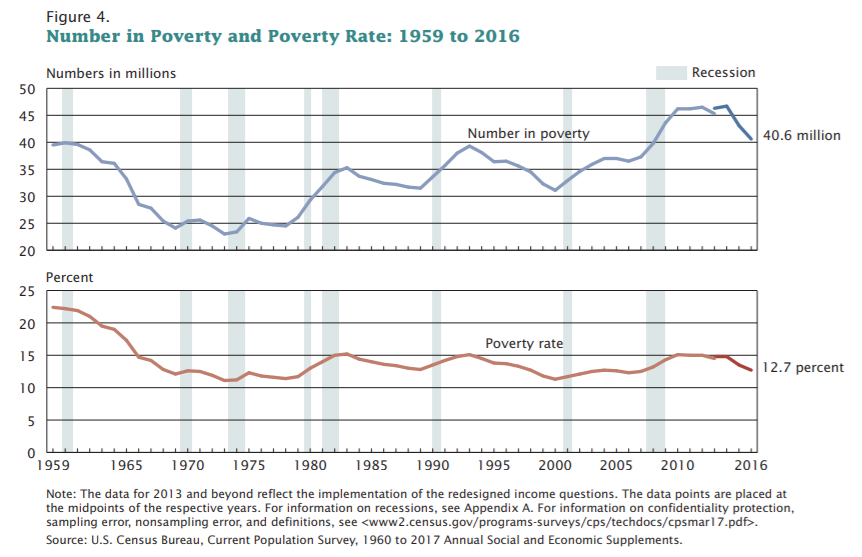
To put some historical context to the dates on these graphs, I looked up War on Poverty on Wikipedia.
Here is the introduction to the article from Wikipedia.
The War on Poverty is the unofficial name for legislation first introduced by United States President Lyndon B. Johnson during his State of the Union address on January 8, 1964. This legislation was proposed by Johnson in response to a national poverty rate of around nineteen percent. The speech led the United States Congress to pass the Economic Opportunity Act, which established the Office of Economic Opportunity (OEO) to administer the local application of federal funds targeted against poverty.
As a part of the Great Society, Johnson believed in expanding the government’s role in education and health care as poverty reduction strategies.[1] These policies can also be seen as a continuation of Franklin D. Roosevelt‘s New Deal, which ran from 1933 to 1935, and the Four Freedoms of 1941.
The popularity of a war on poverty waned after the 1960s. Deregulation, growing criticism of the welfare state, and an ideological shift to reducing federal aid to impoverished people in the 1980s and 1990s culminated in the Personal Responsibility and Work Opportunity Act of 1996, which, as claimed President Bill Clinton, “end[ed] welfare as we know it.” Prof. Tony Judt, the late historian, said in reference to the earlier proposed title of the Personal Responsibility and Work Opportunity Act that “a more Orwellian title would be hard to conceive” and attributed the decline in the popularity of the Great Society as a policy to its success, as fewer people feared hunger, sickness, and ignorance. Additionally, fewer people were concerned with ensuring a minimum standard for all citizens and social liberalism.[2]
Nonetheless, the legacy of the War on Poverty policy initiative remains in the continued existence of such federal programs as Head Start, Volunteers in Service to America, TRIO, and Job Corps.
Now look at the poverty rate (in % on the second graph above) at the beginning of the war in 1964, and then look at the rate as it was up to 1980 when Ronald Reagan took office. Even with the steps that President Clinton took, the poverty rate went down because of the huge boomlet in the economy. We asked at the time what would happen if we end welfare as we know it when the economy faltered? It didn’t take long into George W. Bush’s administration starting in 2001 to find out. Also notice which unusual non-recession period had poverty rates still rising.
It seems if you wage a War on Poverty, it can succeed. If you wage War on the Poor, it can succeed, too.