Monthly Archives: March 2014


The Boston Globe Cheats Its Subscribers

Do you actually pay for a subscription to The Boston Globe, as I do?  When you read the Doonesbury Comic strip in your newspaper, do you think you are getting the whole comic strip.  Compare this image to what you saw in the newspaper today.

The whole Doonesbury strip

If you cannot trust them to publish the whole comic strip, how can you trust them to print all the news?

If you pay them good money, how can you trust them to give you all that you paid for?

I sent a letter to the editor complaining about this. If I get any response, I will add it to the bottom of this post. Maybe they will have an explanation of how they are going to regain my trust.


Cosmos, A Space Time Odyssey on the National Geographic Channel

The television series Cosmos, A Space Time Odyssey on the National Geographic Channel, is on at 10PM Eastern on Monday nights.  It is also rerun at other times and days.

The National Geographic Channel schedule is available on the web.

This series in produced in conjunction with another television network that I will not name and which I will not watch.  I am sorry that I did not look up this alternative place to view the show until now.  If it as morally repugnant to watch this on the other channel, I hope you will find this alternative acceptable.  It is going to be hard for me to do, but I think I will try to watch the show on NatGeo.

I’ll make up some excuse to ease my mind about the morality of watching such a show that might in the slightest way benefit that other channel.


Neil deGrasse Tyson on Science, Religion and the Universe | Moyers & Company

Neil deGrasse Tyson on Science, Religion and the Universe | Moyers & Company is the second part of a three part series hosted by Bill Moyers.


I have not seen part 1 yet, let alone part 3, but this segment stands on it own so remarkably well, that I wanted to post it right away.

It should be no surprise to anyone who has watched or listened to Neil DeGrasse Tyson that he explains so eloquently why belief in a supreme being does not have to be part of a person who knows enough science.

Of course he says it much more eloquently than I ever could.  However, to put the feeling in my own words, I might say I  can understand why someone might want to attribute the unknown to the mysterious workings of a supreme being.  On the other hand, I am quite willing to look at a mystery of science, and accept the fact that we don’t know the answer yet.  I do not need to make up an answer that is outside of the realm of science for my own peace of mind.

Tyson has at the tips of his fingers, numerous examples of mysteries of science of the past that even the most brilliant scientists of those days were willing to attribute to a supreme being.  However, all of the examples he mentioned have been explained by science since then.  So, it is not impossible that there is some mystery that actually is the hand of a supreme being, but history has shown that the chances of any current day mystery being that hand of a supreme being is extremely low.

Mathematicians have proven that there are some things that are true in any self-consistent mathematical system that cannot be proved to be true using that system.  Not things we haven’t proved yet, but things that they can prove cannot be proved.  Keeping this in mind, it would not surprise me if there were mysteries of science that we will never figure out.

I have little doubt that most of the mysteries we know about now will be solved in the thousands or millions of years of intelligent life that will follow my own lifespan.  That means that I also know for sure that some of those mysteries will not be solved in my lifespan.  I can live with that idea.  If you cannot live with that idea, then feel free to make up any explanation you want that will give you peace of mind, if that is what you would prefer.  As Tyson says, just don’t insist that your idea be taught in our public schools as science.


Congressional Progressive Caucus’s Better Off Budget

I have found two Congressional publications so far for the Congressional Progressive Caucus’s Better Off Budget. The first is a 2 page summary.

When the federal budget invests resources wisely, we can meet the needs of working families and shrink the deficit. The Better Off Budget not only creates jobs, it reduces deficits by $4.08 trillion over the next 10 years. It’s the right budget for the country, for working families and for our future.

The second one goes a little deeper in 26 pages.

In a previous post Congressional Progressive Caucus Budget Strikes Back Against Austerity, I took the commentator to task for implying that increased spending must be “paid for”.  Reading the two page summary, I didn’t find the statement to be quite as bad as the analyst implied.

Still, this two page summary might leave some people with the impression that cutting the deficit is an important issue to tackle.  The above quote only mentions reducing the deficit in 10 years.  Perhaps toward the end of the 10 years it might be appropriate to have some deficit reduction, but it must be clear that deficit reduction is completely unnecessary and unwanted until the recovery is much more robust and the income inequality is reduced significantly.

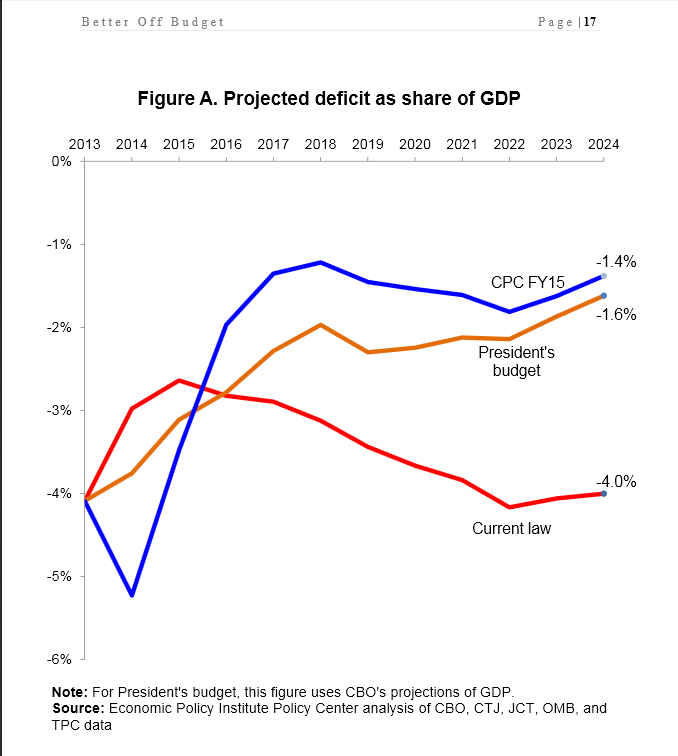
When I looked at the 26 page document, I did find some charts that plotted the deficit as a fraction of the gross domestic product.

Projected Deficit As Share Of GDP

This shows a very short term increase in the deficit and then a rapid decline in the deficit.  By the beginning of 2015, the Better Off Budget deficit is smaller than the current law and smaller than the President’s proposed budget.  I don’t have the capability of determining exactly when the deficit ought to start to decline as the economy recovers.  A lot depends on the speed of the recovery and the needs of the economy for deficits.

As a rough measure, I bet it would be safe to say that a long term federal budget deficit that is a smaller share of the GDP than is the growth of the GDP in the same period of time would be a deficit that is well within the capability of the economy to handle without a hiccup.

If we could get a budget like this passed, it would probably be a good first step.  My fear is that if it turns out that the economy does not recover as fast as hoped and the need for deficits does not go down as fast as hoped, voters will be left with the impression that this budget failed and we need to go back to austerity.  This is what happened after the President’s too weak stimulus at the beginning of his term in office.  Rather than recognizing that the stimulus and deficit were too small, and that they needed to be increased and tried for a longer period of time, the voters were convinced that the program was a failure and that we had to go in  the opposite direction.  (Or at least that is how the 2010 vote that turned the House Republican was interpreted by the nattering nabobs of negativism.)

The fact that President Obama was either too timid, or didn’t believe it himself, to explain what had happened, has made correcting the problem unnecessarily hard from a political point of view.  The political problem is amply demonstrated by the need for a Congressional Caucus to publish a budget that is much better than the President’s proposed budget.



Journalist Schools BBC on Russian Intervention in Crimea

Naked Capitalism has the post Journalist Schools BBC on Russian Intervention in Crimea by Yves Smith.

A fellow blogger with substantial experience in Europe sent this BBC footage, which I believe readers will find instructive. There were several things I liked about this segment. First, in contrast to US TV, where two sides who hold strongly opposed views talk past each other, there was a real discussion. Each side actually went beyond its talking points while remaining civil. Second was that the Telegraph writer Liam Halligan debunked some popular perceptions about Russia and Putin.

Here is the video of the BBC show.


We seem to have this uncontrollable urge to “do something”, even when there isn’t much to be done.

Even I have the troubling thought that we can’t just sit there and do nothing, but the choice isn’t between doing something and doing nothing. The choice is between doing something to make the situation worse and doing nothing. In that case, doing nothing does seem to be the better alternative.

With the empty threats that Obama has been making against Russia, it calls to mind Mark Twain’s statement, “It is better to keep your mouth closed and let people think you are a fool than to open it and remove all doubt.”

Or as I have always said, “Never make a threat that you aren’t willing to carry out.” It would be the height of foolishness to carry out some of the threats that have been made. What credibility do you have when the person you are threatening knows that you have made a threat you dare not carry out?

The corollary to this is not that if someone calls your bluff on an idle threat that you must go through with it to maintain your credibility. The corollary is that if your bluff gets called, learn the lesson to stop making such threats. You should have foreseen the likelihood of getting into such a spot before you opened your mouth.


The Timidity Trap

The New York Times has the OpEd The Timidity Trap by Paul Krugman.

And I’d argue that an important source of failure was what I’ve taken to calling the timidity trap — the consistent tendency of policy makers who have the right ideas in principle to go for half-measures in practice, and the way this timidity ends up backfiring, politically and even economically.
.
.
.
The classic example is the Obama stimulus, which was obviously underpowered given the economy’s dire straits. That’s not 20/20 hindsight. Some of us warned right from the beginning that the plan would be inadequate — and that because it was being oversold, the persistence of high unemployment would end up discrediting the whole idea of stimulus in the public mind. And so it proved.

What’s not as well known is that the Fed has, in its own way, done the same thing. From the start, monetary officials ruled out the kinds of monetary policies most likely to work — in particular, anything that might signal a willingness to tolerate somewhat higher inflation, at least temporarily. As a result, the policies they have followed have fallen short of hopes, and ended up leaving the impression that nothing much can be done.


This is another ironic Paul Krugman piece where he unknowingly identifies his own problem and blames it on others.

The irony is that a purported Keynesian economist is too timid to come right out and say what it is that Keynes taught us.  There is no monetary solution to this problem.  Anybody who pretends that the Fed has any effective tools to combat the type of Great Recession that we faced is setting us all up for a huge disappointment.

Krugman does identify the weakness in Obama’s stimulus.  He should never leave that topic.  To hint that there is another solution in the hands of the Fed is to promote Milton Friedman propaganda.  At various points, Krugman admits that he was mesmerized and bamboozled by Friedman, but he seems to forget these moments of clarity for the most part.


Abby Huntsman Promotes the Wall Street Banksters’ Big Lie

Truthout has the article Abby Huntsman Promotes the Wall Street Banksters’ Big Lie. The article has this piece of information that I am surprised that I did not know (because it is not true).

From when it was created in 1935 up until the 1980s, Social Security was paid for by taxes coming in from people who were currently working. In other words, people currently in the workforce paid for the Social Security benefits of people who had already retired and started collecting Social Security checks.

But in 1983, the Reagan administration changed things around. It raised Social Security taxes so that, in effect, working people from the Boomer generation would pay for both their own retirement and the retirement of people older than them.

The Reagan administration did this so that Social Security could afford the benefits surge that would come about once all the Boomers retired. The extra money it got from raising Social Security taxes was invested in government bonds. Today we call that extra money the Social Security trust fund.

And right now, that fund is working just swimmingly. In fact, it’s running at a $2.6 trillion surplus!

As a result, Social Security, will continue to pay out 100 percent of its scheduled benefits, until 2033, when the trust fund runs out of money.

Again, though, this isn’t a problem. It’s part of the plan.

The trust fund was created to pay for Boomers’ retirements, and since by 2033 most Boomers will be well into their eighties and nineties, it makes sense that the fund will run out by then.

Maybe, I need to do some more research on this.  It is odd that I have never seen this information about the trust fund until today.

The Social Security Administration web site has the article Debunking Some Internet Myths.

The Social Security Trust Fund was created in 1939 as part of the Amendments enacted in that year. From its inception, the Trust Fund has always worked the same way. The Social Security Trust Fund has never been “put into the general fund of the government.”

The statement at the end of the excerpt from the article about Abby Huntsman is very misleading.  The trust fund was not created to pay for Boomer’s retirements.


Craziest person in Illinois wins Republican primary

The Daily Kos has the article Craziest person in Illinois wins Republican primary.


I have been going back and forth as to whether or not to post this. The video is 7 minutes long, but I have never managed to get past the 56 second mark. When she starts talking about all the money in the vaults of the banks, it just becomes too much for me. Maybe, I just don’t need to hear any more to see the point of the headline. Maybe you either need more convincing or you have a stronger stomach than I do.

Enjoy, if that’s the proper word.


Bill Kristol confuses fiasco-fatigue with war-weariness

The Daily Kos has the article Bill Kristol confuses fiasco-fatigue with war-weariness.

The article juxtaposes this political cartoon

Tom Tomorrow Cartoon

With the following quote from Bill Kristol:

Are Americans today war-weary? Sure. The Iraq and Afghanistan wars have been frustrating and tiring. Are Americans today unusually war-weary? No. They were wearier after the much larger and even more frustrating conflicts in Korea and Vietnam. And even though the two world wars of the last century had more satisfactory outcomes, their magnitude was such that they couldn’t help but induce a significant sense of war-weariness. And history shows that they did.

So American war-weariness isn’t new. Using it as an excuse to avoid maintaining our defenses or shouldering our responsibilities isn’t new, either. But that doesn’t make it admirable.


Just as people still read yearly predictions from the astrologers in the newspapers, people keep listening to the talking heads that have a proven record of being wrong on almost everything.