Daily Archives: October 19, 2014


Democratic Party, Here’s the Problem

I received an email from the Democratic Party.


Here is my reply.

Well, I think you have isolated the problem. I am pretty disappointed in Obama and Biden for their failure to even argue the merits of their own campaign promises after they were elected.

A turn toward Hillary in 2016 would only be going farther in the wrong direction. I know she doesn’t even believe in some of the things Obama promised (and failed to even promote).

If the Clintons, Obama, and Biden are the best you can do while not mentioning Warren and Grayson, then I think we are very near a parting of the ways.


You don’t suppose any influential person in the party will ever hear about my response? What do you think it will take for these people to hear those of us who feel the way I do?


Question 2 hinges on more than just residential recycling

The letter to the editor by W. D. Stefanowicz in The Boston Globe more eloquently states a position that I have tried to explain.

Media coverage of the bottle deposit law, such as Tom Keane’s Oct. 12 op-ed column (“Does a ballot question kill the cause?”), frequently mentions the availability of residential curbside recycling, but this is misleading. The proposed extension of the law to water and sports drinks would greatly affect consumption that happens away from home.

Currently, instead of carrying bottles home, people will often add them to landfills by placing them in trash cans or leaving them elsewhere as litter. A small deposit would be a rewarding incentive for the bottles to be returned by their buyers or by the enterprising people who remove them from trash cans and from our parks, sidewalks, and roadways.


W.D. Stefanowicz

Burlington

See my puny effort to explain this buried in my previous post.

Just in case you were suspicious about the author of the letter to the editor, W. D. Stefanowicz is not one of my aliases nor one of my nom de plumes.


Fidelity fought Washington over money market funds — and won

The Boston Globe has the story Fidelity fought Washington over money market funds — and won.

The rules will allow money market managers to slam down a “gate’’ in times of distress to temporarily block investors from cashing out their shares. Mutual fund executives supported that concept.

“It will stop the run at the first fund, but if you are sitting at any of the other funds, you are going to want to get out before the gates are imposed,’’ said Eric Rosengren, president of the Federal Reserve Bank of Boston.

Harvard Business School professor David Scharfstein, an influential figure in the debate, said the result of the new rules overall is underlying risks have not changed that much:

“There’s still an incentive to get out,” he said, “before there’s a fire sale.”


The part of the story that The Boston Globe left out is that Fidelity has quietly taken steps to adapt to the reality that professor David Scharfstein mentioned above.

One feature that Fidelity has added to their money management services for their customers is the ability to have Fidelity automatically sweep your excess money market funds into insured bank deposits. When you want to spend this money, they will automatically pull the money from the banks to which they have swept the money, and put it into your account where you can do what you want with it – buy an investment vehicle or make a payment to someone else.

I always wondered if this new service was driven by the problems that The Boston Globe article described about the money market funds.

The challenge that I am going to finally have to come to grips with is figuring out how to make my money tracking software better handle these sweep transactions. In trying to make this fix, I recently introduced a substantial discrepancy in what Fidelity knows I have and what my software thinks I have. Fortunately Fidelity knows I have more money than my software thinks I have.


A Vision for Massachusetts

Martha Coakley’s campaign web site has a video A Vision for Massachusetts.

A Vision for Massachusetts

Massachusetts has been through difficult economic times, and many are still struggling. But the tough, smart, resilient, people of this Commonwealth can and will build a better future together. Our state is poised to take off. We must continue to rebuild our economy in a way that gives everyone the opportunity to succeed and attain the skills they need to compete in a global economy. That’s why Martha’s running for Governor, and she’s ready to lead and to earn your support.


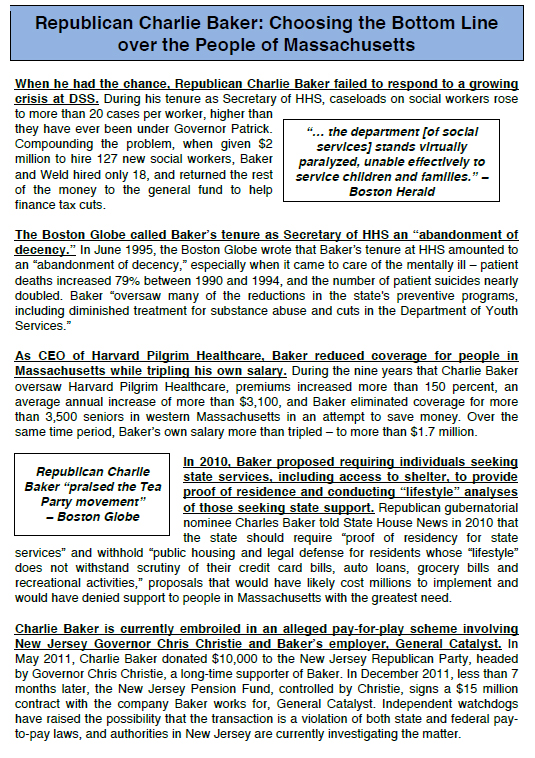
I also received an email that had a comparison chart of Coakley vs. Baker.

Comparison of Coakley and Baker

One particular item addressed one of my hot button issues that I discussed with Martha Coakley at a house party in Sturbridge.

Has an economic development plan that focuses on building from the ground up, not hoping that tax breaks for businesses will trickle down.

I looked at her published economic plan On Our Terms: An Economic Strategy for a Prosperous and Fair Commonwealth.

This plan has quite a few initiatives to foster growth of jobs and businesses in Massachusetts, none of which include giving away huge tax breaks to wealthy companies and individuals.

Martha Coakley understands that Massachusetts has huge advantages for companies. These advantages make them want to relocate in Massachusetts. We don’t need to pay them to come here. The taxes we don’t give away to companies to entice them to come can be used instead to invest in the advantages that make them want to come here.


You might also be interested in the second page of the comparison that I showed above.

Page 2 of Coakley/Baker comparison