Yearly Archives: 2014


Shocking Interview With Michael Dunn’s Neighbor: ‘He Always Wanted To Shoot Somebody’

The Crooks and Liars web site has the article Shocking Interview With Michael Dunn’s Neighbor: ‘He Always Wanted To Shoot Somebody’ that contains the video below.

Here is the YouTube description that goes with the video.

Charles Hendrix, Michael Dunn’s former next-door neighbor, describes violent behavior, lies, insurance fraud, cocaine use, bragging about putting a hit out on someone, and a first wife who said he’d held a gun to her head and threatened to kill her. He says Dunn bragged that he was smarter than everyone else and could outthink them.


I am not a lawyer, but I have seen one on television. I suppose none of what was said in this video interview would have been acceptable in court. It would prejudice the jury, I suppose. I guess the idea is to keep the jury focused on the facts of the case, and not let them be swayed by personalities. I get the reasoning, but sometimes I don’t think it serves justice. Perhaps the judge will be able to consider this information in the sentencing phase.


Did The War On Poverty Fail?

You may have been told (over and over again) that The War on Poverty failed.  In the YouTube comments on the video in my previous post Progressives Candidates Go On Offense On Minimum Wage there was such a claim.

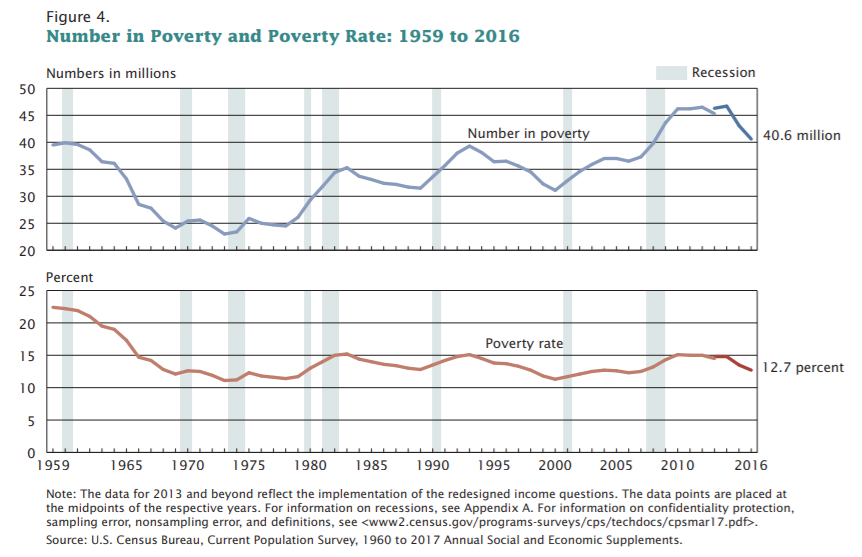
I sent the commenter to look at the graphs I found in the WikiPedia article Poverty in the United States.

Graphs on poverty levels since 1959

To put some historical context to the dates on these graphs, I looked up War on Poverty on Wikipedia.

Here is the introduction to the article from Wikipedia.

The War on Poverty is the unofficial name for legislation first introduced by United States President Lyndon B. Johnson during his State of the Union address on January 8, 1964. This legislation was proposed by Johnson in response to a national poverty rate of around nineteen percent. The speech led the United States Congress to pass the Economic Opportunity Act, which established the Office of Economic Opportunity (OEO) to administer the local application of federal funds targeted against poverty.

As a part of the Great Society, Johnson believed in expanding the government’s role in education and health care as poverty reduction strategies.[1] These policies can also be seen as a continuation of Franklin D. Roosevelt‘s New Deal, which ran from 1933 to 1935, and the Four Freedoms of 1941.

The popularity of a war on poverty waned after the 1960s. Deregulation, growing criticism of the welfare state, and an ideological shift to reducing federal aid to impoverished people in the 1980s and 1990s culminated in the Personal Responsibility and Work Opportunity Act of 1996, which, as claimed President Bill Clinton, “end[ed] welfare as we know it.” Prof. Tony Judt, the late historian, said in reference to the earlier proposed title of the Personal Responsibility and Work Opportunity Act that “a more Orwellian title would be hard to conceive” and attributed the decline in the popularity of the Great Society as a policy to its success, as fewer people feared hunger, sickness, and ignorance. Additionally, fewer people were concerned with ensuring a minimum standard for all citizens and social liberalism.[2]

Nonetheless, the legacy of the War on Poverty policy initiative remains in the continued existence of such federal programs as Head Start, Volunteers in Service to America, TRIO, and Job Corps.


Now look at the poverty rate (in % on the second graph above) at the beginning of the war in 1964, and then look at the rate as it was up to 1980 when Ronald Reagan took office. Even with the steps that President Clinton took, the poverty rate went down because of the huge boomlet in the economy.  We asked at the time what would happen if we end welfare as we know it  when the economy faltered?  It didn’t take long into George W. Bush’s administration starting in 2001 to find out.  Also notice which unusual non-recession period had poverty rates still rising.

It seems if you wage a War on Poverty, it can succeed.  If you wage War on the Poor, it can succeed, too.


Trade Pact With Asia Faces Imposing Hurdle: Midterm Politics

The New York Times has the article Trade Pact With Asia Faces Imposing Hurdle: Midterm Politics. The authors of the article are  Mark Landler and Jonathan Weisman.  If the editors have not severely changed the article they wrote, the gist of their explanation for opposition to the TPP comes in the following excerpt from the article:

Many Democrats typically oppose trade deals, along with their allies in unions and environmental and consumer groups, because they do not want to encourage free-trade agreements that they say would siphon off manufacturing jobs in the United States and create pollution.

This has got to be one of the most deceptive paragraphs and articles that have ever appeared in The New York Times.  This rivals the false article leading up to the Iraq War that claimed weapons of mass destruction in Iraq were the reason for the war.  The author of those articles was fired.  The Democrats who are opposed to this treaty have evidence that the secret negotiations have led to sections that allow corporations to sue governments over any regulation that harms the corporations’ interests.  This would make it impossible for countries to enforce regulations on labor standards,  environment policies, or product safety.  Also included in the treaty are huge concessions to corporations on intellectual property rights that protect a corporation’s monopolies on technology that are beyond all reason.  No wonder our 11 trading partners are having a hard time accepting these parts of the treaty.

For a better explanation of what is wrong with TPP, you could search this blog for the phrase “TPP”.  One of the article you will find is Bill Moyers: The Corporate Plot That Obama and Corporate Lobbyists Don’t Want You to Know About.


Dershowitz vs Chomsky debate Israel at Harvard

I found the following debate on YouTube uploaded in January 2012.


I only managed to watch the first 35 or so minutes of this debate. It seemed to be devolving rapidly. You may be able to watch more and actually get something from it. I couldn’t.


February 15, 2014

After thinking about this for a while, I realized the difference between the two presentations. One side seemed to present evidence that the presenter must have known was not the whole story. If you have a good case to make, do you need to deceive your audience?


Noam Chomsky (2014) “How to Ruin an Economy: Some Simple Ways”

A great deal of thanks goes to MardyS for posting this on his Facebook page – Noam Chomsky (2014) “How to Ruin an Economy: Some Simple Ways”

Here is part of the summary that is on the YouTube video where also the copyright rules for this video are explained.

Noam Chomsky spoke at Third Boston Symposium on Economics on February 10th 2014, sponsored by the Northeastern University Economics Society in Boston, MA.

Chomsky argued that certain factors, among them cutting federal funding for research and development and the growing gap between the richest 1 percent and every¬body else, have led to the country’s current economic climate.

“The system is so dysfunctional that it cannot put eager hands to needed work using the resources that would be avail¬able if the economy were designed for human needs,” Chomsky said. “These things didn’t just happen like a tornado, they are the results of deliberate policies over roughly the past generation.”


Be sure to watch the Q & A session at the end. The poor student questioners kept getting the same answer in one form or another as to who is going to fix this. In every case Chomsky came down to, you are the only ones who can fix this.


This is How Citizens United Dies

The Daily Kos has the post This is How Citizens United Dies.

In a first of its kind case, federal prosecutors say a Mexican businessman funnelled more than $500,000 into U.S. political races through Super PACs and various shell companies. The alleged financial scheme is the first known instance of a foreign national exploiting the Supreme Court’s Citizens United decision in order to influence U.S. elections.

I just figured out the solution to the immigration problem.  If corporations are people too, and if all you have to do is to file some paperwork to form a US corporation, then all the undocumented workers ought to incorporate themselves as US corporations.  Why fool with all that INS paperwork and red tape?


World asleep as China tightens deflationary vice

Naked Capitalism pointed to The Telegraph article World asleep as China tightens deflationary vice.

The transmission channel to the global banking system is through Hong Kong and Macao. Bejing’s credit squeeze is causing a scramble for off-shore dollar credit to plug the gap. It is this that keeps global regulators awake at night, for foreign currency loans to Chinese companies have jumped from $270bn to an estimated $1.1 trillion since 2009.

The Bank for International Settlements says dollar loans have been growing “very rapidly and may give rise to substantial financial stability risks”, enough to send tremors across the world.

The BIS data shows that British-based banks — a broad-term, including branches of US and Mid-East outfits — are up to their necks in this. They hold a quarter of all cross-border bank exposure to China. By contrast, German, Dutch, French and other European banks have cut their share from 32pc to 14pc as they retrench to shore up capital ratios at home.

With my newly acquired knowledge of Modern Monetary Theory (MMT), I am quite sure that I do not understand this article at all.  As I understand it, China has huge dollar reserves.  So I do not understand why dollar loans are a problem.  I also don’t understand who is lending to whom.  If US banks are involved, are they making dollar loans to China, or is the loan in the other direction?  Why would either one of them borrow dollars from the other?

Well, if Naked Capitalism thinks we need a dose fright, who am I to disagree?  Enjoy.


What Then Must We Do?: Straight Talk about the Next American Revolution

I have a book to highly recommend, What Then Must We Do?: Straight Talk about the Next American Revolution, by Gar Alperovitz, Chelsea Green Publishing.

Here is the beginning of the description of the book at the above link to Amazon’s page for the book.

Never before have so many Americans been more frustrated with our economic system, more fearful that it is failing, or more open to fresh ideas about a new one. The seeds of a new movement demanding change are forming.

But just what is this thing called a new economy, and how might it take shape in America? In What Then Must We Do? Gar Alperovitz speaks directly to the reader about where we find ourselves in history, why the time is right for a new-economy movement to coalesce, what it means to build a new system to replace the crumbling one, and how we might begin. He also suggests what the next system might look like—and where we can see its outlines, like an image slowly emerging in the developing trays of a photographer’s darkroom, already taking shape.

There is a section of the book that suddenly made a light bulb light up in my head.  This is something we could do here in Sturbridge.  This is something that could turn out to be the raison d’être of the little group of progressives that we have here in Sturbidge.

I have copied the following excerpt from my Kindle edition of the book, but you will have to read for your self the parts of the book that surround this excerpt.

As noted, traditional progressive strategy has always tried to focus taxation at the very top to the extent feasible—as a matter both of equity and of good politics (keeping the middle class out of the line of fire and out of the political embrace of the opposition). Let’s keep this in the package. Nothing wrong with it except that it is obviously inadequate—as the ongoing budget, program, salary, and benefit cutting so painfully reminds us.

The longer-term strategic way out of the box, logically, is clearly an approach that rebuilds the local economy (and the local tax base) in ways that are efficient, effective, stable, redistributive, and ongoing. It also should involve capturing greater revenues and profits for municipal use. Which means a different form of development—and a specific plan for how to do it over time so as to secure funds for public-sector employees, teachers, and retirees, and also to secure services for those who need them.

There is a potentially interesting alliance here that can even include local small businesses interested in getting the economy going, and some taxpayers interested in finding new resources to reduce the pressure they face. Not to mention some interesting groups that might act together—including public-sector and teachers’ unions, along with activists who have fought (and rightly continue to fight) the good fight in many areas along traditional lines.

People who see some possibilities in the ideas in the book could get together and strategize on how to raise more interest in the ideas.  We could influence local government to adopt some of these ideas.  I think the seeds are already growing locally.  Perhaps the library could have a book club discussion of these ideas.  Maybe the Senior Center members might take an interest.

There is a wealth of small and medium sized business talent in Sturbridge that is politically active and interested in progressive ideas. I would be willing to bet that I could name a few people around here who probably already know a lot of the ideas put forth in this book.

Certainly our schools, our town, and other local institutions spend a lot of money.  What if we tried to focus some of that spending on improving the local business climate?

Think of the possibilities.  Where do we get started?

This one revelation in the bombshell Benghazi report from House Republicans will stun and amaze you

The Daily Kos has the article This one revelation in the bombshell Benghazi report from House Republicans will stun and amaze you. Unlike The Daily Kos, I will not try to build up suspense, but will go right to their quote from The Washington Post article Republicans investigating Benghazi blame White House, State Dept. for failures.

While the GOP lawmakers said that commanders could have pushed harder to position forces to respond to threats in North Africa in general and Libya in particular, they concluded that no U.S. military assets could have arrived in Benghazi in time to affect the outcome of the attack, according to committee staff members who briefed reporters on the report.

Of course, this will have no impact on the Republicans continued use of this story to undermine Hillary Clinton.  Fortunately, what the Republicans don’t understand is that if they simply told the truth about Hillary Clinton, she would lose the support of her base in the Democratic party.