Yearly Archives: 2015


“Religion is the opium of the people” and Salon Knows Who the Pushers Are

Salon magazine has the article “Pagan statism”: The frightening corporate/Christian alliance that invented “In God We Trust” and “One Nation Under God”

In 1949, some of the country’s top advertising executives launched a national marketing campaign. They weren’t selling a physical product. They were selling religion. Before long, the Religion in American Life campaign was placing close to 10,000 newspaper ads per year, coordinating national radio marketing, and putting up thousands of billboards, all intended “to accent the importance of all religious institutions as the basis of American life.” Major corporations bankrolled the effort.

We tend to imagine public expressions of faith as rising spontaneously from the American people, for good or for ill. When a politician says “God bless America,” she’s trying to sound like a populist, not like a corporate pawn. But as Princeton historian Kevin Kruse details in a new book, “One Nation Under God: How Corporate America Invented Christian America,” our country’s religious slogans owe more to corporate campaigns than they do to grassroots work.

You probably already had a good guess as to the types of people who were and are the pushers. Did you know about the specifics described in the article, and presumably, the book?

As you may recognize, my headline is derived from something that Karl Marx wrote in an introduction to his paper A Contribution to the Critique of Hegel’s Philosophy of Right.

Religious suffering is, at one and the same time, the expression of real suffering and a protest against real suffering. Religion is the sigh of the oppressed creature, the heart of a heartless world, and the soul of soulless conditions. It is the opium of the people.

The abolition of religion as the illusory happiness of the people is the demand for their real happiness.

You can read the full context, and try to figure out exactly what Marx was saying. Maybe it is and maybe it isn’t what you always thought it was. It depends on your interpretation, and what you always thought about the statement.

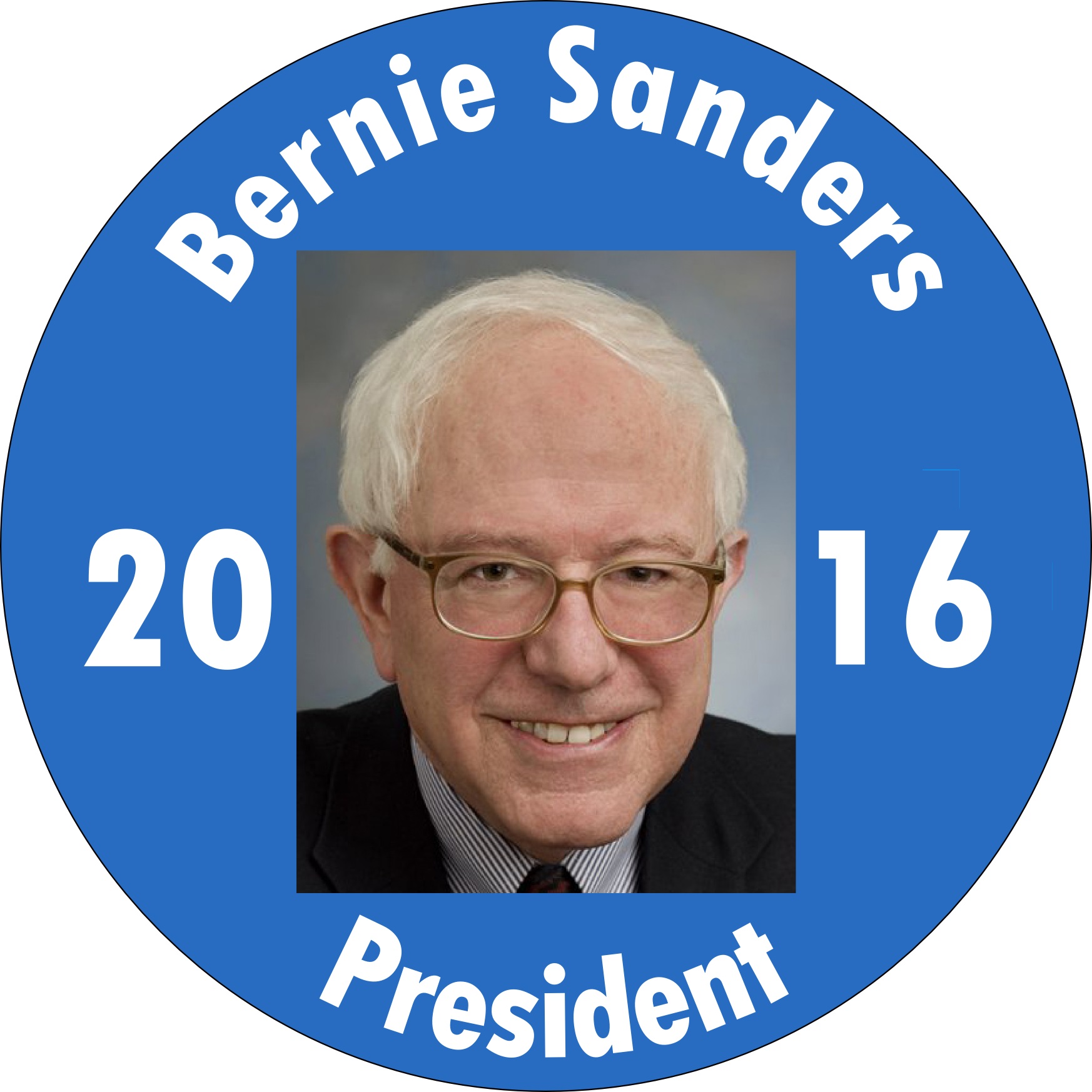
It Looks Like Bernie Sanders Is Going To Run For President

Politicus USA has the article It Looks Like Bernie Sanders Is Going To Run For President.

If Sen. Sanders (I-VT) does run, it will be great news for Democrats and liberals on numerous fronts. Sen. Elizabeth Warren (D-MA) is not running. Former Maryland Gov. Martin O’Malley has no traction with Democratic voters. Sen. Sanders is largely unknown to many rank and file Democrats, but he is on television often enough that he has more of a base of support than any of the other non-Clinton Democrats who are considering running.

If he does run, I have the bumper sticker and button all ready for him.

Bumper Sticker

Large Image of Bernie Sanders Button


Does The Free Market Need An Intervention?

The article discussed in my previous post, The great unraveling of globalization, has some interesting things to say about emerging markets.

“Growth in consumer spending in 2014 hit multiyear lows in many countries,” said Unilever CEO Paul Polman, analyzing his company’s results. “In South Africa, it is half to less than 2 percent, and in Brazil it had fallen to just 1 percent. There was no volume growth in these markets.”

There are myriad reasons why these markets have lagged, some of them unique to specific countries or regions. For instance, China’s one-child policy has produced a penurious generation of young adults who are the sole support for aging family members. And in parts of Southeast Asia and Africa the infrastructure in rural areas, where much of the population lives, is too primitive to support extensive retail activities. But equally problematic is that the growth of the middle class in China and most other developing economies has been slow. And these newly minted consumers face volatile, often expensive prices for housing, food and other staples.

Perhaps the race to the bottom to produce goods at the cheapest prices is also affecting consumers in the emerging markets.

The paradox is that what companies need to do to employees to get the most out of them for the least cost is to minimize wages and benefits.  What consumers need to spur their buying is large enough incomes and less risk in their economic environment.  The paradox is that the workers and the consumers are just two different roles of the same people.

The competition of the free market does not make it easy for an individual corporation to decide that it wants to pay high wages to spur consumption among its customers.  There is no way to assure that the workers whose wages are raised will spend all of that raise with the company that is giving the raise.

One way out of that paradox is for some entity to take a more global approach to a solution.  The global approach would have all companies raise wages to all workers which would cover all consumers.  The increased consumption would be spread across all companies so that the companies raising the wages would be assured of getting some of the benefit of not only their own wage increase, but the wage increases of their competitors.

Sort of reminds me of the situation of an addict, whether that be drugs, alcohol, tobacco, or food.  The addict cannot stop the self destructive behavior without some help from an external source.

I leave it as an exercise for the reader to figure out what external sources are available and powerful enough to provide this economic intervention.


The great unraveling of globalization

The Washington Post has the article The great unraveling of globalization.

Indeed, although multinational executives avoid talking about it publicly, profits in global markets are underwhelming — and doing business internationally is full of unanticipated risks.
.
.
.
The shortcomings of globalization manifest in any number of ways. For one thing, international trading patterns point to an increase in protectionist attitudes rather than a golden age of open borders. Between 1986 and 2005, global trade volume increased at a rate of about 2 to 3 times that of GDP growth, but the ratio since then has fallen dramatically (except for one year) and is now close to 1, according to research by UBS strategist Bhanu Baweja.
.
.
.
That’s about the best way to sum up globalization now. Instead of flat and seamless, globalization is full of hurdles and obstacles. There’s money to be made for multinationals the world over, but they are going to have to rethink their strategies for making it. Though presented as a way to eliminate economic disparities and magically expand multinational revenue streams, globalization is, simply put, still a barely profitable and perplexing strategy for most companies.

If you read the details, and believe them, then perhaps this is a clue as to why business is so intent on getting the TPP.  It’s only a clue, because you would have to guess at how the TPP would solve any of these problems.  Perhaps the idea of the “Investor-State Dispute Settlement”  (ISDS) in the TPP is corporations’ way of getting around some of the difficulties mentioned in The Washington Post article.

See my previous post ISDS is a bad deal for America – Part ot TPP “Trade” deal for some background for why US corporations may be pushing for this without any care for the harm it could do to the rest of us.

I wonder if any corporations or trade negotiators ever consider that the cause of increasing protectionism is how badly past “free” “trade” deals hurt the countries who are becoming more protectionist.  Rather than getting even more draconian in the next trade deal, they might consider coming up with something that was actually better for the people in the countries who will sign the pact.

Thanks to reader RichardH for bringing this article to my attention


VIDEO: When Van Jones met Elizabeth Warren

MoveOn has an addition to its page on the Lawrence Lessig event. VIDEO: When Van Jones met Elizabeth Warren is an introduction by Van Jones.

I loved the introduction, but there is one point that we should not get carried away over. After seeing Elizabeth Warren debate Scott Brown, I am not so sure that she could elevate the conversation. There is only so much one can do when the only questions asked are stupid questions. I have a much better role for Elizabeth Warren in the upcoming debates, if there are any on the Democratic side. Elizabeth Warren should be the moderator.

Have you watched any videos of Elizabeth Warren in action on a Senate panel questioning witnesses? Elizabeth Warren can do more with asking a question than most of the witnesses can do in answering those questions.

Elizabeth Warren Blasts New York Fed President William Dudley

Watch Elizabeth Warren Push The Bank Regulators

Elizabeth Warren still taking on the banksters, regulators


TPP Could Bring On Armageddon 3

Thinking about my previous post, Joe Firestone: Another Danger of the TPP: It Sacrifices Monetary Sovereignity and taking into account Murphy’s Law, I started to wonder if signing the TPP could bring on Armageddon.

I decided to look up the major foreign holders of US Treasury securities.

Here is the Murphy’s Law scenario. Suppose we decide to devalue the dollar to bring our wage rates more in line with the countries where all our jobs are being outsourced. Supposing some of those countries decided to sue us before one of the tribunals established by the TPP. Their claim is that by devaluing our dollar, we will be harming their profits and the value of their holdings of our currency. It seems pretty obvious that their claim is true, and our sole purpose for taking that action is to take back some of those jobs and lower the value of our foreign debt.

So what could they sue us for? Japan holds $1.2 trillion of our foreign debt and will be one of the major signatories of the TPP. China holds another $1.2 trillion of our foreign debt. China will not be a signatory of TPP, but I bet they could buy lots of companies in countries that will be signatories. That would give them standing before one of the tribunals.

Rather than demanding immediate payment of $2.4 trillion, they could just hold us hostage and control our major policies.

I have come to a new understanding of Murphy’s Law. It is not just by chance that everything that can go wrong, will go wrong. It is that if you give an adversary a brand new weapon that they could use against you, then they will use it. Do you want to hold your breath hoping they won’t? You could turn blue in the face just from that.


Joe Firestone: Another Danger of the TPP: It Sacrifices Monetary Sovereignity 2

There are two places to go to read this story. Naked Capitalism has the headline Joe Firestone: Another Danger of the TPP: It Sacrifices Monetary Sovereignity. New Economic Perspectives has the headline How Can Our Senators and Representatives Vote for Giving Away Our Monetary Sovereignty?

Let’s see if giving you the first and last paragraphs can give you a clue as to the magnitude of this blunder.

Right now the US fulfills the three essential conditions for monetary sovereignty: 1) it issues its own non-convertible currency, 2) which it allows to float on international currency markets; and 3) it owes no debts in any currency other than dollars. Because it is monetarily sovereign, and can always meet its obligations the US can never be forced into insolvency.
.
.
.
Which brings us back to our erstwhile Representatives and Senators in Washington. How they can even consider Fast Track Authority for the President without extensively considering and debating the sovereignty-infringing aspects of the TPP is beyond me. Its potential infringement on Monetary Sovereignty is only one of these. There are many others, as well. And it is hard to understand how people who swear fealty to the United States can justify their apparent complete lack of concern for these issues when they make trade agreements.

In one fell swoop, a decision in a single case could force a $350 billion dollar debt on our country and the complainant could insist on payment in Chinese yuan.

If, after seeing the financial collapse of 2008/2009, you realize the magnitude of Bill Clinton’s blunder in doing away with the Glass-Steagal Act, you should contemplate how the TPP could be a blunder of far larger magnitude. What is surprising is that it has taken this long for someone like Joe Firestone to expose the full implications of the Investor State Dispute Settlement (ISDS) tribunals that are set up by the TPP.

All the phoney issues the Republicans raise about our debt to ourselves in our own  currency could be made to come true by changing that debt to be in a foreign currency of the lender’s choice after we have incurred a debt we didn’t even know we had incurred.


Senator Warren cites ‘rigged’ process in concerns on trade deal

Rachel Maddow has an interview with Elizabeth Warren about the TPP controversy.

Senator Elizabeth Warren explains to Rachel Maddow why she is reluctant to give fast track power to President Obama on a new trade deal, citing concerns that the crafting of the deal is ‘rigged,’ and insisting that the deal be made public first.

I have seen people wonder how the Senators could know what they are complaining about. Well, this should stop it. Elizabeth Warren says that she has read the TPP. So here’s the challenge Mr. President, if it’s such a good deal, let us see it. Otherwise, we just plain don’t believe you. The more you keep it hidden, the less we believe you. What you say about it is belied by your actions to keep it secret.

I notice that Rachel Maddow gives deserved credit to Bernie Sanders and others who are fighting this deal. As for the President and interpreting his mentioning only Elizabeth Warren by name, “Bernie who. Never heard of him.” He’ll even mention John Boner, but not Bernie Sanders. The trouble is that Bernie Sanders refuses to go away.


Why Elizabeth Warren Should Run

I received an email from Run Warren Run about why she should run.  The main topic was about the trade disagreement between Warren and Obama.  I agree fully about that argument, and I will show the email at the end.

What I found most powerful was the speech by Prof. Lawrence Lessig about why Warren should run.  The email provided the link to that speech in its postscript.

Until Warren says she wants to run, I am putting most of my effort in promoting Bernie Sanders. I also think he has the broader platform of the two candidates. If Lessig is right that she is the candidate we need, and she agrees to run, then I would certainly support her efforts.


Tell new Attorney General Loretta Lynch: End “too big to jail.”

Now that we have been forced to accept the unqualified Loretta Lynch as our next Attorney General, all is not lost.

Credo Action has the petition Tell new Attorney General Loretta Lynch: End “too big to jail.”

“Begin your term as attorney general by announcing criminal charges for the fraud that led to the financial crisis, ending the abuse of deferred prosecution agreements without steep penalties, and committing to bring to trial any financial institutions caught breaking the law in the future.”

We are getting close to the statute of limitations for some of the crimes committed during the financial crisis.  However, these crooks are still committing the crimes, so that deadline shouldn’t stop prosecution or quiet our calls for prosecution.

I am aware that these petitions from Credo are probably only a way to get your email address so they can send you junk email, but perhaps it can do some good to at least listen to the message which is a good one.