Yearly Archives: 2016


On Pivoting: Ideas on Organizing During a Trump Administration

Truth Out (one of the fake “fake” news sources) has the article On Pivoting: Ideas on Organizing During a Trump Administration.

I’m defining a “strategic pivot” as a change in organizing strategies or tactics to ensure a community’s survival or to increase the impact or reach of its political vision. In this moment we know that systems of oppression are historical and deeply embedded within US culture and institutions. White supremacy, misogyny, ableism, Islamophobia, homophobia, transphobia and xenophobia are not new. What is new is that we’re encountering an incoming administration that is more transparently oppressive and violent than many of us have seen in our lifetimes.


The Fatal Flaw in Macroprudential Policy: It Ignores Political Risk

Naked Capitalism has the interesting article The Fatal Flaw in Macroprudential Policy: It Ignores Political Risk.

In contrast, the macropru policymaker is faced with a complex, ill-defined policy domain in which there is not a clear consensus on either the problem or the objective. The indicators at this policymaker’s disposal are often imprecise and conflicting. The surgical implementation tools are often ineffective, and the powerful implementation tools are too blunt. Macropru also tends to result in clearly identifiable winners and losers, perhaps even more so than monetary policy. As a result, it is subject to intensive lobbying and political pressure.

This adversely affects both the legitimacy of the macropru regulator, and the regulator’s reputation for impartiality.

I have a hard time figuring out who or what is a macropru regulator in the system that prevails in the USA. In my imagination, such a “regulator” would decide on budget deficits and fiscal policy in a wider sense. There is no such purely technocratic entity in our system of governance. Every time I try to imagine what one would look like, I come up against political (and practical) roadblocks to creating one.

So we are left to speculate on how great things would be if there were a technocratic solution divorced from politics. As far as I know there is no democratically run government of any significance that has figured out how to do this.


What is the Worst Case Scenario for Bonds?

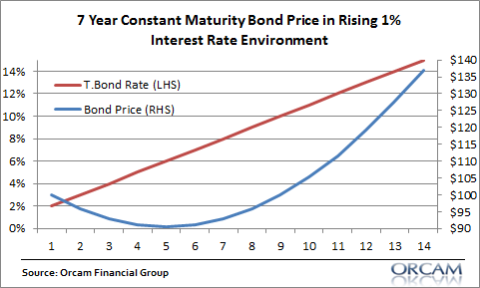
Pragmatic Capitalism has a couple of interesting articles. What is the Worst Case Scenario for Bonds? is the one that held the most interest (pun intended) for me. The reason for preferring this article is that the small amount of money I have invested in bonds is in a bond fund.

A Medium duration bond portfolio (such as a bond aggregate) should not expose you to significant loss of principal even in the case of a sharply rising interest rate environment.

If you aren’t going to read the article to see the limitations on what this quote means, then you might be better off forgetting that you ever saw this post.

The article that led me to the above was Repeat After me: “Bonds Don’t Necessarily Lose Value When Rates Rise”. Maybe this is more the headline you should forget if you aren’t going to read the articles.


Site Behind Washington Post’s McCarthyite Blacklist Appears To Be Linked to Ukrainian Fascists and CIA Spies

Naked Capitalism has published the article Site Behind Washington Post’s McCarthyite Blacklist Appears To Be Linked to Ukrainian Fascists and CIA Spies. The article explains the propaganda war being waged by the Washington Post.

The WaPo is essentially an arm of the American deep state; its owner, Jeff Bezos, is one of the three richest Americans, worth $67 billion, and his cash cow, Amazon, is a major contractor with the Central Intelligence Agency. In other words, this is as close to an official US government blacklist of journalists as we’ve seen—a dark ominous warning before they take the next steps.

This article is filled with cross references that are too numerous for me to check them all. This can be a sign that the article is well researched, and has significant factual support for what it has to say. Of course, this technique can also be used to mask an article of pure fiction because authors know that nobody follows up on the cross-references. I tend to believe what this article is saying, but I keep in mind that I am subject to being tricked. Can I enlist some help from the readers to check up on the references and offer their opinions? If each reader checks just one reference, and shares their knowledge here, then we might have a more reliable idea about the veracity of this article.


Avoid Malware Scanners That Use Insecure Hashing

Word Fence has the article Avoid Malware Scanners That Use Insecure Hashing. If there is anyone reading this blog who still works for one of the companies where I used to work, I hope they see this mention of the MD5 hashing algorithm.

Today, I received the following email:

This morning we’ve posted an analysis and advisory that describes a problem with malware scanners using the MD5 hashing algorithm.

Several popular security products in the WordPress space use MD5 to verify safe files and detect malicious files. Using this weak hashing algorithm creates a security hole that an attacker can use to craft malware that avoids detection by these scanners.

In today’s post we describe why this is a problem and we include some research demonstrating how attackers can bypass MD5. We also share the history behind MD5 and why some malware scanners for WordPress may have confused MD5 with a secure hashing algorithm.

You can read the full story on our blog…

Regards,

Mark Maunder
Wordfence Founder & CEO

Macroeconomics in the Crossfire (Again)

Naked Capitalism has the article Macroeconomics in the Crossfire (Again).

… the standard New Keynesian model is not a Keynesian model at all – it is a monetarist model. Aside from the mathematical sophistication, it is all but indistinguishable from Milton Friedman’s ideologically-driven description of the macroeconomy.

My political blog has always had an advantage over the economists who learned their macroeconomics much later than I did.

The economics I learned in the early 1960’s seems to work as well now as it did back then. I was lucky enough to be so busy at work in the decades that followed, that I did not have a chance to keep up on the mis-education of the time. When I had the time to start paying more attention to the subject again, I couldn’t understand what had happened to the knowledge that I had learned that seemed to explain all that was happening in the economy.

I had a similar experience with technical mis-education in my early years of work. As I worked in software engineering, it was mostly self teaching by reading and by working with other people on developing computer software. I decided to take a course in computer science at graduate school at Southern Methodist University in Dallas, Texas where I was working at the time. We were studying binary searching algorithm which I thought I had understood from my own studies. The more the course went on, the less I seemed to understand. I had the good sense to drop the course before I ended up knowing less than when I started.

People who studied macro-economics in the 1980s for the first time didn’t have my good fortune of having knowledge of the topic that comported with real life experience of macro-economics. Apparently, not so many of them could resist learning stuff that was patently false to those who understood what Keynes had explained.

Fifty years later, some of the economics community is learning what I knew way back then.


#Recount2016: Frequently Asked Questions

Jill Stein has published #Recount2016: Frequently Asked Questions.

Here is a generally informative FAQ about the recount. However, I must object to one trick that all candidates and all the corporate news media play.

How much have you raised so far?

As of 10 a.m. Eastern Time, on Wednesday, November 30, the Stein Recount had received more than $6.55 million in mainly small-dollar donations. More than 144,000 contributors donated an average of $48. That average contribution amount has remained steady since we began fundraising for the three-state recount. To illustrate the grassroots quality of this effort, only a little more than 400 contributors donated $1,000 or more, representing about 0.5 percent all recount donors.

I don’t care about the fraction of donors. I care about the fraction of the money donated.

If 400 people gave the legal maximum of $2,700 each, then they gave a total of $1,080,000. The remaining amount, $5,470,000 was donated by 143,600 people at an average of $38 per person. So 0.3% of the donors could have given 16% of the money. I bet those 400 people would get more attention than the 143,600 others.

So you see that the number quoted by Stein, and similarly Sanders and Clinton, is a totally useless way of telling you about the influence of large contributions. If there were a single reporter in all the corporate news media around the world who had a modicum of math skills, they would point out this fallacy every time someone quoted the useless statistic.


Rust for Web Developers | Mozilla ♥ Rust

Mozilla has introduced a new web systems programming language. I have played with it a teeny, tiny bit. I may follow up with it some more. To that end, I embed a few videos here to remind me.

Rust for Web Developers | Mozilla ♥ Rust


Safe Systems Programming with Rust | Mozilla ♥ Rust

There are more videos in this series which you will find when you just let these play one after another.


Trumpism Has Dealt a Mortal Blow to Orthodox Economics and ‘Social Science’

Naked Capitalism has published the article Trumpism Has Dealt a Mortal Blow to Orthodox Economics and ‘Social Science’.

Second, there is financialization, which led to increasing disconnection between stock market performance and the real economy, with large rewards going to firms that undertook asset stripping, outsourcing, and offshoring. The combination of globalization and financialization produced a new plutocratic class of owners, managers and those who serviced them in global cities, alongside gentrification of those cities, proleterianization and lumpenization of suburbs, and growing insecurity and casualization of employment for the bulk of the middle and working class.

Financialization also led to the near-abandonment of the ‘national’ industrial economy in favor of global sourcing and sales, and a handsome financial rentier economy built on top of it. Meanwhile, automation trends led to shedding of jobs everywhere, and threaten far more.

Maybe I just like this article for the wordsmithing. There is nothing new here that I have not observed over my 40 year career in high tech and my 10 years of retirement.

One thing I have observed almost from the beginning of my career is that the “casualization of employment for the bulk of the middle and working class” has been climbing up the economic ladder to reach the upper ends of the middle class. I have been warning people at this upper end to not feel so smug about their own presumed safety. It may have been a leap of faith to predict this in the late 1960s as I did. However, it is becoming so obvious now, I have to feel sorry for those who still cannot see it coming.

The New York Times has the article Why Does Education Translate to Less Support for Donald Trump? This is unknowingly an almost perfect example of the stories the over-educated tell themselves to stave off the realization that th e oligarchs are coming for them next.

I found The New York Times article on Randy Katz’s Facebook page.


Don’t Be Deceived By A Political Campaign’s Average Donation

I am pretty sure that I have made a number of warnings on this politics blog about how deceiving averages can be. I started to wonder recently if Jill Stein’s campaign had been deceived by the numbers coming the Sanders campaign. I hadn’t done any arithmetic to figure out what could be hidden in Bernie’s numbers, but my wondering about the Stein campaign led me to this little thought experiment.

Supposing a million people give $1 each and one person gives $1 million. You have $2,000,000 of donations from 1,000,001 people. This is an average of about $2 per person. However, I bet the 1 person who gave $1 million would have more influence on a candidate than the 1 million people who each gave $1.

This thought experiment is just an example to give you an idea of how deceptive averages can be. I have no knowledge of the contribution details of either the Sanders campaign nor of the Stein campaign.

Questions have arisen lately as to how Jill Stein raised $5 million in a few days for her recount campaign when she was unable to raise money at this rate throughout the presidential campaign. Perhaps she realized that she was letting herself be deceived by Bernie’s numbers to think she could run a national campaign only on small dollar donations. I have no idea if she has learned that it might be ok to take larger donations depending on who was giving them.

It is fashionable to blame all our economic problems on the billionaire class in general and the money they pour into politics. It is easy to get lulled into believing that any contribution from any billionaire is inherently evil. A more discriminating line of reasoning may conclude that not all billionaires are created equal and neither are their contributions. One billionaire in particular is being vilified by the extreme right, and the left is propagating this vilification without considering the source of the smear campaign or its motivations. The motivation from the right might be to get the working-class progressive to disarm themselves in the fund raising war because of a misplaced sense of scruples, whereas the right doing the smearing has no need to disarm because they have no scruples

By now, you may have figured out that I am talking about the anti George Soros smear campaign. He is one billionaire who tends to donate to progressive causes (see The Young Turks video George Soros Pledges 10 Million To Combat Hate Crime). When he takes advantage of people to make his billions, it tends to be other billionaires rather than ordinary people that he focuses on. Of course, the “little” people tend to be collateral damage. Perhaps there would be a better way to take advantage of other billionaire’s greed without hurting “little” people, so I am not completely defending what Soros has done. However, I do see somewhat of a distinction.

I put as this blog’s motto “Extremism is the Enemy of Rationality™” exactly because I know that it is easy to go to extremes without thinking, when thinking is always a better alternative.