Daily Archives: April 6, 2019


German ‘rent insanity’ sparks mass tenant protests, expropriation action

RT has the article German ‘rent insanity’ sparks mass tenant protests, expropriation action.

Germans in large cities are protesting on Saturday against what they see as the unfair influence of large landlords on the housing market. They want the biggest players undercut and their property expropriated.

Is this a movement coming to a country where you may be living? Sometimes people have a limit to the exploitation they are willing to put up with. It is not wise for the exploiters to push past that point.

In the USA, real-estate prices are essentially set by what the banks are willing to finance. The more money you need to borrow to buy your real-estate, the more interest the banks make. With rising real-estate prices, the real-estate you pledged to get the original loan rises in value to protect the bank’s investment in the mortgage. So the problem is not only with the big owners of real-estate.


This Is How MMT Applies To Emerging Markets (Podcast)

The Gower Initiative for Modern Money Studies posted a transcript of the introduction and a link to the Bloomberg episode This Is How MMT Applies To Emerging Markets (Podcast).

“In discussions about Modern Monetary Theory (MMT) you often hear that while it may be true that the U.S. has the space to expand its deficits significantly, that it doesn’t apply to emerging markets. On this week’s episode of the Odd Lots podcast, we speak to Fadhel Kaboub, a professor of economics at Denison University, who examines emerging markets through the MMT lens. While it’s true that emerging markets don’t have the same kind of fiscal capacity as nations like the U.S., Canada, and Australia, the theory still offers insights into how EMs can pursue development policies that are different from the mainstream prescriptions”…..and the U.K.


Excellent podcast. As a follower of MMT, I learned how to apply it to emerging markets in ways I would never have figured out for myself. In some ways it is frustrating to hear these interviews conducted by people who do not understand MMT. However, the only way for MMT to progress is for the experts to explain it to the non-experts, which was done in an excellent fashion in this podcast. If you are not an MMT expert, then this podcast may be just what you need.


Rewards Aren’t the Key to Employee Motivation

Cornerstone On Demand has the post Ted Talk Tuesday: Rewards Aren’t the Key to Employee Motivation.

In his TED Talk, “The Puzzle of Motivation,” Pink explores what motivates people and how company leaders can apply this research to their own organizations. He goes on to explain what social scientists know, but most managers don’t: Traditional rewards aren’t always as effective as we think.


There is a lot of truth here, but don’t get carried away by a good sales pitch.

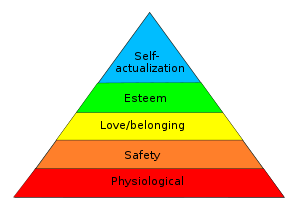
Some detail about the subject of motivation can be gleaned from Maslow’s hierarchy of needs, coincidentally from WikiPedia.

Maslow’s hierarchy of needs is a theory in psychology proposed by Abraham Maslow in his 1943 paper “A Theory of Human Motivation” in Psychological Review.


Maslow’s hierarchy of needs, represented as a pyramid with the more basic needs at the bottom

Companies I worked for had the practice of periodically announcing special rewards for exceptional achievement. I don’t know how much of an incentive this presented to the winners of the award, but I frequently observed what a disincentive it was to all those people who thought they had done great work, but did not receive any special award or acclaim. To the “self-actualized” people, the lack of a reward was only a temporary disappointment.

I was led to this video by a comment on the post A belief in meritocracy is not only false: it’s bad for you in Naked Capitalism.

Meritocracy has become a leading social ideal. Politicians across the ideological spectrum continually return to the theme that the rewards of life – money, power, jobs, university admission – should be distributed according to skill and effort. The most common metaphor is the ‘even playing field’ upon which players can rise to the position that fits their merit. Conceptually and morally, meritocracy is presented as the opposite of systems such as hereditary aristocracy, in which one’s social position is determined by the lottery of birth. Under meritocracy, wealth and advantage are merit’s rightful compensation, not the fortuitous windfall of external events.

Here, again, is an article with some merit, but be very careful that you don’t get carried away with the ideas in the article.