Periodic Posts

Posts made periodically by a particular author. The periodicity may be totally random.


Rewards Aren’t the Key to Employee Motivation

Cornerstone On Demand has the post Ted Talk Tuesday: Rewards Aren’t the Key to Employee Motivation.

In his TED Talk, “The Puzzle of Motivation,” Pink explores what motivates people and how company leaders can apply this research to their own organizations. He goes on to explain what social scientists know, but most managers don’t: Traditional rewards aren’t always as effective as we think.


There is a lot of truth here, but don’t get carried away by a good sales pitch.

Some detail about the subject of motivation can be gleaned from Maslow’s hierarchy of needs, coincidentally from WikiPedia.

Maslow’s hierarchy of needs is a theory in psychology proposed by Abraham Maslow in his 1943 paper “A Theory of Human Motivation” in Psychological Review.


Maslow’s hierarchy of needs, represented as a pyramid with the more basic needs at the bottom
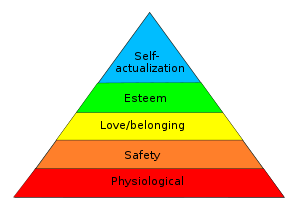
Companies I worked for had the practice of periodically announcing special rewards for exceptional achievement. I don’t know how much of an incentive this presented to the winners of the award, but I frequently observed what a disincentive it was to all those people who thought they had done great work, but did not receive any special award or acclaim. To the “self-actualized” people, the lack of a reward was only a temporary disappointment.

I was led to this video by a comment on the post A belief in meritocracy is not only false: it’s bad for you in Naked Capitalism.

Meritocracy has become a leading social ideal. Politicians across the ideological spectrum continually return to the theme that the rewards of life – money, power, jobs, university admission – should be distributed according to skill and effort. The most common metaphor is the ‘even playing field’ upon which players can rise to the position that fits their merit. Conceptually and morally, meritocracy is presented as the opposite of systems such as hereditary aristocracy, in which one’s social position is determined by the lottery of birth. Under meritocracy, wealth and advantage are merit’s rightful compensation, not the fortuitous windfall of external events.

Here, again, is an article with some merit, but be very careful that you don’t get carried away with the ideas in the article.


Money supply drives rally (E1366)

RT (formerly known as Russia Today ) has the video Money supply drives rally (E1366).

In this episode of the Keiser Report, Max and Stacy discuss the money supply increasing at the same pace as the S&P 500 stock market rally. Could they have anything to do with each other? Hmmmm. We wonder. They also discuss the rapidly increasing rents causing voters to demand action from candidates when, perhaps, the only problem is the central banks printing money for their member banks.

In the second half, Max interviews Steve Beauregard of Bloq about building in a bitcoin bear market.


It is amazing how these people can be so wrong about so much, but introduce an idea or two that is correct.

They did not exactly say this, but what they said about asset price inflation including real estate and rents made me realize why rent-control is a bad idea. Real estate price increases and rent price increases are the consequence of the massive money creation that is going on that is not producing “consumer” price inflation. As some proponent of Modern Money Theory (MMT) has pointed out, real estate prices are driven by how much money banks will lend for real estate. With all that central bank money that has been created with nothing to invest that money in except some assets and stock prices, this is what is driving up real-estate and rents.

The rent price control that might work would be to stop putting the money directly in the private banks, but for the government to spend this money into the economy in ways which increased the size of the real economy to produce economically useful stuff for the consumers. By buying stuff and employing people to make it, the money would be recirculated into the economy to buy the new stuff the growing economy could produce. Let’s also not forget that tax policy can also be used to redirect private sector money away from harmful uses. The taxes that the government collects can then be redirected to productive uses.

One of the issues that the current discussion of Modern Money Theory lacks is a discussion of the economic impacts of the distribution of money within a sector. MMT gains a lot of insights from looking at the sector balances between the government sector, the domestic private sector, and the foreign sector. As important as the flows between the sectors is, the flow of money within a sector is important too.

If you need for me to try to untangle the last few sentences I have written, ask questions on Facebook so I will know what needs to be untangled.


Economic Update: Beyond Universal Basic Income

The Real News Network has the episode Economic Update: Beyond Universal Basic Income.

On this week’s show Prof. Wolff presents an in-depth analysis of UBI shows its advantages over most welfare, safety net systems. An even better alternative would avoid capitalism’s unnecessary production of unemployment because it utilizes technical progress (rising productivity) for profits. The alternative benefits workers’ leisure rather than profits. It is more democratic and avoids splitting people into unemployed vs employed, non-poor vs poor population.


Wow! This may be the most important video you see this year. Sure, there are things to discuss about this, but first absorb the concepts, and then we can talk about the details.

I’ll copy a couple of questions and answers that I got into on The Real News Network.

JoAnn : It’s, certainly, a good idea, but, getting US corporations to forgo that extra profit would be difficult.

Me : Once you get the concepts, this is one of the issues to discuss. Suppose you were given the task of getting corporations to go along with the basic idea. What things could you conjure up to solve the problem? Maybe some of the benefits of productivity could accrue to the corporations, but just not all of the benefits.

goedelite : “On this week’s show Prof. Wolff presents an in-depth analysis of UBI shows its advantages over most welfare, safety net system” opens the article. Do you find such linguistic garbage an invitation or a discouragement? I read no further.

Me : I think this is one description of a closed mind. If you could stand to listen, you might actually be exposed to good ideas you have never had.


The Origins of Venezuela’s Economic Crisis

The Real News Network has the episode The Origins of Venezuela’s Economic Crisis.

Venezuela has become a popular argument against socialism amongst conservatives because of the deep economic crisis it is currently traversing. Defenders of the Bolivarian project, though, say that US sanctions and economic war are to blame for the crisis. Greg Wilpert presents an analysis that tries to take all the factors into account


This provides the factual basis for an honest discussion of Venezuela. Of course, I can only judge that it seems plausible because of its balance. It is not rabidly anti-Chavez/Maduro, and it is not rabidly pro-Chavex/Maduro. I don’t doubt that it probably has its imperfections.


The effectiveness and primacy of fiscal policy

The Economic Outlook blog has a three part series, The effectiveness and primacy of fiscal policy – Part 1, The effectiveness and primacy of fiscal policy – Part 2, and The effectiveness and primacy of fiscal policy – Part 3.

The series is designed to help readers see that the recent criticisms of Modern Monetary Theory (MMT) as being politically naive and unworkable in a real politic sense have all been addressed in the past. In Part 1, I gave examples of how ‘agile’ or ‘nimble’ fiscal policy can be when an elected government has it in their mind to use their spending and taxation capacities to change the direction of the non-government economic cycle. It is simply untrue that fiscal policy is inflexible and cannot make effective, well-designed policy interventions. In this second part, I will address aspects of how such interventions might be organised. Specifically, some people have advocated that MMT might replace the so-called ‘independent’ central bank, with an ‘independent’ fiscal authority, which they seem to think would take the ‘politics’ out of fiscal policy decision-making and focus it on advancing the well-being of the people. The intentions might be sound but the idea is the anathema of what progressives, interested in maintaining democratic accountability would propose. I consider such an independent fiscal authority would constitute the continuation of the neoliberal practice of depoliticisation and further increase the democratic deficit that is common in our nations these days. Politicians are elected to take responsibility and make decisions on our behalf. They should be always be held accountable for those decisions and not be allowed to defer responsibility to an external source (like an ‘independent’ central bank or an external fiscal authority).


April 2, 2019

I covered the first part of the series in my previous post The effectiveness and primacy of fiscal policy – Part 1


Abby Martin and Bill Binney: Mass Surveillance and the Intelligence Industrial Complex

Dandelion Salad has the post Abby Martin and Bill Binney: Mass Surveillance and the Intelligence Industrial Complex. The article has links to other stories, and it includes the following video:


Too bad nobody that interviews Bill Binney asks him about the possibility of downloading the DNC emails to a USA situated thumb drive at the requisite speed, and then transferring it to WikiLeaks at leisure.

What Bill Binney never says is that the data from the DNC email hack, if there was one, was collected by the NSA. They know exactly when it happened, and where it went. That may be why Seth Richards is dead. The fact that the NSA knows where the data is, if it doesn’t store it itself, is implied by what Bill Binney describes in this interview.


Reading Marx’s Capital with David Harvey

Here is the entry point the online course Reading Marx’s Capital with David Harvey. This is where you will get to the table of contents for the course.

A close reading of the text of Karl Marx’s Capital Volume I in 13 video lectures by Professor David Harvey.

I don’t quite know what to put here to explain why I think this course might have such great value. I’ll list the two podcasts that gave me the hint, in case you are interested. It is not necessary to listen to either one of them if you are already interested in diving into the course. Social Media and the Internet as a Powerful Organizing Tool – Part 1 and Social Media and the Internet as a Powerful Organizing Tool – Part 2. I actually listened to Part 2 before I listened to Part 1.

The Getting Started web page for the course will tell you how to get the version of the book that has the same page numbers as discussed in the lecture. This link is also in the table of contents mentioned at the top of this post.


Fed Official: Climate Change is an ‘International Market Failure’

Naked Capitalism has the article Fed Official: Climate Change is an ‘International Market Failure’.

Since Congress has yet to take sufficient action, Rudebusch says that the Fed could, in theory, take matters into its own hands by encouraging a shift away from fossil fuels. The problem is, the Fed’s only official job is to keep inflation tame and unemployment low. And its tools are limited to buying and selling government debt to tweak interest rates.

What was the Fed buying in the various phases of quantitative easing? Quantitative Easing Explained.

The bank buys securities from its member banks to add liquidity to capital markets.

So, there already seems to be a little stretchiness in the definition of what the Fed can buy. Still, the stretchiness that already exists might not be enough to cover what Rudebusch thinks is necessary.


Alexandria Ocasio-Cortez is a fan of a geeky economic theory called MMT: Here’s a plain-English guide to what it is and why it’s interesting

Business Insider has the article Alexandria Ocasio-Cortez is a fan of a geeky economic theory called MMT: Here’s a plain-English guide to what it is and why it’s interesting.

The theory is geeky because you have to understand it enough to make rational budget decisions for the federal government. If you are a Senator or Representative, and do not understand how the federal budget impacts the national economy, one wonders what you are doing holding such an office.

In explaining what traditional economists had to say about MMT, the article says:

Not one agreed that governments able to print their own currencies should forget about federal deficits or be free to spend what they like.

That’s fine by us MMT proponents. MMT has never said that we should forget about federal deficits. It says we have to put the deficits in context of what the economy needs. If the economy needs the government to run a deficit of a certain size, then the government should run a deficit of that size. Anything that is much more or much less than the deficit needed by the economy is what causes problems.

I guess that Business Insider does not really understand the subject of the article. However, they do a good enough job of presenting the facts of MMT as explained by the MMT experts. They go off the rails when they pay obeisance to the economic “experts” who explain that the way the USA has been run since 1776 cannot possibly work.