SteveG’s Posts


Consumer Reports Shills for ObamaCare

Naked Capitalism has the article Consumer Reports Shills for ObamaCare, Pooh-Poohs Medicaid Clawbacks on Bizarre Assumption They’ll be Waived.

Summarizing the Medicaid clawback issue, Paul Craig Roberts has a new post that explains what can happen to your estate if you’re over 55 and ObamaCare forces you into Medicaid because your income is under 138% of the Federal poverty level:

In violation of moral philosopher John Rawls’ second principle of justice [q.v.], some of the poorest Americans will pay the highest cost of health care as they, and they alone, are subject to having the family home and any other assets they might possess confiscated by the state in order to reimburse Obamacare for the cost of their medical expenses….

.
.
.
[B] Estate recovery was not an unintended consequence of Obamacare. The House Ways & Means Committee and The House Energy & Commerce Committee share jurisdiction over health care, including Medicare and Medicaid, and both worked extensively on Obamacare. So, don’t bother thinking that the members of these committees didn’t know that estate recovery would impact millions of Americans who would be tossed into Medicaid. The asset test was dropped and the age limit was increased explicitly in order to expand Medicaid. Yet, did We the People hear any concern about estate recovery? Certainly not in the many floor speeches given by Democrats as well as Republicans or from the media.


Apparently the public outcry that this author is trying to stir up is getting the attention of the politicians and the advocacy groups. Keep your eyes open for your opportunity to get this issue addressed.

See my previous post How Obamacare Raids the Assets of Low-Income Older Americans that links to the previous article on this subject by this author, Lambert Strether.

Yanis Varoufakis: BITCOIN: A Flawed Currency Blueprint with a Potentially Useful Application for the Eurozone

Naked Capitalism has the article Yanis Varoufakis: BITCOIN: A Flawed Currency Blueprint with a Potentially Useful Application for the Eurozone.

Bitcoin is a hard-core version of the Gold Standard, in that the money supply is algorithmically fixed to grow at a pre-determined rate and, eventually, to reach a maximum quantity of Bitcoins that remains fixed forever.

Actually I like this article for its explanations of several things.  It has a good explanation of problems that deflation presents.  It has the above explanation of one feature of Bitcoin like currencies. Lastly, it has a good discussion of the economic issues in the Eurozone.

I follow and understand most of the explanations, but dealing with money and economics in situations that are outside our normal experience takes a little more mental effort than I am used to.

The article answers a question about why poorer people are not helped by deflation.

In a recent debate, I was confronted with the argument that deflation is a godsend. “Poorer people crave lower prices”, I was told, “and they cannot understand why ‘elitists’, like yourself, oppose them”. Of course people, especially those who struggle to make ends meet, prefer lower to higher prices other things being equal. But under the heavy shadow of deflation other things are not equal . Deflation is indiscriminatory. Once it sets it, all prices subside, including the price for labour. In fact, wages tend to fall faster than prices of other goods during deflationary times, leaving the weak poorer. Worse still, deflation reduces investment which, in turn, raises unemployment.

However, there is another part of the answer that it leaves out.

Another important point about deflation is its effect on borrowers. As we have seen, when you have a mortgage on your house and the house price drops precipitously, it can wipe out all your wealth, and still leave you owing money. Same is true for any borrower for other things – cars, home appliances, payday loans, college loans.

I also had my problems wrapping my head around a few ideas in the article – not saying the article is wrong, though.  I probably just need to think about it some more.

I see where deflation hurts a manufacturer who buys her raw materials at a high price, but has to sell at a deflated price. You’d think then that inflation would allow a manufacturer to buy raw materials at a lower price, but sell at a higher price. I haven’t quite been able to figure out why this is not good for a manufacturer. It seems the manufacturer is squeezed in both directions. Of course the worker is also squeezed in both directions. Although borrowing on the inflated value of real estate in an inflationary period seemed to be heaven sent for a while.

My other problem is understanding why a Bitcoin like deflationary FT-coin is a solution in times of deflation. The FT-coin would have to deflate faster than the Euro to make people want to hold it.


Shocking Interview With Michael Dunn’s Neighbor: ‘He Always Wanted To Shoot Somebody’

The Crooks and Liars web site has the article Shocking Interview With Michael Dunn’s Neighbor: ‘He Always Wanted To Shoot Somebody’ that contains the video below.

Here is the YouTube description that goes with the video.

Charles Hendrix, Michael Dunn’s former next-door neighbor, describes violent behavior, lies, insurance fraud, cocaine use, bragging about putting a hit out on someone, and a first wife who said he’d held a gun to her head and threatened to kill her. He says Dunn bragged that he was smarter than everyone else and could outthink them.


I am not a lawyer, but I have seen one on television. I suppose none of what was said in this video interview would have been acceptable in court. It would prejudice the jury, I suppose. I guess the idea is to keep the jury focused on the facts of the case, and not let them be swayed by personalities. I get the reasoning, but sometimes I don’t think it serves justice. Perhaps the judge will be able to consider this information in the sentencing phase.


Did The War On Poverty Fail?

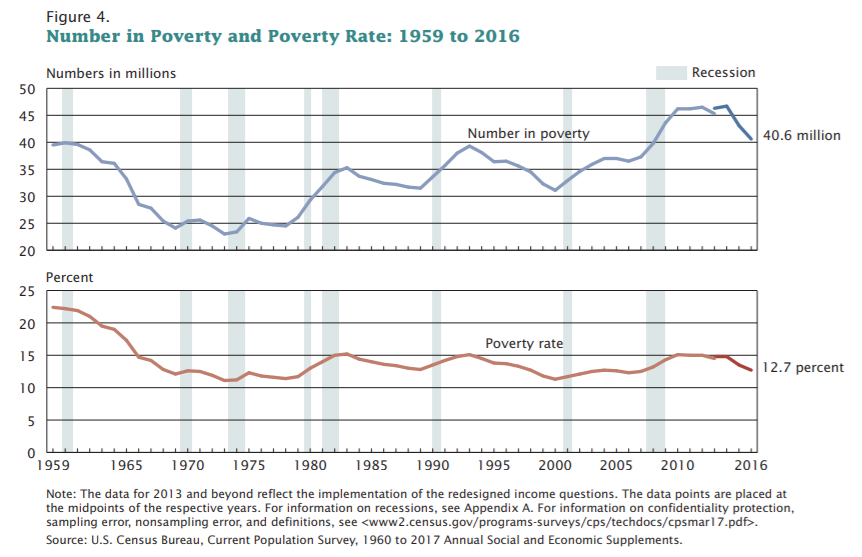
You may have been told (over and over again) that The War on Poverty failed.  In the YouTube comments on the video in my previous post Progressives Candidates Go On Offense On Minimum Wage there was such a claim.

I sent the commenter to look at the graphs I found in the WikiPedia article Poverty in the United States.

Graphs on poverty levels since 1959

To put some historical context to the dates on these graphs, I looked up War on Poverty on Wikipedia.

Here is the introduction to the article from Wikipedia.

The War on Poverty is the unofficial name for legislation first introduced by United States President Lyndon B. Johnson during his State of the Union address on January 8, 1964. This legislation was proposed by Johnson in response to a national poverty rate of around nineteen percent. The speech led the United States Congress to pass the Economic Opportunity Act, which established the Office of Economic Opportunity (OEO) to administer the local application of federal funds targeted against poverty.

As a part of the Great Society, Johnson believed in expanding the government’s role in education and health care as poverty reduction strategies.[1] These policies can also be seen as a continuation of Franklin D. Roosevelt‘s New Deal, which ran from 1933 to 1935, and the Four Freedoms of 1941.

The popularity of a war on poverty waned after the 1960s. Deregulation, growing criticism of the welfare state, and an ideological shift to reducing federal aid to impoverished people in the 1980s and 1990s culminated in the Personal Responsibility and Work Opportunity Act of 1996, which, as claimed President Bill Clinton, “end[ed] welfare as we know it.” Prof. Tony Judt, the late historian, said in reference to the earlier proposed title of the Personal Responsibility and Work Opportunity Act that “a more Orwellian title would be hard to conceive” and attributed the decline in the popularity of the Great Society as a policy to its success, as fewer people feared hunger, sickness, and ignorance. Additionally, fewer people were concerned with ensuring a minimum standard for all citizens and social liberalism.[2]

Nonetheless, the legacy of the War on Poverty policy initiative remains in the continued existence of such federal programs as Head Start, Volunteers in Service to America, TRIO, and Job Corps.


Now look at the poverty rate (in % on the second graph above) at the beginning of the war in 1964, and then look at the rate as it was up to 1980 when Ronald Reagan took office. Even with the steps that President Clinton took, the poverty rate went down because of the huge boomlet in the economy.  We asked at the time what would happen if we end welfare as we know it  when the economy faltered?  It didn’t take long into George W. Bush’s administration starting in 2001 to find out.  Also notice which unusual non-recession period had poverty rates still rising.

It seems if you wage a War on Poverty, it can succeed.  If you wage War on the Poor, it can succeed, too.


Trade Pact With Asia Faces Imposing Hurdle: Midterm Politics

The New York Times has the article Trade Pact With Asia Faces Imposing Hurdle: Midterm Politics. The authors of the article are  Mark Landler and Jonathan Weisman.  If the editors have not severely changed the article they wrote, the gist of their explanation for opposition to the TPP comes in the following excerpt from the article:

Many Democrats typically oppose trade deals, along with their allies in unions and environmental and consumer groups, because they do not want to encourage free-trade agreements that they say would siphon off manufacturing jobs in the United States and create pollution.

This has got to be one of the most deceptive paragraphs and articles that have ever appeared in The New York Times.  This rivals the false article leading up to the Iraq War that claimed weapons of mass destruction in Iraq were the reason for the war.  The author of those articles was fired.  The Democrats who are opposed to this treaty have evidence that the secret negotiations have led to sections that allow corporations to sue governments over any regulation that harms the corporations’ interests.  This would make it impossible for countries to enforce regulations on labor standards,  environment policies, or product safety.  Also included in the treaty are huge concessions to corporations on intellectual property rights that protect a corporation’s monopolies on technology that are beyond all reason.  No wonder our 11 trading partners are having a hard time accepting these parts of the treaty.

For a better explanation of what is wrong with TPP, you could search this blog for the phrase “TPP”.  One of the article you will find is Bill Moyers: The Corporate Plot That Obama and Corporate Lobbyists Don’t Want You to Know About.


Dershowitz vs Chomsky debate Israel at Harvard

I found the following debate on YouTube uploaded in January 2012.


I only managed to watch the first 35 or so minutes of this debate. It seemed to be devolving rapidly. You may be able to watch more and actually get something from it. I couldn’t.


February 15, 2014

After thinking about this for a while, I realized the difference between the two presentations. One side seemed to present evidence that the presenter must have known was not the whole story. If you have a good case to make, do you need to deceive your audience?


Noam Chomsky (2014) “How to Ruin an Economy: Some Simple Ways”

A great deal of thanks goes to MardyS for posting this on his Facebook page – Noam Chomsky (2014) “How to Ruin an Economy: Some Simple Ways”

Here is part of the summary that is on the YouTube video where also the copyright rules for this video are explained.

Noam Chomsky spoke at Third Boston Symposium on Economics on February 10th 2014, sponsored by the Northeastern University Economics Society in Boston, MA.

Chomsky argued that certain factors, among them cutting federal funding for research and development and the growing gap between the richest 1 percent and every¬body else, have led to the country’s current economic climate.

“The system is so dysfunctional that it cannot put eager hands to needed work using the resources that would be avail¬able if the economy were designed for human needs,” Chomsky said. “These things didn’t just happen like a tornado, they are the results of deliberate policies over roughly the past generation.”


Be sure to watch the Q & A session at the end. The poor student questioners kept getting the same answer in one form or another as to who is going to fix this. In every case Chomsky came down to, you are the only ones who can fix this.


This is How Citizens United Dies

The Daily Kos has the post This is How Citizens United Dies.

In a first of its kind case, federal prosecutors say a Mexican businessman funnelled more than $500,000 into U.S. political races through Super PACs and various shell companies. The alleged financial scheme is the first known instance of a foreign national exploiting the Supreme Court’s Citizens United decision in order to influence U.S. elections.

I just figured out the solution to the immigration problem.  If corporations are people too, and if all you have to do is to file some paperwork to form a US corporation, then all the undocumented workers ought to incorporate themselves as US corporations.  Why fool with all that INS paperwork and red tape?


World asleep as China tightens deflationary vice

Naked Capitalism pointed to The Telegraph article World asleep as China tightens deflationary vice.

The transmission channel to the global banking system is through Hong Kong and Macao. Bejing’s credit squeeze is causing a scramble for off-shore dollar credit to plug the gap. It is this that keeps global regulators awake at night, for foreign currency loans to Chinese companies have jumped from $270bn to an estimated $1.1 trillion since 2009.

The Bank for International Settlements says dollar loans have been growing “very rapidly and may give rise to substantial financial stability risks”, enough to send tremors across the world.

The BIS data shows that British-based banks — a broad-term, including branches of US and Mid-East outfits — are up to their necks in this. They hold a quarter of all cross-border bank exposure to China. By contrast, German, Dutch, French and other European banks have cut their share from 32pc to 14pc as they retrench to shore up capital ratios at home.

With my newly acquired knowledge of Modern Monetary Theory (MMT), I am quite sure that I do not understand this article at all.  As I understand it, China has huge dollar reserves.  So I do not understand why dollar loans are a problem.  I also don’t understand who is lending to whom.  If US banks are involved, are they making dollar loans to China, or is the loan in the other direction?  Why would either one of them borrow dollars from the other?

Well, if Naked Capitalism thinks we need a dose fright, who am I to disagree?  Enjoy.