SteveG’s Posts


Interview With James Galbraith

Mark Thoma has posted an Interview with James Galbraith that was conducted by Roger Strassburg in the German publication NachDenkSeiten.  I give the link to Thoma’s post of the interview just so you get a few introductory remarks and also get a chance to see other links on his blog.  One of those links is to a speech made by James Galbraith at a conference in Germany. The actual interview on the original site are part 1 and part 2.

The teaser I have chosen from the interview is a response by James Galbraith:

The specifics of this begin with the question of the debt, and recognition that you cannot adjust your way out of a debt that can’t be paid. A debt that can’t be paid won’t be paid. The sooner you relieve the burden of that debt, the better off you are.

This is just an example of the practicality of the discussion.  I see it as an attempt of both the interviewer and the interviewee trying to get people to see reality as it is rather than as their preconceived notions would want it to be.


Untold History: Early US Imperialism, Hitler, Roosevelt, The Spanish Civil War

The Real News Network has the dialog Untold History: Early US Imperialism, Hitler, Roosevelt, The Spanish Civil War as the second part of the series.  I posted the first part previously in The Making of “Untold History of the United States”.


It is hard to pull out a sentence or two to act as a teaser. All I can say is that it is a fascinating discussion of history. As in any telling of history, I am no authority to tell you who is right, or wrong, or even anywhere near the truth on what actually happened.

I am beginning to think that the only purpose of delving into history is to get an understanding of what various people think about each other based on what their understanding of history is. The reason for people to have the attitudes they do is based on what they think history is. It almost makes no difference how close to reality that imagined history is. Our understanding of people is probably no more accurate than our understanding of history. So where does that leave us?

Maybe the real lesson is that life is just very complicated. As an engineer, I feel like the best attitude to have is to always put safety margins in your plans based on the premise that what you think you know may not be completely accurate or may not be complete. Putting such contingencies in your plans has a cost. The art of engineering is to make these contingencies as small as possible without making them too small. Competition makes for pressure to cut the safety margin. As an engineer you have to give in to that pressure enough so that your enterprise survives the competition, but not give in so much that your product becomes unsafe. That’s a neat trick if you can do it.


So You Think You Know the Second Amendment?

The New Yorker has the post by Jeffrey Toobin So You Think You Know the Second Amendment?

For more than a hundred years, the answer was clear, even if the words of the amendment itself were not. The text of the amendment is divided into two clauses and is, as a whole, ungrammatical: “A well regulated militia being necessary to the security of a free state, the right of the people to keep and bear arms shall not be infringed.” The courts had found that the first part, the “militia clause,” trumped the second part, the “bear arms” clause. In other words, according to the Supreme Court, and the lower courts as well, the amendment conferred on state militias a right to bear arms—but did not give individuals a right to own or carry a weapon.

You will have to read the rest of the article to see how this interpretation got turned around.  It’s hard to tell if enough people will change their minds on this issue.


The Making of “Untold History of the United States”

The Real News Network has the first installment of a series on The Making of “Untold History of the United States”. The article has a transcript of the video below and links  to related article.


The actual series on Showtime sounds like it holds some promise. Part of the series depends on the history of Henry Wallace, an historical figure whose name I know and of whose history I am completely ignorant.

Henry Wallace was as progressive a mainstream politician as this country ever saw, and becomes vice president at a critical period.

There are links on The Real News Network to more information about Henry Wallace. Two of the items are WHEN THE AMERICAN VP WAS PROGRESSIVE and IS THERE ANY ‘WALLACE’ LEFT IN DEMOCRATIC PARTY?


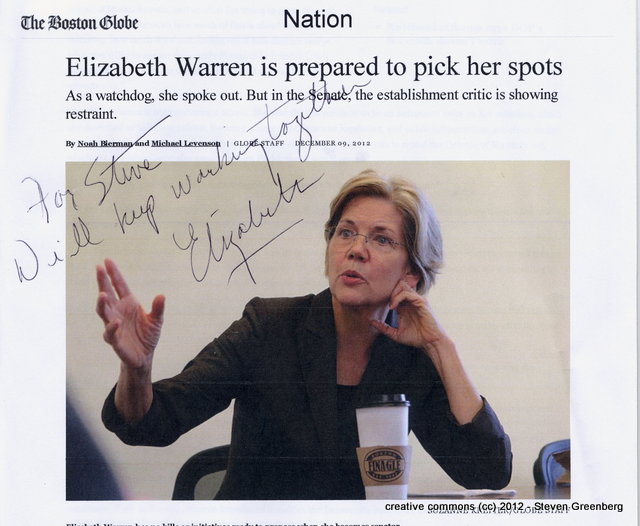
Elizabeth Warren Appointed To Senate Banking Committee – It’s Official

I just got an email from Elizabeth Warren.  Please follow up with Harry Reid as Elizabeth Warren has suggested.

On 12/12/2012 6:22 PM, Elizabeth Warren for
Daily Kos wrote:


Steven,

Just moments ago, I received a call from Sen. Harry Reid’s office, confirming my position on the Senate Banking Committee in January.

I appreciate the faith that Leader Reid has put in me to take this assignment, and I am looking so forward to playing a role in Congressional oversight over big banks on Wall Street and the banking agencies in Washington. Middle class families need more watchdogs in Washington that will try to hold the big guys accountable and to stop bad deals for the American people. I’m ready to help.

Please join me in thanking Leader Harry Reid for this incredible opportunity.

Over the years, your faith in my work has strengthened me. You donated to my election campaign, you made phone calls to help identify volunteers and get out the vote in Massachusetts, and you pushed hard again and again to put wind in my sails in every way imaginable so that I could take on the big guys.

Against the odds, you helped give me a real shot at winning.

You’ve been there for me since the beginning, and I’m so grateful. This is how real change happens – we do it together.

Of course, fighting for the middle class means more than talk or strongly worded emails. It means across-the-board, consistent accountability for anyone who breaks the law — no matter where they work or who their friends are. And that’s what we’re going to work hard to accomplish.

But before we get started, please join me in thanking Leader Reid for his giving me this incredible opportunity.

I’ve taken on Wall Street banks and other powerful interests for years, and, with your help, I’ll continue to do so for many years to come.

Thank you for being a part of this, and keep fighting!

Elizabeth

donate


Angry with Obama, GOP threatens political war next year

CNN has the story Angry with Obama, GOP threatens political war next year.

Conservative Sen. Lindsey Graham, R-South Carolina, promised the newly re-elected Obama “one hell of a fight” next year if the president forces through his plan for high-income earners to pay more taxes without agreeing to substantive steps to reduce the nation’s chronic federal deficits and debt.

“But there will come a time in February and March where we have to raise the debt ceiling,” Graham said Tuesday on “Piers Morgan Tonight” on CNN.

“I will not raise the debt ceiling ever again until we get significant entitlement reforms, because if we don’t reform entitlements, we’re going to become Greece,” adding that the situation presented a chance for Obama to lead. “But if he doesn’t lead, there’s going to be one hell of a fight over raising the debt ceiling.”

Do you need any more proof that we need to reform the filibuster rule in the Senate in order to disarm the Republicans who want to wage war against the country?

To take action see my previous post Reform The Filibuster – Don’t Just Stand There, Do Something. If the Republicans see the growth in signatures on this position every time they threaten the country, maybe they will get the message.  In any case, this reform needs to happen.  If the Republicans claim to be conservative and long for the good old days, then they should all be in favor of putting the filibuster rules back to their traditional status.  It was the recent change that made it too easy to stop the Senate with a mere threat of a filibuster that has brought this country to the sorry deadlock in which it finds itself.


Oregon Mall Shooting Hero Gets Mom to Safety, Evacuated Others

ABC News has the story Oregon Mall Shooting Hero Gets Mom to Safety, Evacuated Others.

A store employee at the Clackamas Town Center mall used his knowledge of the shopping complex to hustle his mother out of the building during Tuesday’s shooting rampage and then twice went back inside to guide other shoppers to exits and safety.

This is particularly scary to us.  We used to frequent the Clackamas Town Center when we lived in Oregon.  We often ate at the Food Court, too.


State Subsidies to Attract Corporate Investment Should be Banned

The Real News Network has the interview State Subsidies to Attract Corporate Investment Should be Banned.


EPSTEIN: Well, they do set up this bidding process, and it’s a race to the bottom, and it’s become—as the New York Times series makes clear, it’s become part of the normal culture of doing business now.

How do you stop it? Well, one way you stop it is you take a proposal from a couple of the economists and the president of the Federal Reserve Bank of Minneapolis about 15 years ago, who said that there ought to be a federal law outlawing this kind of tax competition. Everybody would be better off, and even the states realize that. It’s like an arms race. When you get into an arms race, you know that everybody’s worse off. So you ought to have a law against it.

I have been thinking for a long time that the only way to stop this race to the bottom inside the country is to prevent it on a national level. I am glad to see this idea is getting some publicity.

With the constitutional mandate that only the Federal Government can regulate interstate commerce, I would think such a law would be a natural.

If we can do it within a country, there is no reason we couldn’t have international negotiations for nations to take back power from corporations.

I think The New York Times series referenced in the video begins with As Companies Seek Tax Deals, Governments Pay High Price. This article is the first in three part series. I had already posted a link to the second part in the series in my previous post Lines Blur as Texas Gives Industries a Bonanza. The third part is the article Michigan Town Woos Hollywood, but Ends Up With a Bit Part.


Paying for Lunch – MMT Style

New Economic Perspectives has the article Paying for Lunch – MMT Style, MMT being Modern Monetary Theory, and the paying for lunch has to do with the common aphorism, “There is no free lunch.” The article starts of with some criticisms of MMT before it gets to the definition below:

Many of the key ideas of Modern Monetary Theory go back to the years during and immediately following the Great Depression and the Second World War, when great thinkers and public servants applied bold, creative thinking and practical problem solving to the daunting economic and organizational challenges of their times, and helped their societies overcome systemic failure, triumph over threats and adversity, and achieve renewed optimism and growing prosperity. One of those thinkers was Abba Lerner, who developed the concept of functional finance, which he described this way in his paper “Functional Finance and the Federal Debt”:

The central idea is that government fiscal policy, its spending and taxing, its borrowing and repayment of loans, its issue of new money and withdrawal of money, shall be undertaken with an eye only to the results of these actions on the economy and not to any established traditional doctrine what is sound and what is unsound.

Lerner then articulated two “laws of functional finance”, which I think still very well capture the spirit of the MMT approach to economic policy.  The two laws are given as follows:

The first financial responsibility of the government (since nobody else can undertake that responsibility) is to keep the total rate of spending in the country on goods and services neither greater nor less than that rate which at the current prices would buy all the goods that it is possible to produce.

The second law of functional finance is that the government should borrow money only if it is desirable that the public should have less money and more government bonds, for these are the effects of government borrowing.

Read the rest of the article to get the full impact. It might blow your mind.