Why Russian hackers, not a lone wolf, were likely behind the DNC breach

PC World has the article Why Russian hackers, not a lone wolf, were likely behind the DNC breach. Here is the “proof” I have been waiting for.

The breach began as far back as last summer and involved malware previously used by two hacking groups known as Cozy Bear and Fancy Bear.

Both are thought to be based in Russia and considered among the best hacking teams in the world, said Michael Buratowski, a senior vice president with Fidelis Cybersecurity, which was called in to examine the malware in the DNC attack.

Wow, this really does it for me “thought to be based in Russia”. Is that definitive or what?

Do I really have to put in the <sarcasm></sarcasm> flags, or can you figure this out for yourselves?

To be sure, there is more in the article than what I emphasized. You can read it yourself to see if you think it is convincing enough to go to war over.

To dig shallower, you can refer to the Info World article Politics bog down US response to election hacks. This article was what led me to the PC World article.

The Democrats “Russia Hacking” Campaign is Political Suicide

Counter Punch has the article The Democrats “Russia Hacking” Campaign is Political Suicide. Talking abou a New York Times article, Mike Whitney had the following to say:

If there was a Pulitzer Prize for fearmongering innuendo or spurious accusations, the Times would win it hands-down. As it happens, readers have to delve much deeper into the article to find this shocking disclaimer:

“But the campaign officials acknowledge that they have no evidence. The Trump campaign has dismissed the accusations about Russia as a deliberate distraction…..”

“No evidence”???

They got nothing. NOTHING!

I’ll be back shortly after I find the link to the NYT article.

The New York Times article Spy Agency Consensus Grows That Russia Hacked D.N.C. By DAVID E. SANGER and ERIC SCHMITT JULY 26, 2016. (Notice that this is not a new article.)

I don’t find the quote exactly in the context as Mike Whitney implied. This is what I found:

Campaign officials have also suggested that Mr. Putin could be trying to tilt the election to Donald J. Trump. But they acknowledge that they have no evidence.

Asked on Tuesday at the Democratic convention in Philadelphia whether “there’s more to the Trump/Russian relationship that hasn’t come out,” John Podesta, the Clinton campaign chairman, said, “Well, he certainly has a bromance with Mr. Putin, so I don’t know.”


Former UK Ambassador Blasts “CIA’s Blatant Lies”, Shows “A Little Simple Logic Destroys Their Claims”

Zero Hedge has the article Former UK Ambassador Blasts “CIA’s Blatant Lies”, Shows “A Little Simple Logic Destroys Their Claims”.

The Kremlin has rejected the hacking accusations, while the WikiLeaks founder Julian Assange has previously said the DNC leaks were not linked to Russia. A second senior official cited by the Washington Post conceded that intelligence agencies did not have specific proof that the Kremlin was “directing” the hackers, who were said to be one step removed from the Russian government.

Craig Murray, the former UK ambassador to Uzbekistan, who is a close associate of Assange, called the CIA claims “bullshit”, adding: “They are absolutely making it up.”

“I know who leaked them,” Murray said. “I’ve met the person who leaked them, and they are certainly not Russian and it’s an insider. It’s a leak, not a hack; the two are different things.

Perhaps the CIA is telling these lies in the hopes that the insider leaker will reveal his or her identity.


How did Hitler rise to power?

Ted-Ed has the video How did Hitler rise to power? by Alex Gendler and Anthony Hazard.

Decades after the fall of the Third Reich, it feels impossible to understand how Adolf Hitler, the tyrant who orchestrated one of the largest genocides in human history, could ever have risen to power in a democratic country. So how did it happen, and could it happen again? Alex Gendler and Anthony Hazard dive into the history and circumstances that allowed Hitler to become Führer of Germany.


I can’t attest to the detailed historical accuracy of everything in this video, but it sounds about right from what I have learned from other sources. There are a few details that add to what I already knew.


Blaming millennials for Trump — 99 problems but the kids ain’t one

Policy.Mic has the article Blaming millennials for Trump — 99 problems but the kids ain’t one – by Scott Goodstein.

While I’m not a millennial, my firm Revolution Messaging specializes in youth voter outreach and helped Bernie Sanders win a record share of youth votes in the primary — more than Clinton and Trump combined. I also ran social media, developed young voter materials and assisted with artist and musician outreach for President Obama’s record-breaking 2008 campaign. So I was surprised, and very concerned, when Clinton’s campaign and their independent coalition leaders all brushed me off. Her team seemed to care little about learning from Sen. Sanders’ successes and about how his tactics could be used in the general election.
.
.
.
The campaign’s arrogance extended to their digital advertising strategy as well. Throughout the primary, our team was shocked that the Clinton campaign failed to match Bernie Sanders’ digital advertising efforts.
.
.
.
Let’s be honest, social network posting and commenting is the modern day version of knocking on your friend’s door. It is the medium that allows a campaign to begin a conversation with undecided voters, bring them into the discussion and move them up a ladder of engagement. Hillary’s outreach efforts should have been focused on establishing real connections wherever they may be, and for young voters, those connections are online.
.
.
.
If Democrats want to get serious about reaching millennials for the 2018 midterms and the 2020 election, we will need to learn lessons from 2016, and quickly. Today’s generation of young voters are civic-minded and passionate, and they are the future of the Democratic party and the progressive movement. It’s time we started treating them like it.

Given recent pronouncements by the likes of Nancy Pelosi, Hillary Clinton, Barack Obama, and Harry Reid, I have full confidence that the Democratic Party leaders have learned nothing, and will learn nothing. They can be defeated even more soundly in 2018. Let us figure out what we want to replace them with. This time no snatching defeat from the jaws of victory. Courage of our convictions is what we need.


On Pivoting: Ideas on Organizing During a Trump Administration

Truth Out (one of the fake “fake” news sources) has the article On Pivoting: Ideas on Organizing During a Trump Administration.

I’m defining a “strategic pivot” as a change in organizing strategies or tactics to ensure a community’s survival or to increase the impact or reach of its political vision. In this moment we know that systems of oppression are historical and deeply embedded within US culture and institutions. White supremacy, misogyny, ableism, Islamophobia, homophobia, transphobia and xenophobia are not new. What is new is that we’re encountering an incoming administration that is more transparently oppressive and violent than many of us have seen in our lifetimes.


The Fatal Flaw in Macroprudential Policy: It Ignores Political Risk

Naked Capitalism has the interesting article The Fatal Flaw in Macroprudential Policy: It Ignores Political Risk.

In contrast, the macropru policymaker is faced with a complex, ill-defined policy domain in which there is not a clear consensus on either the problem or the objective. The indicators at this policymaker’s disposal are often imprecise and conflicting. The surgical implementation tools are often ineffective, and the powerful implementation tools are too blunt. Macropru also tends to result in clearly identifiable winners and losers, perhaps even more so than monetary policy. As a result, it is subject to intensive lobbying and political pressure.

This adversely affects both the legitimacy of the macropru regulator, and the regulator’s reputation for impartiality.

I have a hard time figuring out who or what is a macropru regulator in the system that prevails in the USA. In my imagination, such a “regulator” would decide on budget deficits and fiscal policy in a wider sense. There is no such purely technocratic entity in our system of governance. Every time I try to imagine what one would look like, I come up against political (and practical) roadblocks to creating one.

So we are left to speculate on how great things would be if there were a technocratic solution divorced from politics. As far as I know there is no democratically run government of any significance that has figured out how to do this.


What is the Worst Case Scenario for Bonds?

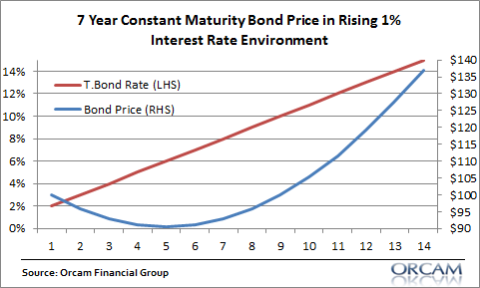
Pragmatic Capitalism has a couple of interesting articles. What is the Worst Case Scenario for Bonds? is the one that held the most interest (pun intended) for me. The reason for preferring this article is that the small amount of money I have invested in bonds is in a bond fund.

A Medium duration bond portfolio (such as a bond aggregate) should not expose you to significant loss of principal even in the case of a sharply rising interest rate environment.

If you aren’t going to read the article to see the limitations on what this quote means, then you might be better off forgetting that you ever saw this post.

The article that led me to the above was Repeat After me: “Bonds Don’t Necessarily Lose Value When Rates Rise”. Maybe this is more the headline you should forget if you aren’t going to read the articles.


Site Behind Washington Post’s McCarthyite Blacklist Appears To Be Linked to Ukrainian Fascists and CIA Spies

Naked Capitalism has published the article Site Behind Washington Post’s McCarthyite Blacklist Appears To Be Linked to Ukrainian Fascists and CIA Spies. The article explains the propaganda war being waged by the Washington Post.

The WaPo is essentially an arm of the American deep state; its owner, Jeff Bezos, is one of the three richest Americans, worth $67 billion, and his cash cow, Amazon, is a major contractor with the Central Intelligence Agency. In other words, this is as close to an official US government blacklist of journalists as we’ve seen—a dark ominous warning before they take the next steps.

This article is filled with cross references that are too numerous for me to check them all. This can be a sign that the article is well researched, and has significant factual support for what it has to say. Of course, this technique can also be used to mask an article of pure fiction because authors know that nobody follows up on the cross-references. I tend to believe what this article is saying, but I keep in mind that I am subject to being tricked. Can I enlist some help from the readers to check up on the references and offer their opinions? If each reader checks just one reference, and shares their knowledge here, then we might have a more reliable idea about the veracity of this article.


Avoid Malware Scanners That Use Insecure Hashing

Word Fence has the article Avoid Malware Scanners That Use Insecure Hashing. If there is anyone reading this blog who still works for one of the companies where I used to work, I hope they see this mention of the MD5 hashing algorithm.

Today, I received the following email:

This morning we’ve posted an analysis and advisory that describes a problem with malware scanners using the MD5 hashing algorithm.

Several popular security products in the WordPress space use MD5 to verify safe files and detect malicious files. Using this weak hashing algorithm creates a security hole that an attacker can use to craft malware that avoids detection by these scanners.

In today’s post we describe why this is a problem and we include some research demonstrating how attackers can bypass MD5. We also share the history behind MD5 and why some malware scanners for WordPress may have confused MD5 with a secure hashing algorithm.

You can read the full story on our blog…

Regards,

Mark Maunder
Wordfence Founder & CEO