The JOBS Act is insane on many levels. It creates an extraordinarily criminogenic environment in which securities fraud will become even more out of control. One of the forms of insanity is the belief that one can “win” a regulatory “race to the bottom.” The only winning move is not to play in a regulatory race to the bottom. The primary rationale for the JOBS Act is the claim that we must win a regulatory race to the bottom with the City of London by adopting even weaker protections for investors from securities fraud than does the United Kingdom (UK).
Perhaps the only way to start to restore sanity to Washington is to elect Elizabeth Warren to the Senate. She seems to understands this issue of bank and financial fraud on a level that equals William Black. Of course, she would only be one voice, but it is a start. We have to start somewhere. Why not start by electing Elizabeth Warren?
The Real News network does it again. Is the Euro Crisis Over? is a conversation among William K. Black, Paolo Manasse, and John Weeks where they discuss the Euro and the danger of global recession. The interviewer is Paul Jay of The Real News.
There is one dissenter in the panel about the issue of Germany’s Beggar Thy Neighbor policy that has had much discussion in other interviews and posts on The Real News. For Paolo Manasse who emphasizes productivity gains in Germany versus a Beggar Thy Neighbor policy, I think that a discussion of his definition of these productivity gains would have shown that there is really no disagreement on what happened. They did not have time to go into it, but I bet that Manasse is talking about productivity as the amount produced per unit cost of labor, not per hour of labor.
If that were the case, then what Germany did to get that productivity is exactly a Beggar Thy Neighbor policy. They cut their wages so that they could produce more cheaply than their neighbors despite agreeing not to do that. They then transferred their unemployment and slow growth problems onto their neighbors in order to only solve their own problems. (We do have such competition among states in this country when it comes to state taxing policy, labor policy, and state subsidies to entice businesses to move from one state to another.)
For balance, you can watch the entire video.
However, for my purposes, I’ll just quote something that William Black said in the video. This is from the transcript provided by The Real News. Let me start off with the description of who William Black is:
William K. Black, associate professor of economics and law at the University of Missouri, Kansas City, teaches White-Collar Crime, Public Finance, Antitrust, Law & Economics. A former financial regulator, he held several senior regulatory positions during the S&L debacle. Black is the author of The Best Way to Rob a Bank Is to Own One (2005) which focuses on the role of control fraud in financial crises. Black developed the concept of “control fraud” – frauds in which the CEO or head of state uses the entity as a “weapon.” Control frauds cause greater financial losses than all other forms of property crime combined.
Now, for what it is he said in one segment of the video.
BLACK: The new credit facility provides exceptionally low-cost funds to banks, well below supposed market rates. And it’s a way of transferring wealth to the banking sector. And I agree with both of my colleagues, there’s absolutely no reason to do it this way except ideology about the role of the ECB. Obama is correct that Europe has more than ample funds to deal with the crisis, but it has allowed it to twist slowly in the wind, and it has exposed the fact that the leading proponents of ever closer union, France and Germany, didn’t really mean it. In other words, once Greece got in trouble, well, it was the damn Greeks that got in trouble; it wasn’t my fellow countrymen analog in the United States, say, when New Orleans has a hurricane. You know, you bail out Louisiana, whether or not you particularly like Louisiana. But Europe is not a united nation. It’s not close to a united nation. And Germany is imposing policies that are exceptionally destructive to the rest of Europe. And so, ultimately, it is completely ideologically driven. You have insanity, after all, going on, where if you go to Ireland, the official policy mandated by the rest of Europe is to cut your wages so that you can out-export the Portuguese. But if you go to Portugal, the strategy is to slash working class wages so you can out-export the Irish. And this is the road to Bangladesh strategy. And it is quite clear that France, Germany, Netherlands are quite willing to saw off the periphery of Europe. They just can’t figure out a way to do it without hurting their own banks.
Remember, I am not saying this is the whole story. You have to spend the time to watch the video or read the whole transcript, if you want the whole story.
The link to the article that is the focus of this blog has both an audio of the interview and a transcript. To try to give you a sense of the magnitude of the fraud being discussed and to whet your appetite to read the article, I have selected some parts of the transcript to quote.
Remember I told you there were over a million cases of mortgage fraud a year and that overwhelmingly it’s lenders who foot the fraud, the lie in the liars loan.
…
To give you a comparison, at the peak of the Savings and Loan Crisis, there were 1,000 FBI agents working the cases.
…
Eight times more FBI agents than were working the cases in fiscal year 2007. And this crisis is forty times bigger and worse than the Savings and Loan Crisis. So you would have required massively more people. To give you another idea of scope, to investigate Enron, and Enron was complex, but it was nowhere near as big and as complex as Washington Mutual. It took 100 FBI agents. So you can see that with 120 nationwide, at most you could have done one major case.
…
Every year, with a million plus cases of fraud a year, if you prosecute a thousand of them or two thousand of them or three thousand of them, you are a million cases further behind every year, right. It is just insane. So the FBI says we got to start going after the big guys at which point Bush’s Attorney General Mukasey says no, he refuses to even create a National Task Force against mortgage fraud, saying famously, this is simply the equivalent of, and I am quoting again, “White Collar Street Crime,” little tiny stuff. Well of course he has assigned the FBI to only look at little cases and they report back, hey we’re finding little cases. And the Mukasey interprets from that, hey only little cases exist.
For some reason, people cannot understand what the Occupy … movement really wants. They must have very short memories.
I found the link to the William Black article on the Occupy Boston Facebook page, but I’ll be darned if I can figure out how to create a direct link to that specific post. If someone else makes a comment after I did, I may receive an email with the link.
BLACK: Well, it’s right out of the movie Blazing Saddles. And, of course, the famous case is the sheriff is surrounded by the angry townspeople about to lynch him, so he takes out his pistol, points it at his head, and says, don’t move or I’ll shoot–
JAY: So then it’s kind of a silly bluff, because there’s no way that the Republicans, as far as we can understand it, would ever allow such a thing to happen, you–one would think an easy bluff for the Democrats to call.
BLACK: Well, but it’s not silly if you’re playing with people that don’t understand how to deal with bullies, and it doesn’t appear that the Democrats have figured–or at least key Democrats in the White House, have figured out that this is a standard ploy in game theory. And it was of course pulled on President Clinton. Remember, after the Democrats lost control of the House and legislature, the Republicans shut down the federal government, and expecting that Clinton would cave rather than have that happen. Well, instead, Clinton told the American people the Republicans were irresponsible and endangering the nation, and the Republicans lasted exactly one day. And once you call their bluff–then, of course, when they threatened it again, Clinton just smiled, and the Republicans went away and had to play nice.
JAY: The main argument that Graham and his colleagues are making is less about short-term deficit and more about long-term debt. You’ve seen these graphs where they show within 20, 30 years the debt ratio becomes unsustainable and you–. And so that’s why they’re going after retirement issues, ’cause in theory it affects long-term debt more while still allowing some short-term stimulus. You see this in Europe as well. They’re–the big austerity measures in Europe are mostly focusing on age people receive pensions. What do you make of this long-term debt issue?
BLACK: This is silly math that doesn’t make any sense, to take these curves and extrapolate them. And everybody knows that, by the way.
JAY: Bill, you say, well, everybody knows this about, you know, the fact that once growth begins, assuming it does, that these numbers start to change.
You might find a remarkable similarity to how these authors describe what happened to what I have been saying on this blog for quite a long time.
My only quibble is their contention that Democrats don’t want to admit that the government screwed up. Their description of how Fannie Mae and Freddie Mac got involved in the mess is exactly what I have said on this blog and on many discussion boards.
The Democrats and I were complaining about the laxity of the regulatory agencies in the executive branch run by George Bush. The description of how politics got in the way of regulators who wanted to put a stop to this is described quite well for the S & L fiasco in the book The Best Way To Rob A Bank Is To Own One. A book that I have featured on this blog.
Let me give credit to RichardH for making me look for something to post about these two authors and their new book All the Devils Are Here: The Hidden History of the Financial Crisis. I have been touting Naomi Klein’s book, but RichardH thought that Bethany McLean was prettier. Actually, my suspicion is that RichardH is just trying to avoid admitting that he won’t read Naomi Klein’s book because I recommended it to him.
Hans G. Despain is a professor in the Department of Economics at Nichols College in Dudley.
While I have found that Hans Despain is one of the few local people who are writing knowledgably about the economy, I am also a little curious about the tone of his article.
For anyone trying to figure out whether or not to vote in more Democrats or more Republicans in the fall, this article seems to leave that as an unaddressed issue. What references he does give to the political struggle leave one wondering just what he does think.
In particular, with his mention of Scott Brown’s election as a catalyst for financial reform, I wonder what Prof. Despain was thinking. Does he really believe that after struggling to pass health care reform over the obstructionist tactics of the Republicans, that Obama would not have tackled financial reform had it not been for Scott Brown?
Does he think giving more power to the likes of Mitch McConnell and John Boehner would end up with better financial regulation?
Having started reading the book ‘The best way to rob a bank is to own one’ I think that Professor Despain isn’t giving enough credit for our troubles to the out and out fraud committed by many of the ‘risk’ takers on Wall Street.
They didn’t just take risks, they cooked the books, they intimidated internal and outside auditors, and they used political influence and bribes to remove any regulators that were getting too close.
It’s not that President Obama and the Democrats don’t deserve any criticism. However, for one so knowledgeable as Hans Despain to leave the impression that the solution might include voting in more Republicans (who actually favor deregulation and little enforcement) is more than I can comprehend.
It bears repeating what Vice President Joe Biden said in quoting former Boston Mayor Kevin White, “Don’t compare me to the almighty. Compare me to the alternative.”
In this second round of conversation, Professor Michael Hudson and Pepe Escobar discuss the emerging economic world order which they define not so much as a conflict between nations, but a rivalry between two competing models of the economy. The finance capital driven model of the West with a domination of the FIRE sector, versus the mixed economy model represented by China and Russia which seeks to rein in rent seeking, combined with public banking and state funded infrastructure to support market compliant industrial development. In Professor Hudson’s view, this model was advocated by classical economists, from Mill, Ricardo, to Henry George; and is largely responsible for the West’s past successes.
This could be the best two hours you have watched in in a lifetime.
Alanna: So Michael, what about one city that it’s desperate that could be educated, that there is an alternative with clarity about a land value tax system and a public bank. For instance, the city of Baltimore that desperately needs a new economy. Can you give us some hope that we could focus on a city level and begin building a template for how cities and like Sao Paulo where Pepe is born, from the cities that desperately need change? Michael, can you give us some sort of template?
We know the federal government is hopeless for us now for we, the people. Texas is having a vote to form the Republic of Texas, to secede. There are other growing secessionist movements in the United States. Could we imagine that there could be an implosion away from centralized control to a regional and city level. Michael, give us some hope.
Michael Hudson: I can’t give you hope. I am all in favor of public banking and I’m on Ellen Brown’s board of directors for her group. However, supposing you had a public bank in Baltimore and the public bank said, we want to provide credit for Baltimore people to be able to afford homes. They would still have to out create enough credit and enough debt to outbid what commercial banks are lending other people that want to buy houses there. So, you can’t have an Island of efficiency and public banking in a system that basically is still financialized. The problem is systemic.
I don’t know much about MMT, but I am going to write about it anyway.
There doesn’t seem to be a way make comments on that blog, so I wrote an email to the author Robert Waldmann.
Whether pure monetary policy is important depends on the circumstances and depends on who gets the money. If you pump money into an economy and give it all to the people you expect to invest it, and there are no investment opportunities because of low consumer demand, do you think it is reasonable to expect investors to use the money to build more production capacity when production capacity is already in excess of demand?
Either these investors give the money right back to the government by buying treasury securities, or they pump up asset prices including the stock market.
When there is full employment, but a lot of that employment is in the FIRE sector which detracts from the productive economy, couldn’t we have a better economy if that money got redirected into useful work? When people are fully employed in jobs that don’t pay a livable wage, is that a good economy?
Surely you know about all these subtleties, but somehow they do not make it into your article.
/Steve
Robert Waldman’s reply was
I don’t know much about MMT and you don’t know what “monetary policy” means. You are discussing fiscal policy. Monetary policy does not consist of giving money to people. It can consist of open market operations — the Fed buying treasury securities. It can consist of reserve requirements, and it can consist of changing the interest rate the Fed charges on loans (the discount rate) or that it pays on deponsits.
None has anything in particular to do with giving money to people. Giving people money is called fiscal policy.
It is not easy to have a useful discussion if people use technical terms with their own definitions. Just for fruitfiul communication, it is best to use the official definitions of official terms.
It is also not ideal to begin an unsolicited e-mail with a criticism bordering on an insult.
/Robert
To which, I replied
So QE was fiscal policy? Is that what you are saying?
/Steve
The final email in this series was his final reply.
QE consisted of purchases of treasuries not gift of anything to anyone. It was an open market operation and did not correspond to what you called monetary policy.
Do not e-mail me again.
I might just add that the purchase in QE (Quantitative Easing) by the Federal Reserve Bank of worthless private bank “assets” at full face value was certainly a gift to somebody. QE was not about the Fed buying Treasury securities in the open market as was the usual Fed activity before QE. I had no inkling of how little Waldmann really knew.
At the time QE was first practiced, I did read commentary that this was as close to fiscal policy as the Fed could come because they did not have legal authority to exercise fiscal policy. It was touted as close to fiscal policy, I suppose, because the federal government (The Fed) bought something from the private sector. I never thought that buying something worthless at full face value was anything like the fiscal policy of buying something from the private sector that both provided a service to the people and also put people to work. Maybe, I don’t understand neo-liberal economics.
The narrow focus on the ZLB [interest rate Zero Lower Bound] and powerless monetary policy within the framing of a loanable-funds financial system blocks out serious macroeconomic policy debate on how to revive aggregate demand in a sustainable manner. It will keep the U.S. economy on the slow-moving turtle — not because policymakers cannot do anything about it, but we choose to do so. The economic, social and political damage, fully self-inflicted, is going to be of historic proportions.
.
.
.
Due to our inability to free ourselves from the discredited loanable funds doctrine, we have lost the forest for the trees. We cannot see that the solution to the real problem underlying secular stagnation (a structural shortage of aggregate demand) is by no means difficult: use fiscal policy—a package of spending on infrastructure, green energy systems, public transportation and public services, and progressive income taxation—and raise (median) wages. The stagnation will soon be over, relegating all the scholastic talk about the ZLB to the dustbin of a Christmas past.
My Thoughts
As I was reading the article, I had various reactions to what I was reading.
I think one of the major problems of the theory of supply and demand is that it may be true as a static model (all other things being equal), but the economy (and life) are not static. Unless you can take dynamic effects into account, then this static or even quasi-static model will just not represent what actually happens. This is just another way of saying what this article says. Over time, the supply curve and the demand curve interact. There is hardly, if any, point in time when all other things aren’t changing.
In my world of simulating the behavior of integrated circuits, the problem involves non-linear differential equations, not just non-linear algebraic equations.
.
.
.
Here is another problem. “… by the national accounts[,] identity of saving and investment (for closed economies),”
Accounting is also a static snapshot of a dynamic system. A bank creates a loan payable in let’s say 30 years. The spending occurs immediately. In accounting terms these two items balance. However, on impact on the economy, they do not balance. Why else would capitalism have noticed the value of buy now, pay later?
.
.
.
This is no longer a chicken and egg problem of which came first, the chicken or the egg. In real life, there are lots of chickens and lots of eggs. Which came first is irrelevant. Chickens create eggs and eggs create chickens.
.
.
.
Models are a simplification of reality. They apply best when the things that were simplified away don’t matter much. They fail when the things that were simplified away become important. So, when does the loanable funds model apply?
IMHO, the loanable funds model applies when there is a run on the bank. When the fractional reserve banking system is running smoothly, the loanable funds model is irrelevant. That’s why banks have reserves and monetary systems have central reserve banks. These reserve systems let us ignore loanable funds models.
Final Comment
After reading the whole article, I think most of my points were covered in one way or another.
Naked Capitalism has the article Midterms 2014: The Red Wedding for Democrats. Here is the best analysis of the 2014 elections that I have seen. I knew a lot of this stuff already, and yet the article was still rather eye opening.
The midterms were not a “wave election” for Republicans, and in fact left policies were adopted by voters. The Democrats did not lose because of technical factors like the electoral map, structural issues with their “coalition,” or even for the reasons put forward by emo-dems. Rather, the midterms were a protest against neo-liberal principles and policy outcomes successfully achieved by Obama and the dominant factions of the Democratic Party: An active protest against Obama’s redistribution of income to the rich, and a sullen refusal to take ObamaCare as the positive good that the political class, refusing to look out the windows as they talk on their cellphones on the Acela, are sure that it is. Finally, Republicans are no less despised than Democrats, and in 2016 it may well be their turn to be subject to the cycle of massacre. Only a cat of a different coat….
This analysis explains why there are so many people who are Ready For Warren. They are also Ready For Warren on Facebook. How anybody could read this analysis and still be for Clinton in 2016 is just beyond my imagination.
This is a wake up call for progressives. We need to understand that we may be backing the wrong horse, and the rest of the country is way ahead of us understanding this. The right horse is not the Republicans and neither are many of the Democrats. This is the message that we have not digested yet.
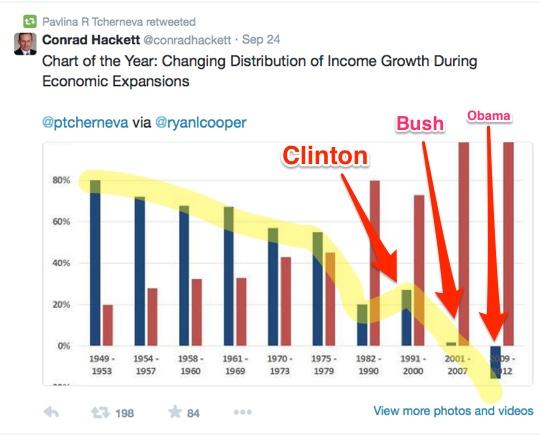
Since most of you won’t click through to the article, I guess I’ll have to put one of the charts from the article here.
The blue bars are the bottom 90% of the population by income; the red bars are the top 10%.
Are you surprised that the bottom 90% might not have appreciated what Obama did for them in the economic “expansion”? I don’t think a lot of the people I know are in the bottom 90%, so we don’t feel it quite the same way as they do.
You can squawk that Bush was the cause of the poor performance during the Obama administration, but politicians who blithely assume that everyone should feel great about the recovery is setting himself up for a big surprise.
Obama should have spent the last 6 years hammering on this issue rather than trying to fool people into congratulating him on a job well done. He should have explained exactly what needed to be done to fix the problem. Leaving the crooked financial executives free from jail to enjoy their ill gotten gains from the bank bailouts was not very convincing. By the way, corporations are not people, so jailing the bank executives is not the same as harming the banks or the financial system. In fact jailing the control fraudsters would have done more to fix the banking system than the Dodd-Frank bill did. Can you think of a politician (hint: her initials are EW) who has been hammering on this issue?
If you just saw the Boston Globe editorial cartoon, before seeing the figure above, you could feel pretty smug about the turkeys.
However, having seen the first image, you might wonder if the bottom 90% of the people figured one hatchet wielding pilgrim is as good as another.