Yearly Archives: 2011


GOP hardens resolve on debt talks after poor jobs report

In the article GOP hardens resolve on debt talks after poor jobs report there is a quote from House Speaker John Boehner.

“Where are the jobs?” House Speaker John Boehner asked at a press conference today after the Labor Department reported that the the unemployment rate rose to 9.2 percent in June. The economy generated just 18,000 net new jobs last month, making it the slowest month for job creation in nine months.

He is great at misleadingly citing statistics to deflect the blame from himself and try to put it on Obama.

I had already done some other reading,  Stocks Fall 1% on Weak Jobs Data, before coming across Boehner’s misleading remarks.

The U.S. economy only added 18,000 jobs in June after gaining 25,000 jobs in May, according to the Labor Department’s report, which was well below the increase of 80,000 that the market had been expecting. The private sector added 57,000 payrolls, missing projected additions of 110,000, according to Briefing.com.

If the total added was 18,000, but the additions from the private sector was 57,000, then one would have to assume that 39,000 jobs were cut from the public sector.  One might also assume that the number of private sector jobs created would have been higher if we had not lost the consumer spending of the 39,000 people who lost their government jobs.  Had it not been for Republican obstructionism, the job numbers for this month could have been above 57,000 instead of the net 18,000 we got.  If the private sector had hit the target of 110,000 mentioned in the article and the government had not laid of 39,000, the job gains would have been 110,000.  Thanks, Republicans, you have been doing an excellent job of holding back the recovery.  You Republicans cut off as much as 90% of the job growth and then blame Obama.  Outrageous!!!

Indeed if you follow one of the links in the above article, you come to June Jobs Increase Falls Short.

However, Canally noted that the report was a “half empty, half full” picture. Although jobs in state and local governments dropped, retail and leisure sectors saw strong gains, Canally explained. He also added that the drop in manufacturing hours worked might be a bit “fluky” given that ISM’s reading on manufacturing was much better last week.

Why do I say that Boehner is misleading?  The cutback of jobs in the public sector is exactly what Boehner wants to happen.  He does not want the Federal government to keep supporting state budgets which would have prevented these layoffs.  In having to balance their budgets, and with their refusal to raise taxes on the wealthy, the states have had to layoff workers.  Thus the absence of net job creation comes exactly from the type of policies Boehner is proposing and not from the Obama policies that Boehner rejects.


Compare my analysis of the job numbers above with the above video of President Obama’s response today to those numbers. What a weak response he has made, when a strong one was needed. At about 1:50 into the video he did mention state and local budget cuts, and that was it for that topic. The President just does not get it, and I don’t think he ever will.

It is apparent to me that this President has just run out of steam and fight.

I saw a a comment on one of the boards that I read that really nails the issue. Our problem when we elected Obama was that we hired a mediator when we needed an advocate. President Obama is not the right person at the right time. We need a strong challenger in the Democratic presidential primary in 2012. This challenger needs to be an extremely strong advocate. If she or he foolishly talks about getting cooperation from the Republicans, we need to write that candidate off immediately.


Earlier this evening I was watching BBC news. They started talking about the job numbers and focused on the 18,000 net jobs lost. They did not dig into the composition of those number to give us any insight. At least they didn’t before I turned them off in disgust.

Later I was watching NBC news where there was a promise that they would dig in. When they brought forth Maria Bartiromo to comment, I could just not stand it anymore. It was better to watch the movie on TCM about the development of the British Spitfire fighter plane before World War II than it was to continue to watch the idiocy that passes for news (at least in this country and in Britain.)

President Obama Needs An Intervention

With reports that President Obama has put cuts to Social Security and Medicare on the bargaining table just to get concessions on some tax loopholes, it has become a time for action.

I have commented on one of Paul Krugman’s articles The Obama-Keynes Mystery that leading like-minded economists must demand an emergency meeting with the president.

There is wonderment in the community of economists on how President Obama can be going down the economic path he is choosing in the face of all the evidence against taking that path.  They wonder if he even understand Keynes’ insights on how the economy works on a national and international scale.

First, the economic delegation must insist that the President explain his economic philosophy.  They need to ask pointed questions.  Does the President think there can be a self-sustaining recovery with the current way wealth is concentrated in the hands of the few?  Does he really believe that the only way to stimulate job growth is by giving incentives to the wealthy and corporations despite the fact that there is insufficient demand for the goods that these investments would produce?  Does he have any understanding of why there is unlikely to be enough demand even if he managed to get the country back to work?  In this case, as soon as the government scales back it stimulus, the economy will fall back into recession.  We cannot afford a never ending government stimulus package.  He needs to get the job done as efficiently as possible, as lastingly as possible, and then withdraw from government stimulus.  Just as in war, decisive victory is not accomplished by starting with too few resources and slowly building up.

The President needs to explain his understanding devoid of political considerations.  If they can get him to first understand how the economy works, then they can get down to figuring out how to make fixing the economy happen, given the present state of politics.

Any of President Obama’s current supporters or people who think they might support his re-election in 2012 need to get behind this call for an intervention.  This is the only way we will save his presidency for him.  Without this intervention, it makes no difference how loyal you are to Obama, he has a serious chance of being thrown out of office if his budget compromise turns out to be as horrible as we are beginning to suspect.

In his bid to become President, his campaign wisely figured out the only strategy that could lead to victory and then they figured out the tactics to make it happen.  They realized there were less bold strategies, but they new they would not lead to success. Where is that version of Obama now?


The Obama-Keynes Mystery

In his The New York Times column, The Obama-Keynes Mystery, Paul Krugman starts with the following:

I’m not alone in marveling at the extent to which Obama has thrown his rhetorical weight behind anti-Keynesian economics; Ryan Avent is equally amazed, as are many others. And now he’s endorsing the structural unemployment story too.

To those defending Obama on the grounds that he’s saying what he has to politically, I have two answers. First, words matter — as people who rallied around Obama in the first place because of his eloquence should know. Yes, he has to make compromises on policy grounds — but that doesn’t mean he has to adopt the right’s rhetoric and arguments. The effect of his intellectual capitulation is that we now have only one side in the national argument.

Second, since Obama keeps talking nonsense about economics, at what point do we stop giving him credit for actually knowing better? Maybe at some point we have to accept that he believes what he’s saying.

I have been attributing this mystery to the fact that Obama spent time as a professor at the University of Chicago. My conjecture has been that the pernicious influence of Milton Friedman has lasted long after his demise. Friedman did build a department of like minded economists around him while he was there. Many of them are probably still there and exerting their influence.

I have just found an article, A Dark Age of macroeconomics (wonkish), by Krugman, himself, that takes a shot at some of the work that is still going on at the University of Chicago.

Obama was not in the economics department at the university, but he did pick his key economic advisors from there. I was going to do some research to see where his advisor, Austan Goolsbee, stands. All I had to do was look at a December, 2010 post of mine on this blog, White House White Board: Tax Cuts, Unemployment Insurance & Jobs.

If Goolsbee as an adviser to the President came up with this justification on his own, then he is not serving the President or the country very well. I have heard that the influence of Milton Friedman at the University of Chicago School of Economics is waning, but I think I see some of the taint of Friedman in what Goolsbee is saying.

Obama has continually ignored advice from economists not in tune with the Milton Friedman doctrine.

Even renowned Keynesian economists such as Paul Samuelson have admitted to having been bamboozled by Milton Friedman for a time. If these kinds of economists could succumb, even for a time, how can we fault Obama? Obama needs an intervention from some good, modern-day economists who understand the way Friedman fooled the world of economics for a time. The names Krugman, Stiglitz, Kuttner, Romer, Tyson, Reich, Galbraith, DeLong readily come to mind.

In the Krugman article, More On Friedman/Japan, he explains some of the bamboozling that Friedman did.

And this also calls very much into question Friedman’s famous claim that the Fed could easily have prevented the Depression, which gradually got transmuted into the claim that the Fed caused the Depression. Yes, M2 fell — but why should we believe that the Fed had any more control over M2 in the 30s than the BOJ had over M2 more recently?


In the online discussion that followed this article, I made the following comment in response to another comment explaining the importance of public investment.

Dave Baltimore said, “private investment has always followed public investment.”

I am afraid that this time might be different. In his book “Aftershock…”, Robert Reich tells of a part of Keynesian economics that was not taught to me in the early 60’s when I had a few college courses in economics.

The missing part was that the wealth could not be so heavily concentrated the way it is now for Keynesian stimulus to produce a follow-on self-sustaining recovery.

In the 60’s it probably was thought to not be necessary to cover this aspect, because at that time nobody could conceive of returning to wealth concentration that has occurred since the 1980s.

With the current wealth concentration, the money spent by the government on stimulus projects will go so predominantly to the rich that not enough purchasing power will be put in the hands of the middle class to stimulate private investment.

One take-away I got from Reich’s book is that even if public investment managed to achieve full employment, the middle-class would still not be getting a big enough share to buy the goods the economy produced so that full employment could continue after the public investment was scaled back.


Protect Us And Israel From Michelle Bachmann


Thanks to EricK, I found the above video on the www.carolineglick.com web site under the title, GOD BLESS MICHELE BACHMANN!!!!!!!!!!

Since, I just became aware of this posting, you cannot think that I had anything to do with the response by Esteban on June 22 (even though a name translation would make our names similar).

By Esteban on June 22, 2011 6:24 PM

Leaving aside the amusing delivery, it’s certainly a very friendly speech. The point about caution vis a vis the Arab Spring movements is also well-taken.

One wonders, however, if Rep. Bachmann really understands the role of the United States in the US-Israel relationship. The US has always been at its best with a sober hand on Israel’s shoulder, restraining its ally’s basest urges, and at its worst as the enabler of an unsustainable Greater Israel vision.

The annexed West Bank would forever remain an albatross around the nation’s neck, dragging it down from the humanity of Judaism to something much darker and uglier, quite akin to South Africa. It would have less of a chance of being a real Jewish State, in the values sense, than if it were flooded with right-of-return refugees.

The best thing the US could do for Israel would be to help it become a normal country, within clear, legitimately recognised borders, without the burden of overlordship over another resentful nation. It saddens me that the EU can do so little toward that goal. No other mediator than a US president will be trusted on both sides, regrettably.

Without even having noticed this comment, I also made reference to South Africa in my response to EricK.


Robert Reich – Invest in America


How many different ways does Robert Reich have to tell you that the Bush tax cuts for the wealthy are part of the cause of our high unemployment? If we don’t get rid of them, we won’t get a self-sustaining recovery.

Every time you hear someone tell you that we must not raise the taxes on the rich during a recession, go to your window, open it up, and yell, “I am mad as hell and I am not going to take it anymore”


Supply And Demand Mysteries Easily Solved

Executive Summary

Rising prices in the face of rising supply is not a violation of the law of supply and demand. If the demand curve shifts upward faster than the supply curve shifts upward, then prices will rise even as supply rises. This is what the law of supply and demand tells us.

Now For The Rest Of The Story

There is a long and circuitous path to the article, DeLong: Sorrow and Pity of Another Liquidity Trap.

On Brad Delong’s web site he posts the article Paul “Cassandra” Krugman Croaks Again! in which he praises Krugman’s article.

In turn Krugman’s article Liquidity Trapped praises a previous DeLong article.

Finally we get to DeLong’s article in Bloomberg, DeLong: Sorrow and Pity of Another Liquidity Trap. In this article DeLong sets up the premise to justify explaining a seemingly odd deviation from economic law.

There is only one real law of economics: the law of supply and demand. If the quantity supplied goes up, the price goes down.

Thus by late 2007, the 10-year U.S. Treasury rate was exactly where it had been when the Clinton surpluses ended at the close of 2001. “How long could this go on?” we wondered. Eventually the market’s appetite for Treasury bonds at high prices and low interest rates had to reach its limit, right? Supply and demand isn’t just a good idea — it’s the law.

Now, maybe the setup is just a strawman for the purposes of easily knocking it down. Otherwise, I am surprised that two economists who have my deep respect can fluff such basic stuff as the law of supply and demand.

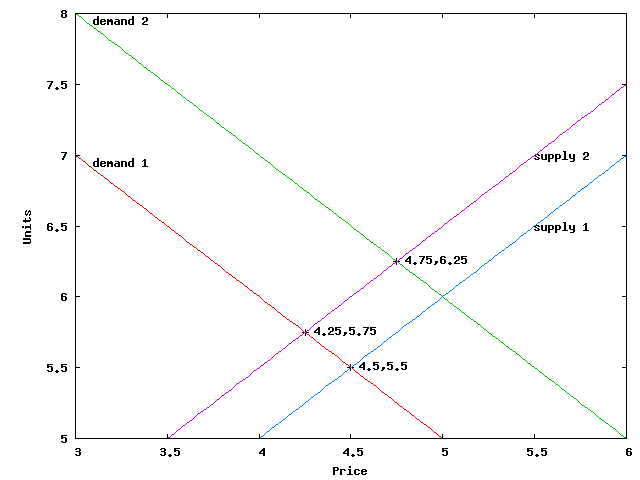
I have plotted some hypothetical and simple examples of some supply and demand curves to show what the law of supply and demand is really about and how the experts proceeded to miss the details.

Supply and Demand Curves
Hypothetical, Simple Supply and Demand Curves

DeLong’s premise is that If the quantity supplied goes up, the price goes down. We see that in the first scenario in the following table.

Scenario Supply Change Price Change
Start at supply curve 1 and demand curve 1, increase the supply to supply curve 2, but stay on the same demand curve 5.5 units » 5.75 units
Supply goes up
$4.5 » $4.25
Price goes down
Start at supply curve 1 and demand curve 1, increase the supply to supply curve 2, and increase the demand to demand curve 2 5.5 units » 6.25 units
Supply goes up
$4.5 » $4.75
Price goes up

However, the second scenario shows that the supply can go up and the prices can go up, too. This is not a violation of the law of supply and demand as long as the inferences from the law are stated in all their details.

If the quantity supplied goes up due to a change in the monotonically increasing supply curve and the demand curve does not change and the demand curve is monotonically decreasing, then the price goes down.

In the second scenario, both the supply curve and the demand curve have changed, thus breaking the assumptions of the fully stated inference. This is why, though the supply goes up, so does the price.

It is not unreasonable that with earth shaking events going on in the world that affect the economy, both the suppliers of the product will change their supply curve and the customers for a product will change their demand curve. Where the final numbers for supply and demand match up depends on how those curves change. Just about any combination of rising or falling supply can result in a rising or falling price.

Could both of these world renowned economists have forgotten that when you study an economic situation by changing one variable, that the usually stated or implied assumption is all other things being equal? You are not allowed to assume that the results apply when you violate the assumption.


Mark Zandi Talks Sense About Debt Ceiling


I used to consider Mark Zandi in my universe of economists who talked sense about the economy, until recent comments seemed to put him on my questionable list. In my mind, this recent interview puts him firmly back on to the list of economists who can get past ideology. This is despite the fact that he had been an adviser to John McCain in the 2008 presidential campaign.


Louder than Words – RootsAction

The following quote is from the article Imagine a MoveOn That Doesn’t Answer to Democrats.

I’m not suggesting we devote our energies primarily to criticizing those who are gently nudging in the general right direction. I’m not saying there’s anything wrong with opposing Tea Party lunatics. I’m suggesting that we need to understand what’s happening in order to create something better that is desperately needed and could alter our entire public discourse.

What if we had an online organizing force that answered only to concerns of peace, civil liberties, and social and economic justice? What if this new movement opposed Wall Street bailouts regardless of partisan positions? What if it opposed wars no matter who was commander in chief?

Here is their video:


Senator John Kerry, Almost Republican, From Massachusetts

My Senator, John Kerry, sent me a link to view his question and answer session.


It is at 2:51 into the video that I realized that Kerry has turned Republican.

On YouTube, I have posted the comment:

Senator Kerry ought to consult with some real economists – Krugman, Stiglitz, Kuttner, Tyson, Reich, Galbraith and the like to find out what this economy really needs for job creation. That is economic demand from the middle class. That is what is missing. A big part of that is the money shifted to the ultra-wealthy, Sen. Kerry, from the Bush tax cuts.

As suggested in the video, I have already sent a couple of questions to Senator Kerry about his false understanding of how to get the economy moving again. How about you? Send questions to question@kerry.senate.gov

Since posting “Aftershock: The Next Economy and America’s Future”, I have come to realize that even many of the Democrats don’t seem to get the point that putting more purchasing power into the hands of the middle class is the only way to get a self-sustaining recovery. What Kerry mentions as solutions to high unemployment miss the mark by a mile.

Other posts of mine on the same theme:

I almost forgot to mention the post Higher Marginal Tax Rates Spur Economic Growth