Monthly Archives: January 2020


Secular Stagnation: Demand Is Indeed the Culprit

Naked Capitalism has the article Secular Stagnation: Demand Is Indeed the Culprit.

Stagnation is a sad instance of iatrogenesis: a pathology caused by the exact economist experts whose task it is to improve the economy’s health. To fail better, we must try again and discard ‘decided opinion’ that secular stagnation is an exclusively supply-side phenomenon and recognize that demand drives growth ‘all the way’ (see also Taylor et al. 2019). Without new economic thinking, macro policy will retain its deflationary biases and secular stagnation remains the ‘normal’.

If I ignore all the economic research of the last 50 years, and hark back to what I learned in the early 1960s, I end up with the same conclusion as this article. Actually, this article does the analysis to back up the conclusion that John Maynard Keynes was right in the 1930s when he explained why the the economy behaves the way it does.


Busting pro-war propaganda: What China is really like

The Gray Zone has the article and video Busting pro-war propaganda: What China is really like.

Red Lines host Anya Parampil speaks with Danny Haiphong, a contributing editor at the Black Agenda Report, about his recent two week trip to China. Danny discusses what he learned about China’s economic model, it’s efforts to reduce poverty nationwide, and his experience in Xinjiang, the province where western media, politicians, and human rights groups claim Beijing is housing millions of Muslims in concentration camps. Did Danny see any evidence of this policy, and what do average Chinese people think about the claims?


Could it be that the USA oligarchs’ news mafia could have been lying to us about China for all these years? Can you consider the possibility that China is not anything like the image most of us in the USA have of China? I would be interested to hear what tourists from USA have experienced in China in recent years.

It will be easiest to leave your comments on my Facebook post of this article.


Joe Biden’s Social Security Record Is Cause for Concern

Social Security Works has the article Joe Biden’s Social Security Record Is Cause for Concern.

The following is a statement from Nancy Altman, President of Social Security Works and one of the nation’s leading Social Security experts:

“Vice President Joe Biden recently claimed that the Bernie Sanders campaign ‘doctored’ a clip of a 2018 speech, to make it appear that he supports cutting Social Security. The truth is that the clip is in no way doctored.

The article has a link to the transcript of the full speech. Here is the couple of paragraphs, one of which was shown in the video clip.

As I say where I come from, get a life. Look what’s happened with the latest tax cut. Once again those at the very top get the biggest breaks and what do we have to show for it? Even our Republican friends are now beginning to admit there’s no evidence these tax cuts are being put to work in the economy. No new growth,just more debt. And that puts middle class programs that they rely on and they’ve worked for at real risk.

Paul Ryan was correct when he did the tax code. What’s the first thing he decided we had to go after? Social Security and Medicare. Now, we need to do something about Social Security and Medicare. That’s the only way you can find room to pay for it.

Maybe this doesn’t sound quite as bad as hearing only the second paragraph. But thinking “That’s the only way you can find room to pay for it.” shows a completely obsolete understanding of economics and money. If Biden really believes this nonsense, then we are never going to have the policy freedom to do what needs to be done in this country. What might be a more enlightened statement is that “We need to expand Social Security and Medicare. If tax cuts for the rich leaves them the wherewithal to compete for limited resources and raise inflation when the government is trying to do its important work, then we need to rescind those tax cuts.”

Using the word “expand” rather than the unclear words “do something about” would have made Biden’s words unambiguous.

Here is a third paragraph from the transcript.

Now, I don’t know a whole lot of people in the top one-tenth of 1 percent or the top 1 percent who are relying on Social Security when they retire. I don’t know a lot of them. Maybe you guys do. So we need a pro-growth, progressive tax code that treats workers as job creators, as well, not just investors; that gets rid of unprotective loopholes like stepped-up basis; and it raises enough revenue to make sure that the Social Security and Medicare can stay, it still needs adjustments, but can stay; and pay for the things we all acknowledge will grow the country.

You actually have to know what Biden ought to be saying to make sense out of this word salad. Maybe somewhere else in the transcript, he finally says something that I can clearly understand without my having to put words into his mouth, but I didn’t have the stamina to read the rest.

STATEMENT: House Budget Committee, “Reexamining the economic costs of debt”, Nov 20, 2019

New Economic Perspectives has the article STATEMENT: House Budget Committee, “Reexamining the economic costs of debt”, Nov 20, 2019

I will argue that the Federal Government’s deficit and debt are not so scary as we are led to believe.

Neither the deficit nor the debt ratio is on an unsustainable path. In some sense, chronic deficits and a rising debt ratio are normal.

They are not due to out of control spending—now or in the future. They serve a useful public purpose. In any case they are largely outside the control of Congress.

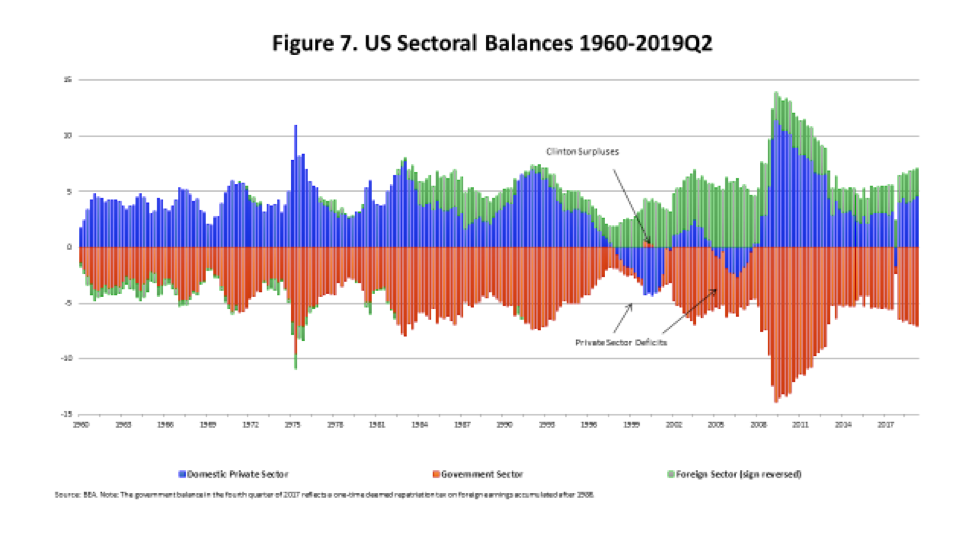
This has too many facts, data, and graphs for any normal person to digest. Only math lovers will appreciate this.


One thing that I have finally come to realize about the sector balance graph is that it tends to hide some important information. By attempting to show three sectors on one graph by using three colors, one color may cover up some important changes that are going on underneath the dominant color.

I get a glimmer of what important changes are going on in the underlying sector, but I could plainly see what that sector did if the one graph were shown as three separate graphs as well as the combined graph.

One might try experiments with 33% opacity in the colors or not fill in the colors, but use line graphs instead.


ALTERNATIVE PATHS TO MMT

New Economic Perspectives has a nice article ALTERNATIVE PATHS TO MMT.

First I’ll clearly state what MMT is and then outline four paths that lead to MMT’s conclusions: history, logic, theory and practice.

What is MMT? It provides an analysis of fiscal and monetary policy that is applicable to national governments with sovereign currencies.

When you say it four different ways, some people can put their understandings of the four paths together for a complete picture. In my days as an unsuccessful amateur tutor of math, I have found that people can be weak in their understanding of all four explanations, so this just confuses them.

One thing I wish MMT would change in its explanations is the idea that private banks create money. The way I put it for the situation of the USA, private banks create promises to give you money. As long as they can work within their promises to give you money, they never have to produce any real money. When people demand real money by cashing in the bank’s promise outside of the particular bank’s private circle, the real money comes from the banks reserves of real money. If the banks run out of reserves, they can go to the USA government’s Federal Reserve Bank to get the necessary real money if nobody else will lend the bank some real money.

The above explanation is how you differentiate between real money and what the private banks create. As all politicians know, it is easier to deliver a promise than it is to deliver the real thing.


The Dreaded New York Times

Some people cannot understand why I call it The Dreaded New York Times. Apparently those people don’t know how unreliable The Dreaded New York Times’ reporting is. This video clip for The Jimmy Dore Show explains why I coined the term “The Dreaded New York Times”.


Economic Update: Answering Our Critics

Democracy at WorK has the episode of Economic Update: Answering Our Critics.

Three major criticisms of Economic Update are considered: (1) that we don’t praise capitalism for reducing world poverty, (2) that we don’t admit that “socialism has never worked anywhere,” and (3) that no inventor of a new product or technique who starts a business will ever accept that employees in such a business are equal partners with the inventor, originator of the business. Today’s program answers these criticisms, refuting their arguments systematically.


Now you know how to respond to people when they make these criticisms. I don’t claim to be a capitalist nor a socialist. I have coined the term “what worksist” to describe how I think. I come at it from the observation that there are certain of society’s needs that are not well served by capitalism. Some of them are better served with some form of socialism. For the important needs of a society, we should try to figure out what works best, and try to use that method that will work best. If something other than capitalism or socialism would be better, we ought to try that instead.


What is Modern Monetary Theory? (with Stephanie Kelton)

Pitchfork Economics has the podcast What is Modern Monetary Theory? (with Stephanie Kelton).

Is government debt real? Is anything real? Professor Stephanie Kelton gives Nick and Goldy a master class on the hottest idea in economics right now: Modern Monetary Theory.

Stephanie Kelton is a professor of public policy and economics at Stony Brook University and a senior economic adviser to Bernie Sanders’s 2016 and 2020 presidential campaigns. She was the chief economist on the U.S. Senate Budget Committee in 2015 and in 2016, POLITICO named her one of the 50 people most influencing the public debate in America. Her forthcoming book, ‘The Deficit Myth: Modern Monetary Theory and the Birth of a New Economy’ will be published by Public Affairs in 2020.

It is always interesting to hear podcasts involving experts in MMT being interviewed by non-experts. After the experts sign off the non-experts talk about all that they don’t understand about MMT. That is exactly the time you need the expert to explain to you the parts you didn’t get. There are answers to all the questions they raise after Stephanie Kelton signs off. She is exactly the person who could have straightened them out, but they let her go.

With only a few years of study of MMT on my part, I think I could have answered all their questions and doubts.

If I had the time and the energy, I would go back through the podcast, collect all the issues they raised before and after they were speaking to Stephanie Kelton, and try to answer them all here.

To concentrate my energy in clarifying what Stephanie Kelton said, People could pose their questions on my Facebook post, and I will try to answer them there.

One thing that I think may have gotten lost in the conversation is that debt of currency users can be a concern, where “debt” of the currency issuer is a totally different matter.


All the Ways Facebook Tracks You—and How to Limit It

Wired has the article All the Ways Facebook Tracks You—and How to Limit It.

If you have a Facebook account—and even if you don’t—the company is going to collect data about you. But you can at least control how it gets used.

I still use Facebook to advertise posts that are on this blog, but for those who don’t have a real need for Facebook, they might rethink what they are doing. Be aware that

Facebook owns WhatsApp and Instagram, too,