SteveG


‘He’s not like that,’ some Bulger jurors said

The Boston Globe has the amazing story, ‘He’s not like that,’ some Bulger jurors said.

A juror in the James J. “Whitey” Bulger trial says the defense argument that the government was also on trial resonated with jurors as they deliberated for five days on the 32 counts against the former gangster.

“It worked!” said Scott Hotyckey in an interview at his Framingham home. “It actually worked for a few days. There [were] people that were shouting about that.”

Some people in the government may have been corrupt and should have also been on trial (I thought some of them are already in prison for what they did).  However, unless you can come up with some reason that says the behavior of the government lessens Bulger’s culpability, then the government corruption does not change the facts of what Bulger did.

Are we to tell organized criminals that if they can corrupt someone in law enforcement that they won’t be held liable for what they do when they come before a jury?

Do people on juries really want to live in a society like that?

This whole business about it is more important not to be a snitch than it is to not be a murderer would be beyond my comprehension if I didn’t know people who teach their children that it is better to put up with bullying than it is to go the teacher and ask for help.  After all, nobody likes a tattletale.  Fortunately some children have a stronger moral sense than some of their parents.

I suppose this may be the same factor that has some people more concerned about Bradley Manning reporting war crimes than they are about the commission of or the covering up of war crimes.  I wouldn’t think you would need religion to tell you what is right and what is wrong in cases like these.  But then again, I guess I would be mistaken, when evidently even religion can’t make it clear to some people.


Larry Summers attuned to both market and middle class

The Boston Globe has published the OpEd piece Larry Summers attuned to both market and middle class by Michael S. Barr.  I thought it was a lot of hooey before I got to the snippet that caused me to comment on the story. Here is what I wrote.

> When Summers came back into government under President Obama, he strongly
> supported tough reform: a new Consumer Financial Protection Bureau to look
> out for the interests of American families;

This one statement is enough to destroy the credibility of the entire article all by itself.  If Summers had been a backer for Elizabeth Warren’s CFPB and had supported her to head it, he wouldn’t be faced with Senator Elizabeth Warren who we hope will continue to be a strong voice to keep him from being nominated to head the Fed.

If somebody has some credible evidence that Summers advised President Obama to go for a much stronger stimulus package than the President opted for, and if somebody has evidence that Summers pushed for a second stimulus package when the first one ran its course, and if someone has credible evidence that Summers advised the President to sell the idea of a second stimulus before the first one ran its course, then I might buy into the idea that Summers was a good economic adviser to the President.  I’d also like to see  some evidence that Summers was on the side of the economic advisers who finally quit the Obama administration in disgust over whose advice the President was really taking. (Kind of hard because I think the disgust was over the advice Larry Summers was giving.)

Later, I ran across the piece by James Kwak on his blog The Baseline Scenario titled The Lame “Uncertainty” Defense.

The indefatigable Brad DeLong has devoted his energies to singlehandedly protecting Larry Summers from the Internet (although, he makes pains to say, he likes Janet Yellen almost as much). Although I’m letting most of the Fed chair sideline debate pass me by, DeLong and others have raised one issue that played an important symbolic role in 13 Bankers and, more generally, the historical background to the financial crisis: Brooksley Born’s proposal to think about regulating OTC derivatives in 1998.

The people who comment on this blog article seem to have deeper knowledge of this issue than the readers of a general interest newspaper such as The Boston Globe. That does not mean that reading their comments settles the argument. It means that they can build points and counterpoints that make your head spin faster than from The Boston Globe.  These commenters at least have more interesting links to back up material for all sides of the argument.


Australia Has $16 Minimum Wage and is the Only Rich Country to Dodge the Global Recession

The Real News Network has the interesting video, Australia Has $16 Minimum Wage and is the Only Rich Country to Dodge the Global Recession.


As I was watching the video questions popped into my mind. What about the exchange rate between Australian dollars and U.S. dollars? What about the quote from a previous post on this blog, Correlation, tiresomely, once again refuses to imply causation?

Many of my questions and then some were eventually covered in the video. For instance, there is the following segment:

BABONES: The cost of living in Australia is in fact slightly higher than in the United States. And if you want to make an adjustment for that, the Australian fast food wage of $17.98 an hour probably comes down to around $12 an hour if you adjust for cost of living. On the other hand, if you adjust for the fact that that Australian $17.98, on top of that, Australian workers get four weeks’ annual vacation, retirement benefits, and full health insurance, then of course you would have to revise the figures upward. So there is some truth in the argument that the cost of living is higher in Australia. But on the other hand, you get more for your tax money and you get more for your wages in Australia as well. So I think the two either balance out or in fact probably workers are better off in Australia.


Bradley Manning, the Nuremberg Charter and Refusing to Collaborate with War Crimes

The Real News Network has the video interview, Bradley Manning, the Nuremberg Charter and Refusing to Collaborate with War Crimes – Pt 3 of 4.  This is part 3 of 4 of an interview with Vijay Prashad, but it is the only part that talks about Bradley Manning.

PRASHAD: Let’s talk about that helicopter attack, because that took place in New Baghdad, where Apache helicopters saw something on the ground, people walking around, and they saw somebody, thinking he had a gun. They shot the crowd, killed, it turned out to be, a photojournalist with a international, you know, agency. He was killed in cold blood there. Nobody engaged the helicopters. A car came to help them, to rescue them. They said, give me the signal, I want to shoot, I want to engage, fired in. There were children in the car, etc.

Now, a ground platoon arrived at the scene, and American troops got out and saw what had happened. Many people saw that this was a great–let’s just call it mistake that had taken place. When questions were asked at the time about that attack in New Baghdad, the United States government denied that anything was wrong, and the United States government also said there is no video. In other words, the government was lying and covering up what took people on the ground, even troops–there was one particular troop, a man named Ethan McCord, later would come out and speak about what he saw, but he was suppressed. Bradley Manning saw that video and felt obliged to release it because not only was this an illegal war, not only was this apparently a war crime, but also the government was covering up the war crime. So he released the video via WikiLeaks. When he released the video, Ethan McCord, who was on the ground and saw the little children inside that car, one of them blinded because glass went into her eyes, this shattered Ethan McCord’s approach to what he was doing. But because Manning, this young, young man, took a courageous decision to release this video, it freed up other people in the military to come out and say, yes, we were party to a war crime.

And the great tragedy is that Bradley Manning was then put on trial for espionage, as well as other quite ridiculous charges like computer fraud. He was put on trial. But that war crime was not investigated further.

To paraphrase Jack Nicholson, “We can’t handle the truth.”  Makes me wonder when Senators and Representatives on Intelligence Committees are briefed about activity that they find reprehensible but feel constrained by laws that insist they cannot talk about what they know, do the Nuremberg Charter rules apply?


August 15, 2013

Now that we have heard about Bradley Manning’s apology for his actions and the attempt to use insanity as a defense, we can see his mistake and the government’s taking advantage of his mistake. Had Bradley Manning stopped at exposing the coverup of a war crime, the government would only have been able to prosecute him for that offense and he could have used the Nuremberg defense.

I suspect that the government carefully kept Manning’s act of the war crime exposure out of the indictment so that it would be impossible for Manning to use that as a defense.

Snowden has probably made the same type of error. He committed a defensible act along with a slew of indefensible acts.

You can’t use defensible acts to wipe out the crime of indefensible acts. Although you can use indefensible acts to wipe out the refuge of defensible acts. I bet they teach that in law school.

Or is it simpler to say that all the crimes you don’t commit don’t excuse you from the ones you do commit?


Reality Asserts Itself

The Real News Network has a new show called Reality Asserts Itself.  Each “episode” so far has been a multi-part interview with a particular person.  I was trying to come up with an adjective to describe the type of person being interviewed based on a sample size of 2.  I guess, radical thinker is the best I can do.

The show starts out with a 7 part interview with Chris Hedges.  Chris Hedges is a Pulitzer Prize winning journalist, a former long-time New York Times reporter, who has been black-balled by the mainstream media  because of his insistence on telling the truth.

Here are the seven parts.

  1. Chris Hedges: Urban Poverty in America Made Me Question Everything – Pt 1 of 7
  2. Hedges: Journalism Should Be About Truth, Not Career – Pt 2 of 7
  3. Hedges: We Must Grasp Reality to Build Effective Resistance – Pt 3 of 7
  4. Chris Hedges: “America is a Tinderbox” – Pt 4 of 7
  5. Chris Hedges: The Liberal Elite has Betrayed the People They Claim to Defend – Pt 5 of 7
  6. Chris Hedges: As a Socialist, I Have No Voice in the Mainstream – Pt 6 of 7
  7. Chris Hedges Answers Questions from Viewers

The issue that runs throughout these parts is “what is it  going to take to rest  control of this country from the corporate tyranny that is now in control so that we can save this country and the world?”  It’s not a pretty picture that Chris Hedges paints, and he realizes it.  However, he feels that he is only being truthful.  To give you a hint, the solution will be something like the occupy movement, except that it will work.  He talks about some of the elements that will finally make it work.


Questioning the Underlying Structures of Property and Power is “Off the Table”

I have stumbled across an interesting series on The Real News Network. The interviews with Vijay Prashad are in 5 parts. The first in this series was Vijay Prashad: Marx and Tolstoy Helped Me See the Limits of Liberalism – Pt 1 of 5. At this point, I felt the series might turn out to be worthwhile, or it might turn out to be just full of bull. Before deciding, I waited for Questioning the Underlying Structures of Property and Power is “Off the Table” – Pt 2 of 5. At this point I decided that Prashad had something worth listening to.


There is a very interesting comment that mentions Thorstein Veblen. I think I read Veblen in college. If I did, I can see that I missed the whole point.

On The Real News Network web pages and in the video, there is mention of a similar series with Chris Hedges. The two parts I have watched so far are, Chris Hedges: Urban Poverty in America Made Me Question Everything – Pt 1 of 7, and Hedges: Journalism Should Be About Truth, Not Career – Pt 2 of 7. I just wanted to let you know about this series as soon as possible. I will make a separate post on the Chris Hedges series.


Is It Difficult To Talk About Race?

The Daily Show with John Oliver has a pointedly humorous segment on this subject.


The question about stop and frisk is an interesting one. In my almost 70 years, I have been stopped by the police without much reason a small number of times. I can be frustrated by it, and yet understand the point of view of the policemen. I can then go on my way, and use the experience as an interesting story.

I can see that if this were to happen to me very often to the point where it made it difficult for me not to worry about being able to keep a normal schedule, I would have a very different view of it.

It surprises me that people who rarely get stopped cannot see how different it would be if one were frequently stopped.

You cannot fully understand all the details of another person’s life, but it would be nice if you could at least have an inkling that not all experiences are exactly like your own.


President Obama is Interviewed by Zillow CEO Spencer Rascoff

Here is the actual interview that was promoted in my previous post.


My question did get addressed somewhat in this interview. Below is the question that is close enough to what I wanted to know to elicit some hints at the answer to my question. Perhaps this question was chosen because it lacks the sarcasm of my question.

Image of question

I’ll have to look at the details of the proposal by Senators Warner and Corker. I know Warner purports to be on the side of the middle-class. Corker I have strong doubts about.


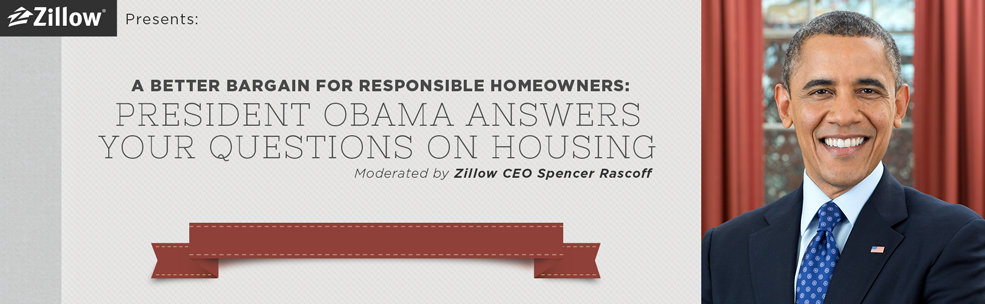
Obama Answers Your Questions On Housing

I received email notifying me of the presentation.

Yesterday, President Obama spoke in Phoenix about his plan to build a better foundation for homeownership.

Today he’s taking your questions online about that plan and what it means for homeowners, and those who want a home of their own. It’s part of an online chat with Zillow — the online real-estate marketplace — and Yahoo!.


If you follow the above link to the video, you will find it fairly content free.

If I could find a way to pose a question for this session it would be, “If semi-privatizing Fannie Mae and Freddie Mac proved to be such a disastrous policy, why do you think fully privatizing these housing agencies is a better idea?”

This is where you ask your question. Actually this place gives you links to where to ask your question, one of them being the method I used below.

Previously, I had followed this route. If you can figure this out, maybe the image below answers the How question.


Why Jeffrey P. Bezos Bought The Washington Post

The Washington Post has the article Bezos could use Amazon model of customer targeting to reboot the newspaper industry.

The article starts with the following:

Amazon.com founder Jeffrey P. Bezos’s purchase of The Washington Post promises not just an ownership change for the 135-year-old institution, but a potential transformation of the fusty mechanics of the newspaper business.

It remains to be seen whether the experiences of an Internet behemoth can be successfully applied to a legacy newspaper — and whether Amazon-style customer targeting would be palatable at a news organization.

I was thinking that the author of this article, coming from a traditional newspaper background, was missing the point a little bit.

My whole purpose for reading this article was the thought that Bezos would put into action the idea I posted in my 2010 post, Monetizing Internet Content. Toward then end of The Washington Post article came these paragraphs:

One move that Bezos might take at the outset is to end the paper’s new online subscription program, which limits how many stories readers can access without paying for a subscription, according to Stone, a journalist who has covered Amazon for more than 14 years.

“What is less customer-focused than a pay wall?” he asked. “You’re making it harder for people to read your story at the same time that there’s an abundance of competition.”

Now, I think they are on to something.  Of course, these paragraphs still haven’t contemplated the use of my idea exactly, but they do comprehend what is the problem with paywalls.  I expected Google would be the one to implement my ideas, but I see that Amazon is another company that has all the necessary technology.

It will be exciting to see whether or not The Washington Post company or Amazon will become a major seller of micropayment subscription plans that give the reader access to a wide assortment of articles from many newspapers and magazines.