SteveG


The Sanders Institute Talks: A National Job Guarantee

YouTube has the video The Sanders Institute Talks: A National Job Guarantee published on Mar 20, 2018.

Dr. Jane O’Meara Sanders (Founder, Fellow of The Sanders Institute) talks with Dr. Stephanie Kelton (Founding Fellow of The Sanders Institute, Professor at Stonybrook University) about the results of a new report on creating a national jobs guarantee program. Dr. Kelton co-authored the report with L. Randall Wray, Flavia Dantas, Scott Fullwiler, and Pavlina R. Tcherneva. The full report will be released through the Levy Institute in April, 2018.


I noticed a while ago that Bernie Sanders had added the idea of a jobs guarantee to his speeches. He never says anything about what he means. I have wondered why he has started talking about this. I know the idea is part of Modern Money Theory (MMT), and I know he hired MMT proponent Stephanie Kelton to be the Senate Budget Committee’s economist for the minority. Well, I think I have finally found the explanation.


A Social Service Job Guarantee Proposal

YouTube has the video A Social Service Job Guarantee Proposal.

Fadhel Kaboub, Associate Professor of Economics at Denison University, on with Steve Grumbine of Real Progressives, discussing a specific proposal that could be used to implement a Job Guarantee. This flavor of JG would use existing local non-profits and service organizations to employ workers applying for JG jobs.


This is the most detailed description that I have heard about how the Job Guarantee would be implemented. I had no idea that this is the way it would be done.


Argentina’s Job Guarantee-Like Program

YouTube has the video Argentina’s Job Guarantee-Like Program.

Professor Pavlina Tcherneva discusses Argentina’s Jefes program, which was similar to the Job Guarantee advocated by proponents of Modern Money Theory.


I had no idea that there was all this research and practical experience behind the idea of a Job Guarantee. After I look at some more of this, I may have to change my mind about how practical it is. This is from 2016.

Here is a playlist of videos on the Jobs Guarantee.


Has The DNC Rigged The Primaries Already?

I am wondering if the DNC has rigged the presidential primaries already. What has me wondering is Rule 2.A.1.

Rule 2
Participation

  1. Participation in the delegate selection process shall be open to all voters who wish to participate as Democrats.
    1. Democratic voters shall be those persons who publicly declare their Party preference and have that preference publicly recorded.
DNC Selection Rules Page 2

In the 2018 primaries in Massachusetts, I took out a Democratic Primary ballot as an unenrolled voter. That means I was not enrolled in any party.

Unlike many years ago, this did not change my party enrollment from unenrolled to Democrat. Long ago, Massachusetts primary voters had to change their party enrollment back to unenrolled. You could do that before even leaving the polling station.

I wonder how the Massachusetts procedure may have to be changed to meet the new DNC rules.

Given that the general election includes unenrolled voters, I wonder why the DNC wants to choose its candidates without any input from unenrolled voters. As in 2016, this choice proved to be disastrous. Over the country, the Democrats chose a candidate that the Democrats liked, but the rest of the voters did not like. Is the Democratic Party wanting to repeat the 2016 debacle?


Bill Black: Tom Friedman Just Noticed that the UK “Has Gone Mad”

Naked Capitalism has the article Bill Black: Tom Friedman Just Noticed that the UK “Has Gone Mad”.

MMT [Modern Money Theory] is not simply an Ivory Tower theory. Finance professionals use it because it produces superior predictive results. If politicians like Blair, Brown, and Obama had studied MMT, they would have avoided many of their worst economic blunders that brought us Brexit and Trump.

As I was reading this article, I suddenly realized the problem with voting for the lesser of two evils. When you “win”, people tend to forget that they won with an evil candidate. After you “win”, you must oppose the evil that you voted for.

In this article Bill Black describes the evil that was done by our choice of winners.


MMT, Models, Multidisciplinarity

New Economic Perspectives has the article MMT, Models, Multidisciplinarity.

The upshot is that, there is an inverse relationship between the price the government pays for goods and services and the quantity of real goods and services it receives, for a given level of taxation and net saving desires. Constraining the budget creates unemployment and under-provisions the government. If instead, the government allowed its budget to float, if could design a countercyclical policy (such as the Job Guarantee) that would be a superior price anchor and automatic stabilizer, which I modeled in a subsequent paper. So unlike basic neoclassical PPF models that pass objectionable tradeoffs as efficient, the Job Guarantee explicitly rejects the use of unemployment for economic stabilization purposes.

There is a lot in this article that is worth learning. It will take further reading and thought to digest it all. The references in the article will be interesting to follow.

There is one comment in the article, that I have said myself.

Now, all models make simplifications and all models are flawed. But they can be used to clarify an idea.

On this blog, I found one post I wrote that expresses the same sentiment. The post is Financial Modelers’ Manifesto posted on December 2, 2010.

I believe in this oath even for my former line of work modeling the behavior of integrated circuits. In my line of work, I was actually modeling laws of physics, but all models simplify.


What is a “Guaidó”?

The Real News Network has a two episode piece What is a “Guaidó”?.

Former Catholic Priest and Wyoming native Charlie Hardy talks about his recent experiences in Venezuela and looks back on 25 years living among the poorest of Venezuela’s poor.

Here are the two videos.

What is a “Guaidó”? A Cowboy in Caracas (Pt 1/2).


What is a “Guaidó”? A Cowboy in Caracas (Pt 2/2).


Watch these two episodes, and then tell me why Bernie Sanders would object to our oligarchs’ news media being called “the enemy of the people”.


German ‘rent insanity’ sparks mass tenant protests, expropriation action

RT has the article German ‘rent insanity’ sparks mass tenant protests, expropriation action.

Germans in large cities are protesting on Saturday against what they see as the unfair influence of large landlords on the housing market. They want the biggest players undercut and their property expropriated.

Is this a movement coming to a country where you may be living? Sometimes people have a limit to the exploitation they are willing to put up with. It is not wise for the exploiters to push past that point.

In the USA, real-estate prices are essentially set by what the banks are willing to finance. The more money you need to borrow to buy your real-estate, the more interest the banks make. With rising real-estate prices, the real-estate you pledged to get the original loan rises in value to protect the bank’s investment in the mortgage. So the problem is not only with the big owners of real-estate.


This Is How MMT Applies To Emerging Markets (Podcast)

The Gower Initiative for Modern Money Studies posted a transcript of the introduction and a link to the Bloomberg episode This Is How MMT Applies To Emerging Markets (Podcast).

“In discussions about Modern Monetary Theory (MMT) you often hear that while it may be true that the U.S. has the space to expand its deficits significantly, that it doesn’t apply to emerging markets. On this week’s episode of the Odd Lots podcast, we speak to Fadhel Kaboub, a professor of economics at Denison University, who examines emerging markets through the MMT lens. While it’s true that emerging markets don’t have the same kind of fiscal capacity as nations like the U.S., Canada, and Australia, the theory still offers insights into how EMs can pursue development policies that are different from the mainstream prescriptions”…..and the U.K.


Excellent podcast. As a follower of MMT, I learned how to apply it to emerging markets in ways I would never have figured out for myself. In some ways it is frustrating to hear these interviews conducted by people who do not understand MMT. However, the only way for MMT to progress is for the experts to explain it to the non-experts, which was done in an excellent fashion in this podcast. If you are not an MMT expert, then this podcast may be just what you need.


Rewards Aren’t the Key to Employee Motivation

Cornerstone On Demand has the post Ted Talk Tuesday: Rewards Aren’t the Key to Employee Motivation.

In his TED Talk, “The Puzzle of Motivation,” Pink explores what motivates people and how company leaders can apply this research to their own organizations. He goes on to explain what social scientists know, but most managers don’t: Traditional rewards aren’t always as effective as we think.


There is a lot of truth here, but don’t get carried away by a good sales pitch.

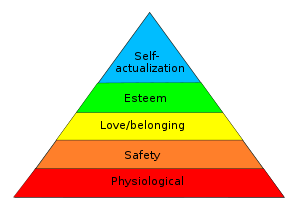
Some detail about the subject of motivation can be gleaned from Maslow’s hierarchy of needs, coincidentally from WikiPedia.

Maslow’s hierarchy of needs is a theory in psychology proposed by Abraham Maslow in his 1943 paper “A Theory of Human Motivation” in Psychological Review.


Maslow’s hierarchy of needs, represented as a pyramid with the more basic needs at the bottom

Companies I worked for had the practice of periodically announcing special rewards for exceptional achievement. I don’t know how much of an incentive this presented to the winners of the award, but I frequently observed what a disincentive it was to all those people who thought they had done great work, but did not receive any special award or acclaim. To the “self-actualized” people, the lack of a reward was only a temporary disappointment.

I was led to this video by a comment on the post A belief in meritocracy is not only false: it’s bad for you in Naked Capitalism.

Meritocracy has become a leading social ideal. Politicians across the ideological spectrum continually return to the theme that the rewards of life – money, power, jobs, university admission – should be distributed according to skill and effort. The most common metaphor is the ‘even playing field’ upon which players can rise to the position that fits their merit. Conceptually and morally, meritocracy is presented as the opposite of systems such as hereditary aristocracy, in which one’s social position is determined by the lottery of birth. Under meritocracy, wealth and advantage are merit’s rightful compensation, not the fortuitous windfall of external events.

Here, again, is an article with some merit, but be very careful that you don’t get carried away with the ideas in the article.