Greenberg’s Law of The Media

If a news item has a number in it, then it is probably misleading.


The Dark Art of Statistical Deception

The New York Times article The Dark Art of Statistical Deception By Tara Parker-Pope is an interview with the author of a new book.

The tendency of academics, politicians and pundits to generate such numerical falsehoods from data — and the tendency of the public to believe the results — is a phenomenon cleverly explored in the new book “Proofiness: The Dark Arts of Mathematical Deception,” by Charles Seife.

This is a great explanation of the reasons why Greenberg’s Law Of The Media is true.


Poll: Americans Don’t Know Economy Expanded With Tax Cuts

Bloomberg News published the article Poll: Americans Don’t Know Economy Expanded With Tax Cuts.

The Obama administration cut taxes for middle-class Americans, expects to make a profit on the hundreds of billions of dollars spent to rescue Wall Street banks and has overseen an economy that has grown for the past five quarters.

Most voters don’t believe it.

A Bloomberg National Poll conducted Oct. 24-26 finds that by a two-to-one margin, likely voters in the Nov. 2 midterm elections think taxes have gone up, the economy has shrunk, and the billions lent to banks as part of the Troubled Asset Relief Program won’t be recovered.

“The public view of the economy is at odds with the facts, and the blame has to go to the Democrats,” said J. Ann Selzer, president of Selzer & Co., a Des Moines, Iowa-based firm that conducted the nationwide survey. “It does not matter much if you make change, if you do not communicate change.”

Isn’t it odd how a news service whose primary duty is to inform the public can find out that the public is ill informed and yet not even think to ask about their own culpability?

When people read the news and find that the reporters of that news often miss the most obvious questions, it is no wonder that the news services are losing customers.  You would think it would be in the news service’s own interest to figure this out, but even with that incentive, they missed it.


Let’s Finish The Job On Health Reform

Follow this link to the request to take action to help finish the job.

Follow this link to the USA Today story Medical expenses have ‘very steep rate of growth’

I followed the suggested action and put the following comment on the Worcester T & G comment board for a news story about health care reform:

Health care spending rose to an estimated $2.5 trillion in 2009, or $8,047 per person — and is now projected to nearly double by 2019.

So the government’s spending of $1 trillion over ten years to get some control of health care spending seems a lot smaller when you consider that we are already on a path to spend $25 trillion to $50 trillion over the next 10 years on health care.

When anybody touts a single number with the intention of getting you to gasp at how large it is, you always have to ask, ‘Compared to what?’


Common Salt – The Most Deadly Poison in Nature

Follow this link to the Associated Press article that breaks this startling news.

The headline is “NYC takes lead in setting next food target _ salt”.  In this article by Stephanie Nano of the Associated Press I find the following statement:

A recent analysis showed that for every gram of salt cut, as many as 250,000 cases of heart disease and 200,000 deaths could be prevented over a decade.

As I said in the title to this post, this must make common table salt the most deadly poison in nature.  Imagine a gram of salt causing 250,000 cases of heart disease and 200,000 deaths. If the 1 gram of salt can be ingested over an entire decade and still cause this effect, you have to wonder what the 1100 milligrams of salt in a single serving of canned soup can do to you.  How does anyone survive?

You have to wonder who edits or fact checks these articles.

I don’t know whether this falls under Greenberg’s Law of the Media or not.  This statement is so blantantly ridiculous that it cannot really be misleading.  It just makes you want to laugh at the author and her editors.


Slate-An Interactive Map of Vanishing Employment 1

In the 15 April 2009 issue of Slate, Chris Wilson wrote An Interactive Map of Vanishing Employment Across the Country. In the article is an animation of monthly job loss and gain by county from January 2007 through February 2009. Watch what starts to happen in August 2008.  Frightening.

[See Steve’s comment on interpreting the monthly changes.]

Diversion–Highway Fatalities and Lemons

Derek Lowe of Corante’s ‘In the Pipeline’ (a drug-discovery blog) points to this graph in an article by Bristol-Myers Squibb’s Stephen Johnson, titled, The Trouble with QSAR (OR How I Stopped Worrying and Embrace Fallacy).

Lowe writes, ‘The most arresting part of the article is the graph found in its abstract. No mention is made of it in the text, but none has to be. It’s a plot of the US highway fatality rate versus the tonnage of fresh lemons imported from Mexico, and I have to say, it’s a pretty darn straight line. I’ve seen a lot shakier plots used to justify some sweeping conclusions, and if those were justified, well, then I’m forced to conclude that Mexican lemons have improved highway safety a great deal. The vitamin C, maybe? The fragrance? Bioflavanoids?

‘None of the above, of course. Correlation, tiresomely, once again refuses to imply causation, even when you ask it nicely.’

I’m sure the readers of Steve’s Politics Blog know the difference between correlation and causality but it is always nice to have an amusing refresher.

BTW, In The Pipeline is one of the many blogs in the Corante family. Check them out; you may find a few that interest you. [I stumbled upon Corante years ago and then met the founder, Hylton Jolliffe, at the tennis courts where, to my surprise, I learned he is the son of one of my tennis buddies.]

I now return you to your hard-core politics and economics.

-RichardH


Confusing Economic Thinking In Worcester 1

Follow this link to a column by Hans Despain in the Worcester Telegram & Gazette titled Economic stimulus package welcome, but will be little felt.

The author says he believes in Keynesian macroeconomic policy.  However, he provides some critiques of that policy and only weak rebutals.

One part that he presented stopped me dead in my tracks:

Economists Harold L. Cole and Lee E. Ohanian argue Keynesian elements of the New Deal failed to stimulate growth, by failing to put Americans back to work. This conclusion is shocking when it is realized that the NIRA created millions of jobs to rebuild America’s infrastructure, e.g. roadways, bridges and schools. Their data are unambiguous: total hours worked per adult fell 18 percent during Roosevelt’s first three years and 23 percent from 1933-39, after the NIRA was passed. We could call this the New Deal paradox: an increase in federal public work projects led to a decrease in total hours worked.

In an online response to this part of his article, I posted the following:

You are aware of the passage in 1938 of the “Fair Labor Standards Act”?

This was the culmination of the Labor movement’s 100 year effort to obtain the 8-hour work day and 40 hour work week.

So the effort to cut the average number of hours worked was deliberate. The purpose was to spread the work over a larger number of workers.

I find that when a statistic makes shockingly little sense and there is no explanation for it, then usually your instinct is right and the statistic is wrong.

Isn’t it ironic that George Bush was able to overturn some of the effect of the “Fair Labor Standards Act”, and we now find ourselves in this economic mess?

I’d say the original article might be another example of Greenberg’s Law of the Media.

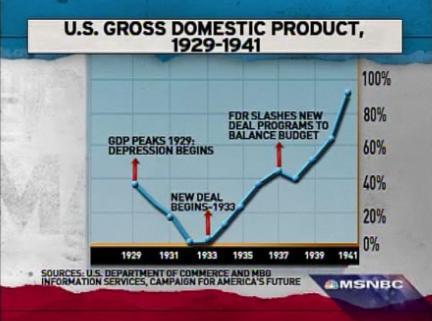
I also wonder how Despain reconciles his statistics with the possibly equally misleading chart shown by Rachel Maddow. Her chart may be a stronger refutation of the straw man that he put up than his own efforts to refute it.


The Real History Of The Depression

Apparently the above graph was used on the Rachel Maddow show this past Monday. This seems to be a pretty strong statement about the history of the depression years.  I await to see what the opposition to economic stimulus can come up with to refute the implications of this graph. (I must admit the scale to the right of the graph makes no sense that I can divine.  However, pay no attention to the numbers that prove Greenberg’s Law of the Media.)

Follow this link to the Huffington Post story about how Representative Steve Austria had to retract his claim that President Roosevelt caused the depression.


As of Feb 13, 2009, I have sent an email to Rachel Maddow asking her to explain the graph. The more I view other statistics about the depression the more I grow suspicious about the meaning of the graph.