SteveG’s Posts


The Disinformation Playbook

The Union of Concerned Scientists has the web site The Disinformation Playbook.

How Business Interests Deceive, Misinform, and Buy Influence at the Expense of Public Health and Safety
.
.
.
There are many things we can do to keep the Disinformation Playbook from sidelining science and disabling democracy. It’s a team effort: scientists, science supporters, public officials, journalists, and companies themselves all have a role to play. Find out more on our Stopping the Playbook page.

Here is a video on one of the 5 techniques described on the web site.

I have read the home page of this site, but there are many links that I have yet to follow. I’ll be looking at these links as time permits.


“Minsky,” a Macroeconomic Modeling Software Platform

Source Forge has a downloadable version of “Minsky,” a Macroeconomic Modeling Software Platform.

Free open-source computer program for building and simulating dynamic, monetary economic models, models without equilibrium and with a financial sector. A vital tool for a new approach to economics.

Read the rest of this post before you go running off to download the software. First of all, I have lost my faith that Source Forge will deliver you a clean version of software that is free of viruses, bloatware, and other annoying crap unrelated to the main point of what you think you are downloading. I posted the link mainly for the explanation of that the software is. I mentioned this software in the previous post Cenk and Young Turks Team: Your Deficit Hawkery is Unrealistic and Stands in the Way of Progressive Change.

Second, I want to say a few words about the designer of this software, Steve Keen. He uses this software to develop his understanding of the dynamics of an economy described in the blurb above. I have tried to listen to many of his lectures where he uses the software to demonstrate his conclusions. Every time he does it, he seems to fumble around, and he gets us so lost in the weeds that I have a hard time understanding his point or how the software proves it. His explanations are so full of hand-waving that I am never sure he has actually proved what he claims to have shown you.

Finally, I came to am interview where he didn’t have access to a computer to go down his usual confusing path. He explained everything just using words. From this interview, I got a much better understanding of his point of view, and he even confirmed my suspicions about some flaws in the explanation of Modern Money Theory (MMT). There is a link to the interview in my previous post Oliver Green in conversation with Steve Keen, Contrarian Economist and Author. Please forgive Oliver Green for trying and failing to get Steve Keen to confirm Green’s misunderstandings of some of the ideas that Keen is presenting.


Cenk and Young Turks Team: Your Deficit Hawkery is Unrealistic and Stands in the Way of Progressive Change

New Economic Perspectives has the article in the form of an open letter Cenk and Young Turks Team: Your Deficit Hawkery is Unrealistic and Stands in the Way of Progressive Change.

There is one area, however, where your coverage of news and economics is quite misleading and creates a trap for the progressive movement that you are elsewhere seeking mightily to foster and strengthen. You have uncritically brought into your coverage some mainstream Democratic and “moderate” Republican economic ideas about federal deficits, federal debt and tax cuts. You might feel you are representing a “solid” position because this locates the Young Turks firmly in the Establishment echo chamber about debt and deficits, as well as seems to put you in a good position to lambaste hypocritical Republicans and Trump.

This whole letter starts off in a very promising way. I feel that when it descends into the weeds to justify the first part, it defeats itself with what I have come to realize is a flaw in the way MMT is explained.

Here is the critique that I posted.

When are MMT proponents going to wake up to the fact that sector balance argument depends on a static accounting balance of assets and liabilities? This static accounting has a loan which issues money right away to the borrower balanced exactly by a debt that must be paid back many years in the future. These two items do balance each other eventually, but in anything shorter than the life of the loan, there is economic activity resulting from the time difference.

The private sector is perfectly able to generate enough liquidity to keep the economy humming along during a boom. The private sector is completely incapable to generate this liquidity in a crash. This is so obvious that it tends to wipe out your argument about sector static balances in an instant. You think you are talking about flows without recognizing the static underpinnings of your argument.

Unless you are working with a dynamic model like Steve Keen’s Minsky computer program, you are deluding yourselves in how a dynamic economy really works.


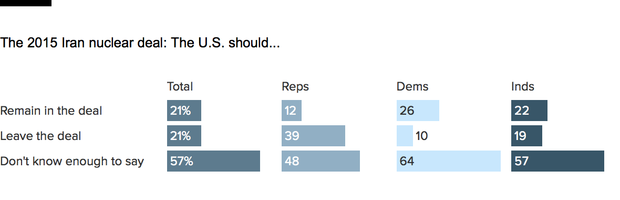
Most Americans don’t know what U.S. should do on Iran deal – CBS News poll

CBS News has the article Most Americans don’t know what U.S. should do on Iran deal – CBS News poll.

CBS News just showed a graphic about this poll which showed that 57% of Americans do not know enough about the Iran nuclear deal to say whether or not Trump should pull us out of it.

Poll Results Image

What I find remarkable about this report from CBS News is that they said not a peep about what part CBS News has played in the fact that 57% of the people do not know enough to form an opinion on this important subject.

Does CBS News think they have even a slight responsibility to inform their audience on important matters like this one? Do they think that they should do any introspection on what they might have done differently to make their audience better informed?

How much longer will CBS News continue to fall down on its main job and not have a pang of conscience of the consequences of their failure?


Framing a Job Guarantee

New Economic Perspectives has the article Framing a Job Guarantee. Just to be clear, this is not the same article I discussed in a previous post Framing the Progressive Platform. The current article is specific to the proposal for a federal job guarantee. To the start the discussion, the author dispels the notion that this is somehow “A federal job for everyone?”

The Job Guarantee (JG) program will use federal dollars to pay wages, but few (if any) of the wage earners would become part of a federal bureaucracy that most Americans believe is already over-bloated and inefficient. Think instead of all the private doctors and nurses paid federal dollars to provide health-care services to Medicaid and Medicare patients; think of all the private enterprise farmers, food-processors and distributors who are paid federal dollars to implement the SNAP (food-stamp) program; think of the millions of private defense contractor employees who build ships, planes, and missiles. Ms. McArdle is being disingenuous in planting the idea that everyone who is paid with federal dollars is a federal employee; it’s an idea that immediately discredits the JG program, and it should be proactively discredited itself.

If you are interested in finding out more about a program that could save this economy, society, and nation from fading into the pages of history, I suggest you read the rest of the article. A rational discussion of the pros and cons of the idea will only help to refine it to an even better program that most of us will be able to agree to.


Government Doesn’t Have to Borrow to Spend

The New York Times has the 2013 article Government Doesn’t Have to Borrow to Spend by James K. Galbraith, a professor of government and business relations at the Lyndon B. Johnson School of Public Affairs at the University of Texas, is the author, most recently, of “Inequality and Instability” and the president of the Association for Evolutionary Economics.

The debt ceiling was enacted in 1917 for one purpose: to fool the rubes back home.

I don’t know why this 2013 story turned up now on my Facebook feed, but it is as true now as it was in 2013. I guess it is just proof that the scam has gone on well after its exposure in 2013. Not that 2013 was the first time this scam was exposed. When Nixon took us off the gold standard in 1971, people should have awakened to the changing facts of life.


How Social Media Platforms Suppress Key Truths

The Off-Guardian has the article How Social Media Platforms Suppress Key Truths.

This hidden, never-explained, but clearly systematic, news-suppression, exemplifies the widespread and coordinated operation by the major media, against any independent sites which document things that the Establishment, the aristocracy, the “Deep State,” or however you call the controlling owners of the corporations that advertise in and own the media, hire their journalists and editors to block from reaching the public.

It should have been obvious from the beginning as it has been to me that when you get a “free” service, you are at the mercy of the people who are giving it to you. That is why I have continued to maintain this blog, which I pay GoDaddy to host. Originally, I only used Facebook and Twitter to advertise the articles on this blog. I have woefully fallen down on the job by posting and making comments on Facebook that are not on this blog.

I have also recognized early on the power of the internet to break the monopoly on the news that is held by the corporate press. I had hoped something would come of this before the oligarchs running our society woke up to the power of the internet. I thought getting rid of net neutrality would be the first step. I now realize that before that change even gets to take hold, the effort to censor the internet is having a larger impact.

I think time is rapidly running out for the power of the internet to overcome the power of the oligarchs.


Universal Basic Income and Minimum Wages: Progressive or Regressive?

The Real News Network has a short video Universal Basic Income and Minimum Wages: Progressive or Regressive?

KATHERINE MOOS: I think that it’s certainly the case that we have a large-scale problem when it comes to good jobs, and there’s a lot of concern about automation. And it’s something that economist Guy Standing calls “the global precariat,” which is precariously employed proletariat. And so, I think that this is a big concern. And what we see from the World Bank’s perspective is that they’re saying, “Work has changed, work is not going to provide for people’s basic needs, so there should be something done to provide [what they call] a societal minimum standard, but it might not come from work.”

Now, Bernie Sanders’ plan, which– the details have not been released, but the general idea is to invest in things like infrastructure, and also things like child care and elder care, which, while there are some technologies that automate these, much of this actually does need to be done by people in place, when we talk about caring for children, caring for elderly people, and even infrastructure projects. So, we’re seeing, now, a response, and different political points of view, of how to resolve this very serious problem of both poor quality of jobs and the threat of automation.


Finally a rational discussion about a real problem that needs to be addressed. Of course, this is just the beginning of describing the problem, and then starting to consider some of the factors that might go into a solution.

In this interview, Katherine Moos correctly explained that the answer to the headline question depends greatly on the details of the proposed program and the context into which it is placed. If is foolish to think that any program is absolutely good or absolutely bad without knowing these factors.

The other point that I believe is true is that automation of jobs is an inevitable outcome of technological advancement. We need to accept that truth, and figure out how society can adapt to the change to make sure it is of the most benefit to the most people. The UBI and the Jobs Guarantee can be two responses that address different aspects of job automation adjustment. UBI addresses the truth that traditional work may no longer be the complete provider of everyone’s support for a minimum acceptable standard of living. The jobs guarantree addresses the problem that there is socially useful work that needs to be done that is not financially supportable by a completely free capitalistic market.

George Soros Lectures: The Way Ahead

The fifth and final lecture is George Soros Lectures: The Way Ahead.

Open Society Foundations chairman and founder George Soros shares his latest thinking on economics and politics in a five-part lecture series recorded at Central European University, October 26-30, 2009. The lectures are the culmination of a lifetime of practical and philosophical reflection.

Soros discusses his general theory of reflexivity and its application to financial markets, providing insights into the recent financial crisis. The third and fourth lectures examine the concept of open society, which has guided Soros’s global philanthropy, as well as the potential for conflict between capitalism and open society. The closing lecture focuses on the way ahead, examining the increasingly important economic and political role that China will play in the future.


If you want to go back to the beginning of this lecture series, see my previous post Soros: General Theory of Reflexivity


April 29, 2018

Here is the accompanying follow up to the lecture – George Soros Lectures: The Way Ahead Q&A.