SteveG’s Posts


What Happens When We Raise The Minimum Wage?

Brave New Films has put together the video What Happens When We Raise The Minimum Wage?

People are stretched -working two or even three jobs, juggling family responsibilities, doing everything possible to keep their heads above water -just to fall short every month. Is that what the American Dream is all about?

But what if we raised the minimum wage? That hard work would pay off. People would be able to make ends meet, they could quit their second jobs, and spend more time with their families. When that happens, whole communities are improved.

Raising the minimum wage means millions of extra dollars in people’s pockets. Families spend their money at Main street businesses, strengthening our local economy.

We’ve already seen this happening. The 13 states that raised their minimum wage in January of this year have added more jobs and have lower unemployment than the 37 states that did not. Hard working families deserve to thrive, not barely survive. Raise the minimum wage. It’s good for families. It’s good for business. It’s good for our community.


There are millions unemployed because some people are working two or three jobs to get by. If those people could get by on the income from one job, there would be millions of jobs opened up to other people.

The 40 (actually 44) hour week was invented in 1938 to help spread the work that needed to be done to employ more people for that same amount of work. If some people are currently working 80 or 120 hour weeks, then other people are put out of work. It is not the fault of the people working long hours. It’s not that they want to work those hours, but they have to in order to survive.

See Fair Labor Standards Act of 1938: Maximum Struggle for a Minimum Wage

Against a history of judicial opposition, the depression-born FLSA had survived, not unscathed, more than a year of Congressional altercation. In its final form, the act applied to industries whose combined employment represented only about one-fifth of the labor force. In these industries, it banned oppressive child labor and set the minimum hourly wage at 25 cents, and the maximum workweek at 44 hours


Germany is currently using the idea of limiting the work week to keep unemployment down.

Lest you think I didn’t notice, the cause and effect relation noted in the video is not a foregone conclusion. See RichardH’s post Diversion–Highway Fatalities and Lemons. I’ll let you come up with your own ideas of how there could have been a correlation between raising a state’s minimum wage and lower unemployment in that state without the correlation being causal. What these facts do seem to indicate to me, though I haven’t thought it through completely, that at least there can be a raising of the minimum wage without causing high unemployment as my explanation above makes plausible.


How is it that the people in the 1930s could figure out that increasing the minimum wage and limiting the work week would actually reduce unemployment. Why is it that we have forgotten what they figured out, and cannot even refigure it out for ourselves?

I think there may be a very good reason for our current failure. The people who want to get rid of these labor laws do remember how and why it was figured out in the 1930s. Therefore, this time around they can deploy propaganda techniques to get us thinking in a direction that will not lead us to the revelation I have made in this blog. (Remember that Germany, among others, still remember the lesson of the 1930s and are still using what they learned. You might ponder why that might be true.)


There is another aspect to consider. There is a never ending competition between labor and management to adapt to new rules. This is like the competition between law enforcement and the criminal. Another example is the competition in war between defense and offense.

In this case, management has adapted to the labor policies put in place in the 1930s and carried forward to this day. With minimum wage, and maximum work week (before time-and-a-half pay kicks in), the new ploy is to cut hours to avoid benefits and overtime pay. Some employees today in some industries cannot get more work than 20 hours a week in any one job. That is another driving force for people to have multiple jobs. We may not be able to get the economy working again just by putting more teeth into the labor laws that we used to have. We may have to come up with new strategies for wage and hour laws in this never ending competition between labor and management.

Perhaps we need a new rule that if you have employees (or potential employees) who want to work up to the maximum work-week, and you have the work for them to do, then you may not split that job amongst multiple people.

How a US and International Atomic Energy Agency Deception Haunts the Nuclear Talks

Truth-Out has the article How a US and International Atomic Energy Agency Deception Haunts the Nuclear Talks  by Gareth Porter.

Senior administration officials, including Secretary of State John Kerry have said that Iran must “come clean” about its past nuclear weapons work as part of the comprehensive settlement that is now being negotiated. … The clever dissimulation by the Bush administration and Heinonen continues to cast a long shadow over the talks.

That’s all I am going to excerpt.  You’ll have to read the article to see what the deception is and what is the evidence that this deception exists.

You cannot expect to read snippets from this blog and think you have learned anything.  That’s just not the way I run this blog.  If that’s not what you want out of a blog, then this blog is not for you.


Goldman Makes It Official That the Stock Market is Manipulated, Buybacks Drive Valuations

Naked Capitalism has the article Goldman Makes It Official That the Stock Market is Manipulated, Buybacks Drive Valuations.

In fact, these companies are being gradually liquidated. Issuing debt, which public companies have done in copious volumes since the crash, and using it to buy shares is dissipating corporate assets. They are over time shrinking their businesses.

As an investor, this is something to keep in mind.  I am not exactly sure what you do with this information, though.


President Bill Clinton “interviews” Martha Coakley

Here is part of Bill Clinton’s talk in Worcester the other day.

If we’re going to make sure Martha gets the job, as next governor of Massachusetts, we just need to get more people heading out to the polls to do the hiring on November 4! Learn how you can get involved: MarthaCoakley.com


What he said about his grand daughter at the end had a surprising ending. It is something I learned when I did a research paper as a Sophomore in college around 1962. It is one of the things that turned me from a Republican to a Democrat.

What he said about interviews is also something that I learned from courses my employers sent me to. The best way to judge what a potential hire will do on the job is to look at what they have done on previous jobs.

Here is the page where you can make a donation if you are so inclined.


Learn To Code

Thanks to Carol Peter for posting this on her Facebook page.

Learn to Code Tutorial for beginners.

Picture of learning to code some angry brirds

Learn the basic concepts of Computer Science with drag and drop programming. This is a game-like, self-directed tutorial starring video lectures by Bill Gates, Mark Zuckerberg, Angry Birds and Plants vs. Zombies. Learn repeat-loops, conditionals, and basic algorithms. Available in 34 languages.
Ages 4-104 | Modern browsers, smartphones, tablets


I learned all this in my 40 or more years of writing software (programs) (code). You can learn it in less than an hour. 🙂

Gee, I am glad that I retired before this younger generation got to take my job away.


Not with a Bang but a Whimper: DOJ Says it Cannot Prosecute “Rocket Science” Frauds

New Economic Perspectives has the article Not with a Bang but a Whimper: DOJ Says it Cannot Prosecute “Rocket Science” Frauds. The starting point for this article is a discussion of the interview with Bloomberg News of departing Deputy Attorney General James Cole. The conclusion ends with the following:

Cole (and Lanny Breuer and Holder, and Obama – all lawyers) never even thought in these terms.
.
.
.
They all failed to even try to do their duty.


Maybe my distaste for Obama and his team is a result of reading too many articles like this one by William K. Black. My disappointment with so much of Obama’s administration is exactly “They all failed to even try to do their duty.” Failing against strong opposition is forgivable, if you at least try. Not trying is the unforgivable part.

Sadly, Obama’s legacy will be “He didn’t even try”.


Democratic Party, Here’s the Problem

I received an email from the Democratic Party.


Here is my reply.

Well, I think you have isolated the problem. I am pretty disappointed in Obama and Biden for their failure to even argue the merits of their own campaign promises after they were elected.

A turn toward Hillary in 2016 would only be going farther in the wrong direction. I know she doesn’t even believe in some of the things Obama promised (and failed to even promote).

If the Clintons, Obama, and Biden are the best you can do while not mentioning Warren and Grayson, then I think we are very near a parting of the ways.


You don’t suppose any influential person in the party will ever hear about my response? What do you think it will take for these people to hear those of us who feel the way I do?


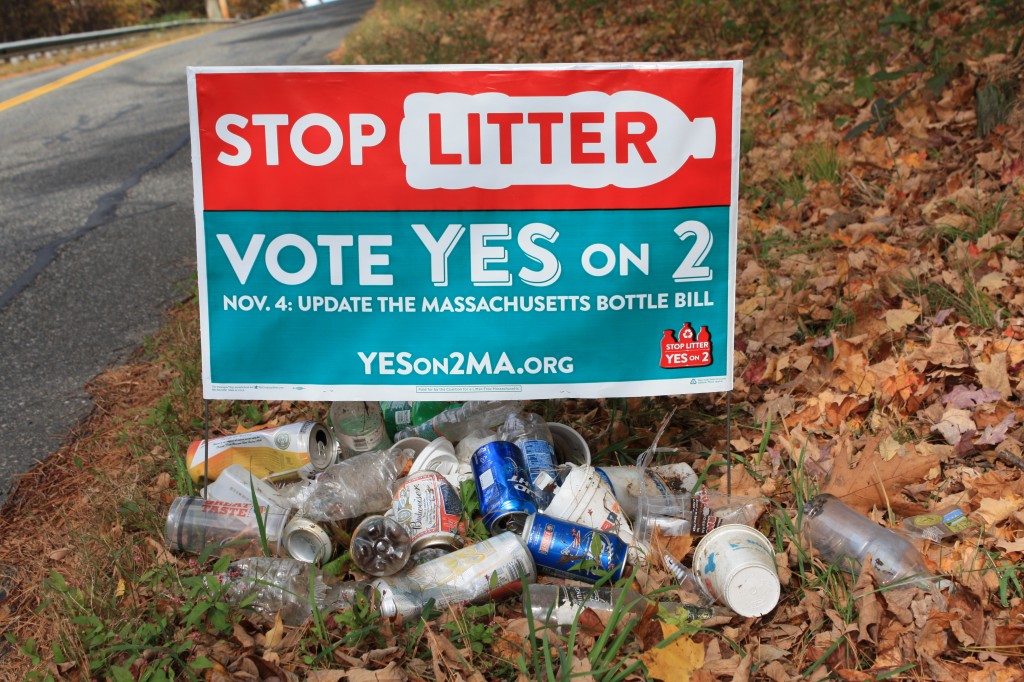
Question 2 hinges on more than just residential recycling

The letter to the editor by W. D. Stefanowicz in The Boston Globe more eloquently states a position that I have tried to explain.

Media coverage of the bottle deposit law, such as Tom Keane’s Oct. 12 op-ed column (“Does a ballot question kill the cause?”), frequently mentions the availability of residential curbside recycling, but this is misleading. The proposed extension of the law to water and sports drinks would greatly affect consumption that happens away from home.

Currently, instead of carrying bottles home, people will often add them to landfills by placing them in trash cans or leaving them elsewhere as litter. A small deposit would be a rewarding incentive for the bottles to be returned by their buyers or by the enterprising people who remove them from trash cans and from our parks, sidewalks, and roadways.


W.D. Stefanowicz

Burlington

See my puny effort to explain this buried in my previous post.

Just in case you were suspicious about the author of the letter to the editor, W. D. Stefanowicz is not one of my aliases nor one of my nom de plumes.


Fidelity fought Washington over money market funds — and won

The Boston Globe has the story Fidelity fought Washington over money market funds — and won.

The rules will allow money market managers to slam down a “gate’’ in times of distress to temporarily block investors from cashing out their shares. Mutual fund executives supported that concept.

“It will stop the run at the first fund, but if you are sitting at any of the other funds, you are going to want to get out before the gates are imposed,’’ said Eric Rosengren, president of the Federal Reserve Bank of Boston.

Harvard Business School professor David Scharfstein, an influential figure in the debate, said the result of the new rules overall is underlying risks have not changed that much:

“There’s still an incentive to get out,” he said, “before there’s a fire sale.”


The part of the story that The Boston Globe left out is that Fidelity has quietly taken steps to adapt to the reality that professor David Scharfstein mentioned above.

One feature that Fidelity has added to their money management services for their customers is the ability to have Fidelity automatically sweep your excess money market funds into insured bank deposits. When you want to spend this money, they will automatically pull the money from the banks to which they have swept the money, and put it into your account where you can do what you want with it – buy an investment vehicle or make a payment to someone else.

I always wondered if this new service was driven by the problems that The Boston Globe article described about the money market funds.

The challenge that I am going to finally have to come to grips with is figuring out how to make my money tracking software better handle these sweep transactions. In trying to make this fix, I recently introduced a substantial discrepancy in what Fidelity knows I have and what my software thinks I have. Fortunately Fidelity knows I have more money than my software thinks I have.