SteveG’s Posts


Congressional Progressive Caucus Budget Strikes Back Against Austerity

The Real News Network has the video interview Congressional Progressive Caucus Budget Strikes Back Against Austerity. The subject of the interview is Robert Pollin, a Professor of Economics at the University of Massachusetts in Amherst. He is the founding co-Director of the Political Economy Research Institute (PERI).


POLLIN: I think it’s a very credible budget that the Congressional Progressive Caucus has put out, the “Better Off Budget”. Let’s start with the things that we know are very straightforward. The projections on job creation are somewhat speculative. But here’s some of the basic things.

The budget that they’ve laid out directly attacks austerity. So that’s number one. That’s really outstanding. So, for example, the cuts to food stamps, I mean, some really basic stuff: 47 million people are facing cuts in food stamps. That’s 15 percent of the population. Twenty-two million children are facing cuts in their access to food. So we are directly attacking food insecurity through the basic budget. So if it didn’t do anything else, just starting there is a really good place to start.
.
.
.
Spending on infrastructure, spending on schools, spending on health care, spending on the green economy, all of those things are expanding, not contracting, under the congressional budget’s —Better Off Budget.

So all of those things are really critical. They’re all moving in the right direction.

Now, if you spend more money in these areas, obviously, you have to pay for them somehow. So what do they do in terms of taxes?


Fairly good analysis until he gets to the part of you have to pay for it. I wish Polin had taken a fire-extinguisher to that part. Why play into the hands of the people who are making such big deal out of deficits during a weak recovery when in fact the deficits help us recover faster? I guess the ideas of Modern Monetary Theory have not reached the PERI at UMass Amherst. Are they too far west in Massachusetts? I am pretty sure they must be connected to the state’s high bandwidth internet backbone, so that can’t be the reason they haven’t gotten the news yet.

I think the best thing that Robert Pollin could have said instead is the following:

At this point in the economic cycle, deficits aren’t harmful if they are spent for the right things. Too much of the money pumped into the economy by deficits and the Fed’s QE policy are going primarily to the wealthy. They use the money for speculative investments. Not only are these investments harmful to the economy for the instability they produce, but they also don’t involve creating many jobs, and certainly not useful jobs.

So, in this case, it actually helps the economy to tax this money away from the people who are misusing it. Rather than encouraging people to create these harmful investment products, we should be doing everything we can to discourage them.

This kind of tax increase is not a job killer, but in fact is a job creator. This is especially true when the money collected is put to a use of creating jobs and producing things the economy desperately needs, anyway.


In fact I emailed the above suggestion to PERI.


New Study Shows Dangers of Trade Agreements that Help Corporations Sue Governments

Naked Capitalism has the article New Study Shows Dangers of Trade Agreements that Help Corporations Sue Governments.

The study’s authors contend that for those concerned with democracy and basic rights, this El Salvador case stands as a potent reminder of how important it is that we fight such unjust corporate lawsuits. It is vital not only to support the people in El Salvador and other countries under assault, but to rally the groups and governments trying to halt new trade and investment agreements built from this same cookie-cutter mold. The governments of Chile and other countries are already raising critical questions about these pro-corporate rules in the proposed Trans-Pacific Partnership (TPP). Social movements in several European nations are making common cause with their governments in raising similar concerns in the trans-Atlantic talks. The Pacific Rim/OceanaGold case is an advertisement of the dangers of such rules

The author of this article is one of the authors of the study that is mentioned in the article.

Download the full report [PDF]

The 17 page report focuses on this one case.  You have to judge for yourself whether or not you think this is typical of what happens, or if trade agreements like the ones being pushed by President Obama cause more harm than good.  I am using these weasel words to guard against being accused of letting one bad apple ruin my opinion of the subject matter at hand.  I am only saying that this is one report to include with all the other things you learn about these trade agreements.  Do your own due diligence.


Philip Pilkington: Thinking Makes It So – The IMF Bailout of the UK in 1976 and the Rise of Monetarism

Naked Capitalism has the article Philip Pilkington: Thinking Makes It So – The IMF Bailout of the UK in 1976 and the Rise of Monetarism.

This was a classic example of a rather unimportant variable becoming important merely because people began to think it important. In 1977 Treasury Minister Denzil Davies summed the situation up perfectly when he said,

[W]e should do all we can do to keep M3 within the announced target during this financial year. It matters not, it seems to me, that the definition of M3 is arbitrary; that the commitment to the IMF is in terms of Domestic Credit Expansion (although everyone knows that DCE is irrelevant when a country is in a balance of payments surplus); and that an increase in the money supply caused by “printing money” may be of a different nature to an increase caused by inflows. All this, no doubt, is good stuff for a seminar. Unfortunately, those people who have the power to move large sums of money across the international exchanges believe, on the whole, that “money counts”. The fact that it may not count as much as they think it does, seems to me to be somewhat irrelevant. (p25)


I wonder about the implication of this on proponents of Modern Monetary Theory.  I presume that Philip Pilkington is one.  Rather than proving that MMT is correct  and the monetarism discussed in this article is incorrect, perhaps it proves that whatever the people with the money believe in most strongly is what is correct.  At least it, not surprisingly, shows that what people believe in most strongly is what dictates their behavior.

I’ll have to read the stories at the links in the article to see the more detailed description.


I think I have figured out what the lesson is here.

There is a natural tendency to look at how people use the rules to take advantage of others. From this analysis people propose new rules to stop this bad behavior under the old rules.  What they fail to account for is that the behavior of the people taking advantage is not a constant.  The behavior is a function of the rules that are there to be used to one’s advantage.

The one behavior that is constant in some people is to think, “Well, if your going to be so stupid as to make an easily subverted  rule like this, then I might as well use it to my advantage.”  I have that philosophy myself when considering how to survive in the current economic system while at the same time decrying some of its rules.  This is how Enron took advantage of the energy market rules in California that were lobbied for by Enron.

The lesson is that when you set up new rules, you must be aware of and constantly guarding against this human behavior.  Just because something will work if people continue to behave the way they do now, there is no reason to believe they won’t change their behavior when the rules change.  In fact, what I am saying is that when you change the rules, you can almost be guaranteed that people will change their behavior accordingly.

This was beautifully demonstrated in the recent financial collapse due to the mortgage bubble debacle.  People were creating and were investing in financial derivatives based on mortgages.  The inventors of these derivatives made calculations on their safety based on historical records of the levels of mortgage default.  What they failed to take into account is that the historical behavior was based on a real estate market that did not have the derivatives they were inventing. The historical market had incentives that forced the purveyors of these mortgages to strictly enforce rules about the creditworthiness of the people getting the mortgages.   The incentive was that the issuers of these mortgages could go bankrupt if there were too many bad loans given out.

The ability to sell mortgages in packages of financial derivatives did away with the incentive to try to make only good loans.  In the new system, the banks could easily get rid of any risk from making bad loans.  In fact, the best way to make money in the derivatives market was to make as many bad loans as possible and sell them off before they went bad.

The buyers of these derivatives felt comfortable because they figured that if people defaulted, the banks would take possession of the valuable real estate and sell it at a profit.  The trouble is that this tactic only worked in the real estate market that existed before the creation of derivatives.  With a real estate market collapse which could be best brought on by massive investments in the same type of poorly thought out financial “asset”, the saving strategy would be made inoperative by the very tool that depended on the tactic to assure that it was a safe investment.

As with most sure-fire investment systems that are validated by back testing against  the historical record, they work until everyone tries it.  Then they don’t work.  They only work when not everyone is trying to do it.  It’s the same paradox that Keynes’ explained about the economy.  Some people can put more money into savings if they just resolve to do it, unless of course everybody makes the same resolution at about the same time.  Keynes pointed out that when everybody tries to do it, the economy collapses and there is not enough income for people to increase their savings when savings are totaled up over the entire economy.  When everyone tries to save, the total net savings actually declines.

This also touches on what George Soros explains is the difference between social systems and systems based solely on physics.  For the most part, you can study physical systems, derive laws of behavior, and then predict future behavior from those laws.  Social systems don’t behave this way because the subjects being studied can learn about the conclusions of the  study,  and change their behavior based on what they read.  Soros called this property of social systems “reflexivity”.
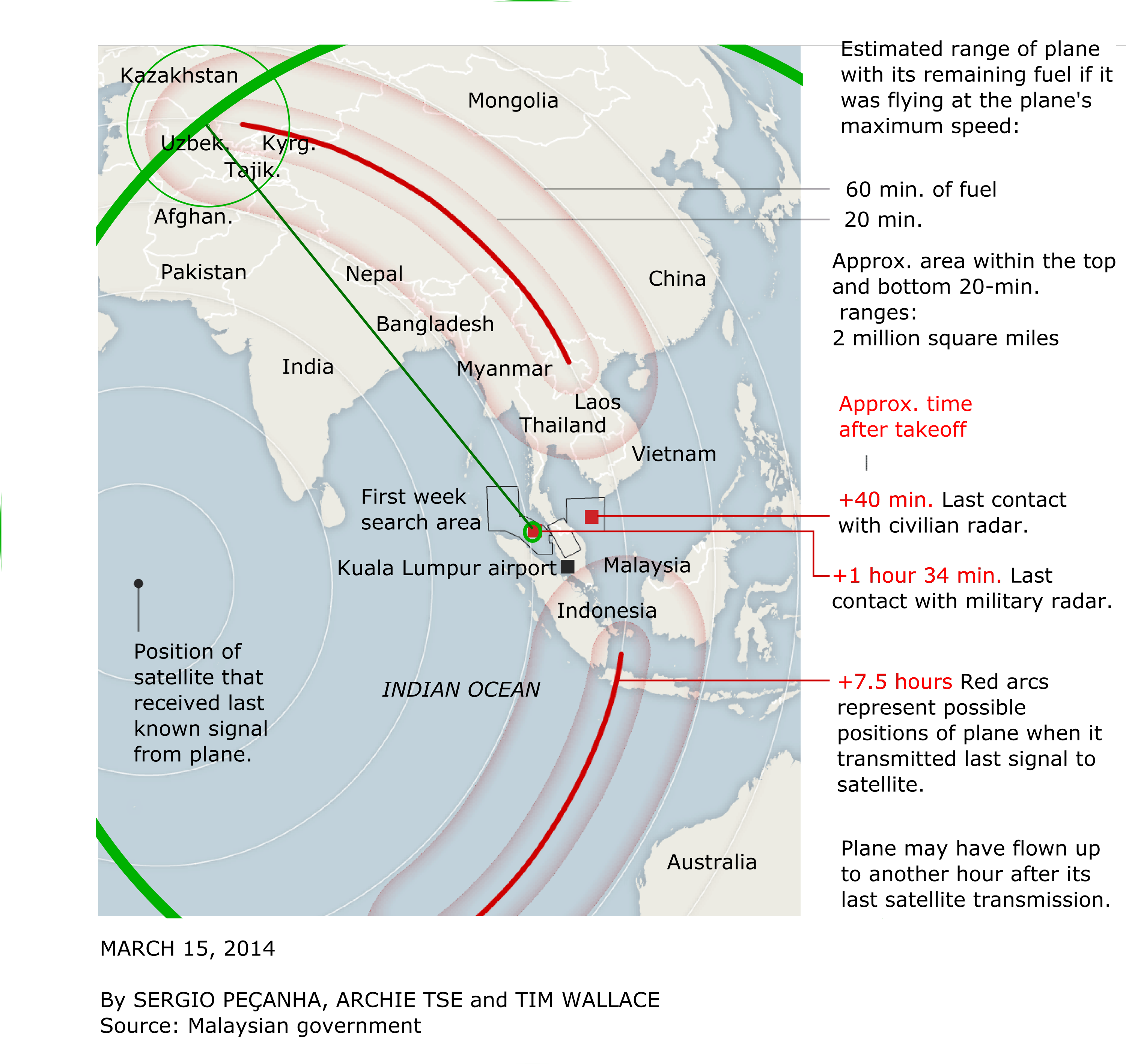

Conjecture On Where That Plane Really Is

The New York Times has the article Lost Jet’s Path Seen as Altered via Computer.

The fact that the turn away from Beijing was programmed into the computer has reinforced the belief of investigators — first voiced by Malaysian officials — that the plane was deliberately diverted and that foul play was involved. It has also increased their focus on the plane’s captain and first officer.

This is all very interesting, but I have been waiting for someone to publish a large enough map for me to draw on.

Whoever publishes one of these maps always shows you two red arcs where the plane could have been when it lasted contacted a satellite.

I was thinking that one could be a lot more precise about where the plane could be if you drew a circle of how far it could have flown between the last time it was sighted by radar and the time it contacted the satellite.

I have drawn that circle.

estimate of flight path o fht plane

The thick green arcs are from the circle I drew of how far the plane could have flown at full speed in the 6.5 hours between its last radar sighting and the time it last contacted the satellite. From that point, I drew an thin green circle for where it could have flown in the hour after the contact with the satellite.  Unless the plane slowed down from its full speed or its ground speed was slower or faster than its air speed due to winds, it would not have intersected the red arcs anyplace else other than where I estimated.

So I assume that the agencies that are searching for the plane have a heck of a better idea where it is than what they have said in public.  Of course, there are lots of assumptions in the arc that I drew, so there is no guarantee that the plane is located within the small green circle, but I bet it is likely.

The plane most likely would have flown over Afghanistan.  Are we expected to believe that our military operation in Afghanistan would not have noticed?

By my estimation the plane is probably in Kazakhstan, Uzbekistan, Kurgyzstan, or Tajikistan.  I wonder if Russia still has much influence in these countries?


I have added a green line to show the flight path from the last known radar contact (before Thailand reported that they have a radar contact) to the intersection. That helps to visualize what countries the plane might have flown over, and how likely the country would have had the radar to detect the overflight.

Also bear in mind that if the plane had not been flying at full speed, drawing concentric circles inside the big one I drew would give you the intersection with the satellite arc for these slower speeds. The radius from that point of intersection to where it could have flown in one hour at the slower speed would also be smaller.

Although, also consider that the last contact with military radar at the 1 hour and 34 minute mark must not have been a single blip. There was probably a flight path detected. Is it a coincidence that the line I drew to the intersection of the satellite detection is right through the section of ocean to which the search was shifted in the first week?


Crimea Referendum: Self Determination or Big Power Manipulation? (1/2)

The Real News Network has the article Crimea Referendum: Self Determination or Big Power Manipulation? (1/2).

Professors Nicolai Petro & Tarik Cyril Amar give their reactions to Crimea voting overwhelmingly to join the Russian federation


What I like about this video is that it does admit of more ambiguity in the situation than TRNN’s previous offerings on this topic. This situation is definitely ambiguous if nothing else.


Bill Maher attacks Noah’s Ark story

The Daily Kos has the article Bill Maher attacks Noah’s Ark story. It featuers the video below:


These ideas kind of makes some of us wonder. Knowing a Jehovah Witness or two, I know there is an answer to every question Bill Maher raises. They make as much sense to me as the claim that finding the preferences of 95% of the Crimean population is anti-democratic. Is this what is meant by “Don’t ask, don’t tell”? Why bother having a dictionary or WikiPedia if words don’t mean anything?


Jeffrey Sommers/Michael Hudson: Russia, Crimea and the Consequences of NATO Policy

Naked Capitalism has the article Jeffrey Sommers/Michael Hudson: Russia, Crimea and the Consequences of NATO Policy.

Russia today has watched covert attempts from the US State Department to the National Endowment for Democracy and other NGOs to break up their country as part of what is becoming a triumphalist global pattern. This threatens to remake their “near abroad” into a neoliberal periphery. Today’s confrontation has taken on an existential character for Russia since it saw NATO’s moves toward Georgia as cutting too close to the bone. The prospects of NATO assimilating Ukraine (Kiev) represents a seizure of Russia’s “heart”: the very ancestral home where Russia was founded and on which it repelled the fascist invasion in the Great Patriotic War–as it had a millennium earlier against the German Crusading Knights pledged to exterminate the Russian-Greek Orthodox population.

Most Russians never forgave Gorbachev for the deal he made with NATO. Russian diplomats have stated clearly that Ukraine is a line that cannot be crossed regarding potential NATO expansion. It is as if foreign agents worked in Texas to mobilize a violent ethnic minority to rejoin Mexico and then place a hostile military alliance on the US border.

My purpose in publishing the links to these articles is not an effort to condone what Russia is doing.  Instead it is an attempt to understand what may be behind their policies.  Whatever actions we decide to take in response to Russian actions, they are unlikely to work if we do not understand the Russians.  An action we might think should encourage the Russians to change course in a direction we prefer, might just have the opposite effect if we do not understand Russian thinking.  In fact, I think this is exactly what is happening.  This is why I urge our own diplomats and leaders to try to understand what is happening from the other sides’ point of view.


Crimea ballot paper: No option to keep things as they are

The BBC has this article Crimea ballot paper: No option to keep things as they are.

James Reynolds shows us round a polling station in Simferopol, takes a closer look at one of the ballot papers, and explains the voting process.

“There’s no option on this ballot paper for people to keep things as they are,” he notes

What follows is my best attempt to quote the understanding of the two questions on the ballot as explained by the reporter in the video.

Do you want crimea to become part of the Russian Federation?

Do you want Crimea to get greater autonomy under the 1992 constitution

Thanks for Cedric Flower’s comment on my Facebook post about  my previous post, Crimea result makes “a mockery” of democracy says Hague.  The actual wording doesn’t seem to be quite as stark as Cedric said.  You can judge for yourself as to what you think of the voting procedure and the ballot wording.

It’s one thing to have an opinion as to whether or not you think this was the fairest way to vote on the subject, but deciding what we ought to do about that judgment is a wholly different matter.  At the very least, before taking any action on our judgment, we ought to know how this type of ballot wording would compare to other ballot wordings that have been used to get the Ukraine to the current political situation it is in. For instance what was the ballot wording for  the acceptance of the 1992 constitution?

There would still be the irony of taking action against a country based on what we thought of someone else’s democratic procedures.  Might we not be best served by letting the people themselves figure out what they want to do about the situation? (I can’t even figure out if the wording of the previous sentence makes any sense even though I invented that wording myself and it sounds kind of literary.)


Crimea result makes “a mockery” of democracy says Hague

The BBC has the story Crimea result makes “a mockery” of democracy says Hague.

The government says it rejects the result of Crimea’s referendum, which Foreign Secretary William Hague has denounced as a “mockery of proper democratic practice”.

A total of 95.5% of voters in Crimea supported joining Russia and leaving Ukraine, officials said.

Mr Hague said Russia must now face “economic and political consequences”.

A statement from Number 10 said that the UK did not “recognise” the referendum or its outcome.

There are similar stories coming from “Democracies” around the world including the USA.

To paraphrase Franklin Delano Roosevelt,  “This is a day that will live in irony.”  The gall of the Crimeans to undemocratically vote at over 95% to go with Russia.    They have not even satisfied our foreign definition of how they must implement their own democracy.  How undemocratic can that be?

Who is supposed to decide what is democratic in a democracy, the people involved, or some third party?

Yes, I know the situation may be somewhat more complex than that, but on the face of it, the world “democracies” seem to be somewhat idiotic to claim that the implementing the desires of an overwhelming majority expressed in a transparent ballot is undemocratic.  It was “transparent” in so far as the ballot boxes that I saw on TV were made out of transparently clear material as pointed out by the NBC reporter who showed the ballot box that was at the polling station where he filmed his report.

Remember that our Civil War was fought because the Southern action violated our Constitution, they shot first, and we decided that the rights of our citizens would be violated if we allowed it to go on.  We have no business telling other countries that they must abide by our rules that we use in our own country when their situation is so different from ours.  The boundaries we set up in our country were freely determined by us, as long as you discount the slaves and the native Americans (SARCASM, SARCASM).  There was no such self-determination in attaching the Crimea to the Ukraine.  Of course, I am not so sure that the Russians in Crimea got there by the free will of the people either.  That is reason in itself why we ought not be meddling in a situation so complex, that we do not even understand it the way the people who have to live with it do.

We might think that “we would never live with those conditions”, but it is not up to us to decide what conditions other people are willing to live with if they choose to do so.  We certainly don’t have the right to foment violence that kills those people because we don’t like the decision they made.


Computer Backwards Compatibility

Now that I have installed a variant of Linux on my old computer, I could handle the format of the file on this tape.

Tar Tape From 1983

The label says it is from 1983 and it is in TAR format.  This format is still a mainstay on Linux computers.  In this case, it is not a problem of software, but of hardware.  I wonder if there are still any mag tape readers for this kind of  tape. I also wonder if all the magnetized bits have faded into randomness.

If you are wondering who Elsie was, she was my μVax computer in my office at Digital Equipment Corporation.