SteveG’s Posts


Tax the Rich: An animated fairy tale

The Real News Network has rebroadcast Tax the Rich: An animated fairy tale narrated by Ed Asner.


Tax the rich: An animated fairy tale, is narrated by Ed Asner, with animation by Mike Konopacki. Written and directed by Fred Glass for the California Federation of Teachers. An 8 minute video about how we arrived at this moment of poorly funded public services and widening economic inequality. Things go downhill in a happy and prosperous land after the rich decide they don’t want to pay taxes anymore. They tell the people that there is no alternative, but the people aren’t so sure. This land bears a startling resemblance to our land. For more info, www.cft.org.

I wonder if this will become a popular bed time story.


In the US, an Insecure Economy Needs a Stronger Safety Net

Truth Out has republished the article In the US, an Insecure Economy Needs a Stronger Safety Net by Paul Krugman.

Every time you read an article by someone extolling the dynamism of the modern economy, the virtues of risk-taking and declaring that everyone has to expect to have multiple jobs in his or her life and that you can never stop learning, etc., bear in mind that this is a portrait of an economy with no stability, no guarantees that hard work will provide a consistent living and the constant possibility of being thrown aside simply because you happen to be in the wrong place at the wrong time.

And nothing people can do in their personal lives or behavior can change this.

Your church and your traditional marriage won’t guarantee the value of your 401(k) or make insurance affordable on the individual market.

So here’s the question: isn’t this exactly the kind of economy that should have a strong welfare state?

Isn’t it much better to have guaranteed health care and a basic pension from Social Security rather than simply hanker for a corporate safety net that no longer exists?

Might one not even argue that a bit of basic economic security would make our dynamic economy work better, by reducing the fear factor?

I have often thought along these lines.  It is often said about the stock market that it is driven by fear and greed.  It’s probably true about much of what happens in life.  Some amount of fear probably helps to drive progress, but too much fear can tend to lead to paralysis. (Deer in the headlights problem).

One issue that I have wondered about for a long time in observing the high tech industry is that a young engineer may be driven to create innovative technology by the love of the challenge and thoughts of possible future rewards.  Once the best and the brightest of our engineers achieve a good amount of success, part of their brain is occupied by efforts to manage the wealth that are the fruits of this success.  They have less time to devote to continued technological achievements.  I wonder what would happen if many of these people, who wanted to, could spend more time in continuing their devotion to research if the safety net were stronger and they had to spend less time worrying about preserving their gains.

Keep in mind that the amount of safety net is a quantitative decision.  I am not saying that either extreme of all encompassing safety net or absolutely no safety net would be the optimum solution.  We need to have a national discussion on where on the scale from zero to infinity we would like to have the safety net.
Why the Fiscal Cliff is a Scam

The Real News Network has the interview Why the Fiscal Cliff is a Scam with economist James K. Galbraith.

For those who are interested in econometric models and their predictions, perhaps this excerpt may talk to you.

But those long-term CBO forecasts of very rapidly rising national debt, very rapidly rising deficits, rest on a couple of very doubtful assumptions. One is that health-care costs will continue to rise more rapidly than every other cost in the economy forever—can’t happen and won’t happen, but that’s—you can build a computer forecast that makes it happen, in which it happens. And the other is that the interest rate that the federal government pays on its public debt will be raised by the Federal Reserve, let’s say, four years from now, to a point where it’s higher than the growth rate of total output, the growth rate of income, and then that interest burden compounds, the interest payments compound as a share of GDP and go up very rapidly after that. If you stretch out that forecast long enough, you can get a debt-to-GDP ratio as high as you like in a computer projection. But once again, it will not happen in real life. It’s not consistent with the way an actual economy is going to function.

I hope to find more details of the article referred to in the interview. Right now, the web site serving this article is not responding. Apparently, this down time is so common that there is a website to answer the question Is the Alternet down right now? Well, the web site is not particular to alternet, but the fact that the link that checks the alternet appears in a Google search is what is indicative.


Class Wars of 2012

The bottom line of Paul Krugman’s piece  Class Wars of 2012 is:

So keep your eyes open as the fiscal game of chicken continues. It’s an uncomfortable but real truth that we are not all in this together; America’s top-down class warriors lost big in the election, but now they’re trying to use the pretense of concern about the deficit to snatch victory from the jaws of defeat. Let’s not let them pull it off.

This blog is trying to do its part to keep our eyes open.  I hope no one was naive enough to think that the recent election meant we had won and we could all ignore politics for the next few years.  In fact, with the election we just staved off disaster for another few weeks.  Now the same forces that some of us may have thought we defeated are back at it just as if nothing happened.

So now we wait for the answer to the question that President Obama refused to answer in the campaign.  What is going to be different now from what it was in the previous four years of his administration?


Fed Comments on Fiscal Bump In The Road

The Wall Street Cheat Sheet has the article Is Bernanke Right About the Fiscal Cliff?.

The article starts with a comment by Dallas Fed President Richard Fisher:

Fisher has requested more governmental action because there are limits to what monetary policy can accomplish, Reuters reported. “We at the central bank have been carrying the load and this is a very dangerous predicament,” Fisher said during a lecture in Frankfurt.

This is a point that I have been trying to get across to people ever since the economic downturn started.

The article ends with the comments by Fed Chairman Ben Bernanke:

As Bloomberg reported, the report also “bolster[ed] Fed Chairman Ben S. Bernanke’s view that an agreement on reducing long-term federal budget deficits without abrupt tax increases and spending cuts would remove a barrier to growth.”

I agree with the comment about the spending cuts not being abrupt. I do find it hard to believe that the barrier to growth doesn’t have something to do with doubts about future consumer spending. That might be a minor quibble as the reduction of future consumer spending would be as a result of abrupt spending cuts and abrupt increases to taxes on the consumer.

Somehow, I don’t believe that the consumer is making decisions based on the long term federal budget deficits. If people were really worried about impending inflation, they would be spending now rather than saving dollars that are going to become worthless.


Legends of the Fault

The Daily Show with Jon Stewart has the video titled Legends of the Fault.

John McCain and Lindsey Graham criticize Susan Rice for her Benghazi misstatement, despite their own history with misstatements.


How much more crap do we have to take from the likes of these Senators before we realize that the Senate rules need to be changed? We should not permit these demagogues to block a nomination from the President of a more than qualified candidate of his choosing.

Every person who backs what these two (or three) Senators are doing should be forced to have their memories refreshed by watching this video segment.

If these Senators have an honest reason for blocking this nomination, they ought to come out and tell us what it is, or STFU.

When Condi Rice lied, people died as a result. No matter what Susan Rice said, the consequences are miniscule.

What is the mental illness which is exemplified by people losing all sense of proportion?

From the article Asperger syndrome from childhood into adulthood, comes the following excerpt:

A natural reaction to the mess of everyday life is to establish order (although the greater the success in achieving a set, predictable world, the greater the distress when faced with novelty and change). For a person with Asperger syndrome this reaction may become pathological: for example, the commonplace collection of objects can come to dominate his life as well the lives of those around him, and if all sense of proportion is lost an obsession can lead to criminal offending.


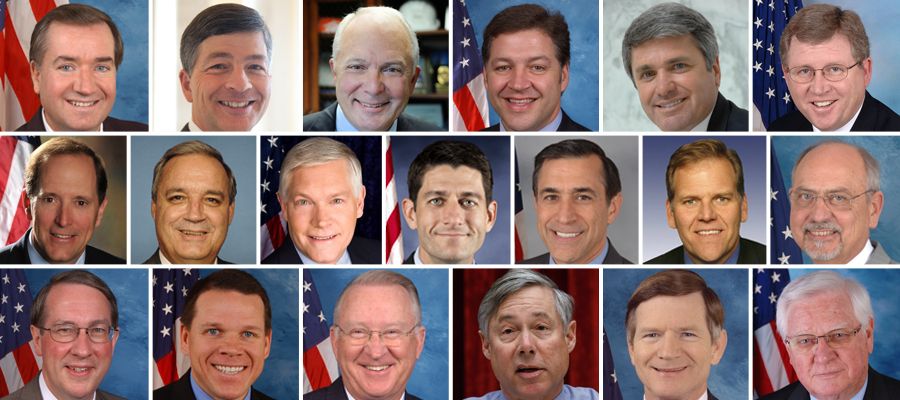
The nineteen new Republican House committee chairmen are all white males

The Daily Kos has the article The nineteen new Republican House committee chairmen are all white males.  The closing remark to the  article is:

Remember all the discussions about the Republican Party learning valuable lessons about the need to reach out and broaden their appeal to women and minorities? It doesn’t look like they are getting off to a very good start.

Here is the picture of the committee chairmen.


Extended Interview with Warren Buffett & Carol Loomis

The Daily SHow with Jon Stewart has this two part interview with Warren Buffet and Carol Loomis about what she collected over 40 years’ worth of Warren Buffett’s stray thoughts for her book, “Tap Dancing to Work.”


The interview is kind of silly, and Stewart walks all over the important points that Buffet tries to make, but it’s probably worth something to capture this on my blog for future reference.

By the way, I don’t revere everything that Buffet has to say. He recently recommended Jamie Dimon for Secretary of the Treasury which is a a perfectly insane idea. The last thing we need is another Secretary of the Treasury blinded by the myths of Wall Street.

The article, Sorry, Warren Buffett, Jamie Dimon probably wouldn’t make a great Treasury Secretary, gets at why I think Warren Buffet is crazy on this particular thought of his. The article describes what the job of Secretary of the Treasury is and why types like Dimon and Geithner are so wrong for the job.

I am not sure I totally agree with the author’s assessment of some previous Secretaries of the Treasury, but it does give to a hint at where else we might find decent Secretaries of the Treaury outside of Wall Street.

Some quite good Treasury secretaries haven’t had particularly deep knowledge of finance or economics, but made up for it with skill navigating the halls of power. Think Lloyd Bentsen under Clinton (a former senator), James Baker under Reagan (previously a lawyer and White House chief of staff), and John Connally under Nixon (a governor of Texas).


Taxing Wealth Is the Answer for Boosting Long-Term Growth: Dan Altman

The Daily Ticker has the story and interview Taxing Wealth Is the Answer for Boosting Long-Term Growth: Dan Altman.


Economist Daniel Altman is proposing something completely different on the tax front — a system that taxes wealth rather than revenue. It’s not intended to raise more revenues but rather to reduce inequality which, he says, threatens growth.

“Wealth inequality is making the pie smaller for all of us,” Altman tells The Daily Ticker. It limits opportunities, which reduces productivity, and ultimately lowers “living standards for all of us in the long term.”

Altman, an adjunct professor at New York University’s Stern School of Business and author of four books, says wealth inequality in the U.S. has been rising steadily for the past 20 years.

“It’s at a crazy high level that you only see in very poor countries, and it’s starting to threaten growth,” he says.

I have two previous blog posts in July 2011 about the idea of a wealth tax We Really Need a Wealth Tax and Wealth and Tax Distribution.

The first link just above is a better explanation for why we need a wealth tax than the one provided by Dan Altman in the interview in this post.

The last link above really shows the difference between the distribution of taxes versus the distribution of wealth.

I should also mention my post Time For A Wealth Tax? of August 2010.