SteveG’s Posts


Warren And Brown Are Two Sides Of Same Tarnished Coin

The Boston Globe published the letter to the editor Warren And Brown Are Two Sides Of Same Tarnished Coin.

RE “A safe distance from Occupy: Warren claimed to have influenced the movement, then backed off’ (Op-ed, Dec. 18): Our country is in big trouble, and it’s not the kind of trouble that’s going to be fixed by trading Democrat Elizabeth Warren for Republican Senator Scott Brown. Winning the political game isn’t going to do it. The beliefs and minds of a lot of people are going to have to be changed, and that’s going to require someone willing to shout out the unvarnished, untriangulated truth, no matter what. I had hoped that Warren might be that fearless truth-teller. I’m afraid that my hopes, like those of columnist Joan Vennochi, are fading fast.

Randy Slaughter
Cambridge

The statement that “The beliefs and minds of a lot of people are going to have to be changed, and that’s going to require someone willing to shout out the unvarnished, untriangulated truth, no matter what.” echoes something that I have been saying in a number of different ways.  Most recently I said something related to Obama along the same lines in the post President Obama Rallies His Domestic Troops – What $40 Mean. Part of what I said in that post was:

I hope this is a sign that the President has come to realize that his most important job is to educate voters so that they know what is at stake. Rallying people around the legislation he wants to pass, is effective as shown by this incident.

In an even earlier post on December 6, Strong Medicine For Elizabeth Warren, I directly addressed the issue of her initial comments about OWS and then her unwillingness to stand by those remarks.

My response to that comment was:

I am so glad someone asked about the intellectual foundation that Elizabeth Warren provided to the Occupy movement.

Elizabeth Warren wrote a book, “The Coming Collapse of the Middle Class”

If you really wanted an answer to the question, you would devote the time to listen to her invited lecture on what is the lesson from the book.

http://wp.me/peCeJ-172

I do not understand why the campaign doesn’t use this strong message to shoot down the Karl Rove meme. I suggested Warren acknowledge the OWS movement. The proviso was that there was going to be blowback, and you had to be prepared for it. Now that you have taken the bold step, you cannot retreat. You must use the blow back as a teachable moment.

The blowback will continue until you answer it forcefully. If some professional political advisor is holding Elizabeth back from making her case, that person ought to be fired.

If she is a bold person, and we like boldness, then you can’t retreat and be a wimp. Go for broke, or go home.

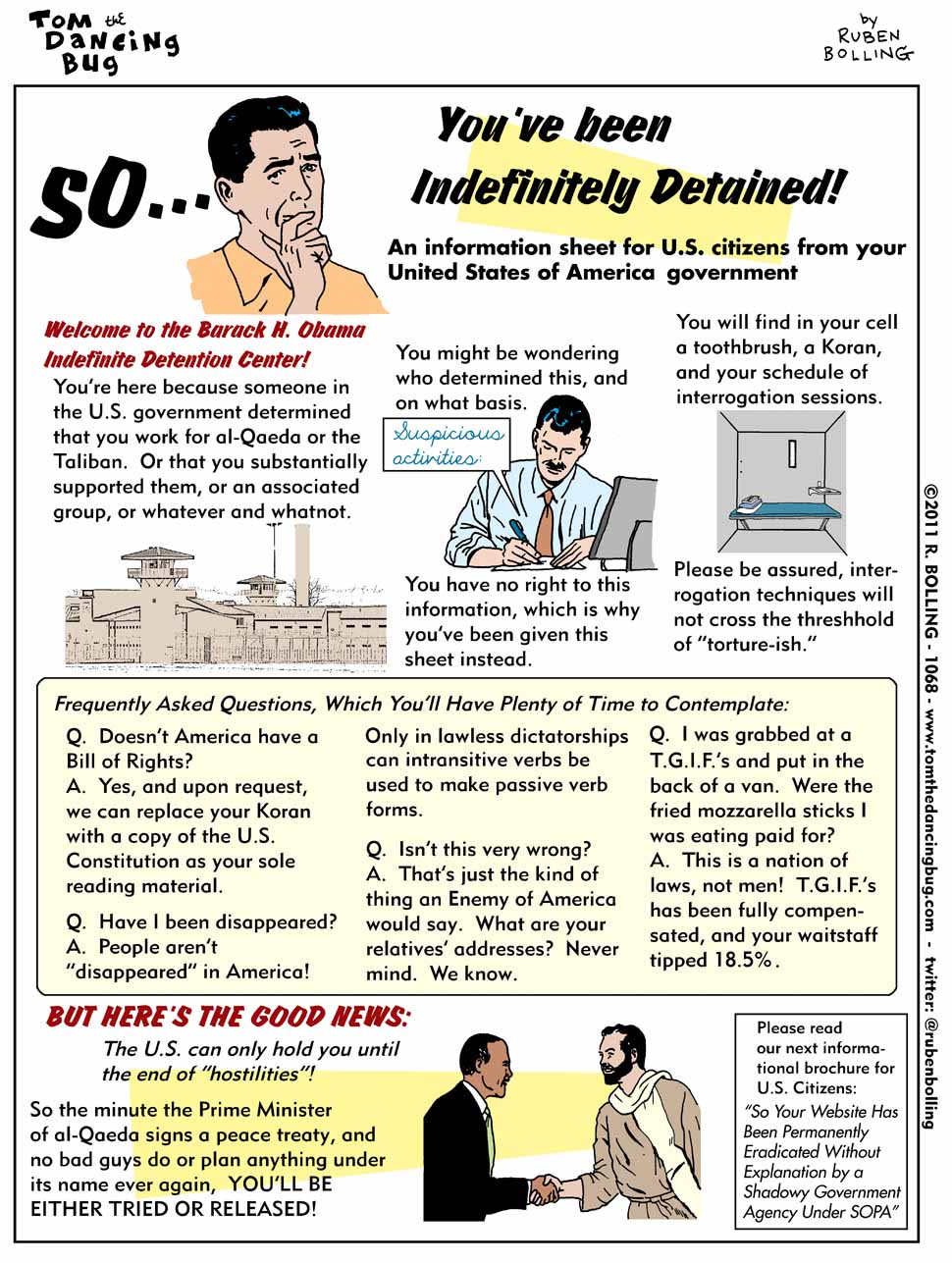

Obama Challenges Provisions in Budget Bill

I am afraid I have to reference the article Obama Challenges Provisions in Budget Bill from The New York Times. The only other link I found on Google that was not just to a blog was to Faux Noise.  It is a sad commentary when those are the only two choices.

When President Obama signed a budget bill on Friday, he issued a signing statement claiming a right to bypass dozens of provisions that placed requirements or restrictions on the executive branch, saying he had “well-founded constitutional objections” to the new statutes.

Among them, he singled out two sections barring the use of money to transfer prisoners from the naval base at Guantánamo Bay, Cuba, into the United States and limiting the ability of the government to transfer them to the custody or control of foreign countries. Mr. Obama said he would apply them in a way that avoided infringing on his powers, without any specific explanation of what that meant.

I am going to have to think long and hard about whether this action by President Obama gets him off the hook with me on my stated inability to ever vote for him again if  he failed to veto this bill.  Even if Obama refuses to use the powers that the bill tries to grant to him, some future president is sure to use them.

As I have said before, we need to prevent the loss of our civil rights in a time when the loss probably won’t be implemented.  When the time comes that a president wants to use these powers, it will be too late for us to try to claw them back.  That time might be sooner than we think, if this president decides to change his mind after he gets re-elected.


Climate Change Evidence

Thanks to Hassan Moradi for +1ing this on Google+.


Those of us in southern New England in the northeast corner of the U.S.A. can appreciate this evidence. We may be looking out for camels tonight instead of reindeer.


Richard D. Wolff: Europe’s Debt Crisis Deepens

Nation of Change has the article Europe’s Debt Crisis Deepens.

Talking about “the markets” who are pushing austerity programs on governments that are in debt, Wolff says:

The chief influences among those creditors are the major banks that represent and/or advise all or most of the rest of them.  The major European banks were and are the chief recipients of the costly bailouts by those European governments since 2008.  Indeed, those bailouts sharply increased the indebtedness of European governments because the latter paid for those bailouts by borrowing.

As far as I can tell, unless I just missed it, Wolff does not suggest any solutions to the problem.

If the indebtedness of European governments’ was sharply increased by the bailouts of the banks, does that not imply that the banks owe these governments the money that the governments are in debt?  Would you not think that the governments have some pressure they could exert back on the banks?

Two comments on the story suggest that nationalization of banks might be a solution.  You would think that even the threat of nationalization might drive banks to the negotiating table. If you don’t like nationalization, how about the governments demand their money back from the banks so that the government could go into competition with the banks as sources for liquidity in the “free” market?  Then the private banks could disappear into oblivion and nobody would care (except for the bank executives and the bank investors.)  The people who caused the problem would suffer the consequences, and the rest of us could just go about our business.

I wonder why Richard D. Wolff didn’t delve into or even hint at these questions and possible answers?


Lessons of the 1930s: There could be trouble ahead

The Economist has an interesting article, Lessons of the 1930s: There could be trouble ahead.

In 2008 the world dodged a second Depression by avoiding the mistakes that led to the first. But there are further lessons to be learned for both Europe and America.

The article talks about opposing theories about the history and lessons learned.  Unlike stories in many U.S. media outlets, this one does give some hints as to which theories have been debunked and which seem to stand up.  The article is worth the read for the specific lessons learned.

That said, I am going to go off on a tangent about methodological lessons learned.

Reading this article had me thinking about a lesson I think I learned from the book Bad Science: Quacks, Hacks, and Big Pharma Flacks.

There is quite a difference between having a premise and seeking data to support it and having some data and trying to figure out what you can learn from it.

In the first case it is almost always possible to find data to support a theory if you look hard enough, massage it, and squint at it if you must, and ignore any data that casts doubt on your premise.  In the second case you gather data in an unbiased way and see where it leads you.

I think you can see examples of both types of theories discussed in The Economist article.

If you think about the two situations more you see that it is very easy to fall into the trap of premise first and data next.  You might start out in the unbiased way, and develop a theory.  Then it is very easy to fall into the trap of just searching for more data to confirm your theory.  This is called confirmation bias.

I can think of one way to search for more data while controlling the bias problem.   When you set up your search or your experiment, always consider ways to disprove your theory as well as ways to prove it.  Consciously think of data to look for or experiments to conduct that will disprove your theory.  If the data you find or experiment you perform in an effort to disprove your theory fails to disprove it and your other searches and experiments tend to confirm it, then you are more likely to have found a theory that is closest to the truth.

Another problem arises when you get into a discussion (argument) with someone who disagrees with your theory.  That is exactly when you are caught in the trap of trying to prove you are right.  If the opposition presents some opposing data, your natural tendency is to look for flaws in that data.  There is nothing wrong with that as long as you are also looking at the possibility that the opposition is right and their data do disprove your theory.

I write this blog entry as much as a reminder to myself as it is a lesson to anyone else.


For Christmas, Your Government Will Explain Why It’s Legal to Kill You

From Lowering the Bar whose motto is “Legal humor. Seriously.” comes the article For Christmas, Your Government Will Explain Why It’s Legal to Kill You.

Summary:

  • The government dropped a bomb on a U.S. citizen,
  • who, though a total dick and probably a criminal, may have been engaged only in propaganda,
  • which, though despicable, is generally protected by the First Amendment;
  • it did so without a trial or even an indictment (that we know of),
  • based at least in part on evidence it says it has but won’t show anyone,
  • and on a legal argument it has apparently made but won’t show anyone,
  • and the very existence of which it will not confirm or deny;
  • although don’t worry, because the C.I.A. would never kill an American without having somebody do a memo first;
  • and this is the “most transparent administration ever”;
  • currently run by a Nobel Peace Prize winner.

Merry Christmas!


Thanks again to RogerG for posting this item on his Facebook page.


President Obama Rallies His Domestic Troops – What $40 Means

In The White House post What $40 Means to Americans Across the Country, President Obama emphasized the value of social media in politics.

Using social media and the internet, the American people told Washington in no uncertain terms that letting the payroll tax cut expire on December 31, 2011 was not acceptable. You tweeted, you called and you emailed to remind Washington that politics is not a game – serving the American people is a serious responsibility and the decisions made in Congress have serious consequences on people’s lives.


I hope this is a sign that the President has come to realize that his most important job is to educate voters so that they know what is at stake. Rallying people around the legislation he wants to pass, is effective as shown by this incident.

Rather than going into battle with the Republicans and leaving his troops behind, this time the President decided to bring the troops along with him. He is in a much more effective negotiating position, when the opposition says, “Oh yeh? You and whose army.” I can see the President now, pulling the curtain aside and saying, “This army!”

It is time that citizens and politicians realize that the citizens’ part in running the government does not end on election day.


Are Pro-NDAA Lawmakers for Military Detention of U.S. Citizens Actually Guilty of “Treason?”

The Daily Kos is carrying the article Are Pro-NDAA Lawmakers for Military Detention of U.S. Citizens Actually Guilty of “Treason?”.

You don’t need to be a meteorologist to know if it’s raining outside, and you don’t need to be a constitutional scholar to know that permanent wartime powers amounts to the overthrow of the Bill of Rights of the US Constitution.  Treason.

This sounds an awful lot like statements to which I always object “You don’t need a PhD in economics to understand [name your favorite economic inanity].  It just takes common sense.”  Nevertheless, this Daily Kos article is worth thinking about.

The article also says:

Thomas Jefferson said of the jury trial:

“I consider trial by jury as the only anchor ever yet imagined by  man, by which a government can be held to the principles of its  constitution.”

I also remind you of my oft stated warning, “The above statement does not derive its wisdom from having been said by a famous founding ancestor.  Instead that famous founding ancestor can be said to have some wisdom because he made the above statement.  Whatever other statements said founding ancestor might have made, need to be judged on their own merits.”

Here is an easy link to RecallTheTraitors.blogspot.com mentioned in the video that went along with the article.  This was in conjunction with the call to Join The Drive to Recall All Congressmen and Senators who voted for the NDAA indefitinite detention of American citizens.


Rocky Anderson, progressive 3rd party candidate for president

Below is the video from The Young Turks Cenk interviews Rocky Anderson, progressive 3rd party candidate for president.


“The Republicans and the Democrats are completely in bed with the same folks, these corporate interests who are in control of our government,” Anderson says. “The reason I’m doing this and the reason the Justice Party was formed is so that we can take the reins of our government and make sure that those in Washington are doing what’s in the public interest.”

Who knew that Salt Lake City, of all places, had a progressive Democratic mayor?